

The Envelope System and Cash Stuffing: Does It Still Work in 2026?

What Is the Envelope System? (A Quick Definition)
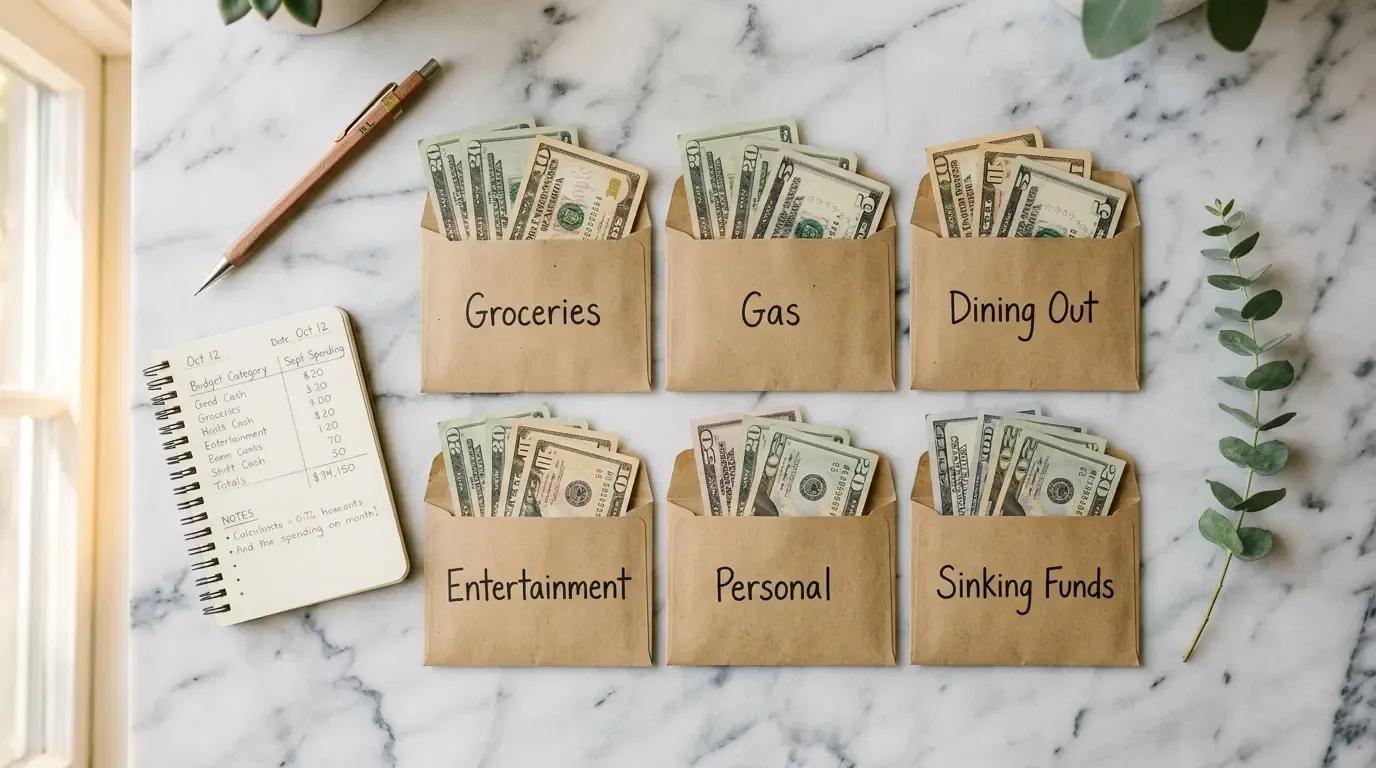
The envelope system is a cash-based budgeting method where you divide your take-home income into labeled physical envelopes – one per spending category. Groceries get their envelope. Gas gets its own. Entertainment, dining out, clothing – each category gets a fixed amount of cash at the start of the month. When the envelope is empty, spending in that category stops until the next refill.
That's the entire rule. No app required. No algorithm. Just a stack of envelopes and the discipline to honor the limits you set.
"When the envelope is empty, you stop spending in that category until next month. That is the whole rule." – Firstcard, 2026
The simplicity is the point. The system forces a decision before every purchase: Is this worth pulling from my groceries envelope?
The Origins: From Larry Burkett to Dave Ramsey
The envelope method has roots in mid-20th century personal finance. Financial counselor Larry Burkett described the mechanics in How to Manage Your Money (1974) and The Financial Planning Workbook (1982). His framework was straightforward: allocate physical cash to envelopes labeled by expense category, and stop spending when the cash runs out. Burkett built this system for families who needed a concrete, tactile way to live within their means – not a spreadsheet philosophy, but a daily physical habit.
Dave Ramsey brought the method to a mass audience. In The Total Money Makeover (2003), he embedded envelope budgeting into his "Baby Steps" financial program and gave it a behavioral framing: "Using cash creates pain… it's an emotional transaction that makes you think twice before spending money." Ramsey's version didn't change the mechanics – it amplified the psychology. For a deeper look at how this method evolved from Burkett's workbooks to a global financial movement, read the history of the envelope budgeting method.
The method's durability across five decades isn't accidental. It works because it exploits a real cognitive mechanism – one that behavioral economists have since quantified. More on that in the psychology section below.
How the Traditional Envelope Method Works
The process has five mechanical steps:
- Calculate take-home income (after taxes and mandatory deductions)
- Pay fixed bills first – rent, loan payments, insurance – directly from your account
- Withdraw the remaining cash from the bank
- Stuff each envelope with its predetermined amount
- Spend only from the envelope assigned to that category
The constraint is physical and immediate. You can't accidentally overdraft an envelope. You can't rationalize "I'll cover it next paycheck." The money either exists in the envelope or it doesn't.
What Is Cash Stuffing? (And How It Differs from the Classic Method)
Cash stuffing is the envelope system – rebuilt for an audience that discovered budgeting through a phone screen. The core mechanic is identical: cash goes into labeled categories, and spending stops when the cash runs out. What changed is everything around the mechanic: the aesthetic, the community, and the cultural framing.
How Cash Stuffing Became a Viral Trend (#CashStuffing on TikTok)
By 2026, the hashtag #CashStuffing had accumulated over 12 billion views on TikTok. The peak growth hit in 2022, with a second wave in late 2023 through early 2024 as inflation and economic uncertainty pushed younger consumers toward more tangible financial control.
The audience skews heavily female – roughly 70% – and concentrates in the 18-34 age bracket. Generation Z and Millennials drive the trend, drawn to a method that turns a mundane financial task into shareable content. Companion hashtags reinforce the scale: #budgeting crossed 25 billion views, while #moneytok surpassed 45 billion.
The data from Nationwide Building Society adds real-world weight to the social numbers. Their 2024 report documented nearly 33 million cash withdrawals among their customers – a 10% increase over 2023, and the third consecutive year of growth. The report explicitly links part of this increase to TikTok-driven cash stuffing behavior among younger customers.
"The 'cash stuffing' trend which rose to prominence across 2023 and 2024 on TikTok and beyond involves allocating specific amounts of money to envelopes for different spending categories." – Yahoo Finance / Nationwide, 2025
Cash Stuffing vs. the Envelope System: Same Idea, Different Vibe?
The mechanics are identical. The differences are cultural and aesthetic.
| Dimension | Classic Envelope System | Cash Stuffing |
|---|---|---|
| Tools | Plain paper envelopes | Decorative binders, zipper pouches, custom inserts |
| Primary goal | Debt elimination, strict discipline | Spending awareness, savings motivation |
| Aesthetic | Utilitarian | Visual, shareable, gamified |
| Core audience | Dave Ramsey followers, families in debt | Gen Z, Millennials, content creators |
| Community | Financial counseling programs | TikTok, Instagram, YouTube |
Cash stuffing introduced something the original method never had: social accountability. When you film yourself stuffing envelopes and post it, the public commitment adds a layer of behavioral reinforcement that Larry Burkett never anticipated.
"'Cash stuffing' uses a cash envelope system, an approach to budgeting designed to help you spend more intentionally." – Investopedia, 2025
The risk, which financial experts consistently flag, is that the aesthetic can overshadow the substance. A $45 leather binder with custom inserts and gold stickers doesn't make the system work better. The discipline does.
How to Use the Envelope Budgeting System: Step-by-Step
Step 1 - Calculate Your Monthly Take-Home Income
Start with the number that actually lands in your bank account after taxes, Social Security, Medicare, and any pre-tax deductions (401(k) contributions, health insurance premiums). This is your real operating budget – not your gross salary.
If your income varies month to month, use a conservative estimate: take your three lowest-earning months from the past year and average them. Budgeting from a floor prevents the trap of spending based on a high-income month that doesn't repeat.
Step 2 - Choose Your Budget Categories
Pull your last two months of bank and credit card statements. Identify every spending category where you made discretionary purchases. Then separate them into two groups:
- Fixed obligations (rent, car payment, minimum debt payments, insurance): These stay in your bank account and get paid digitally. No envelope needed.
- Variable spending (groceries, gas, dining out, entertainment, personal care, clothing): These become your envelopes.
Start with 6 to 8 variable categories. Most practical guides – including Firstcard's 2026 analysis – confirm that more than 10 envelopes creates administrative friction that kills consistency.
"Six to eight categories cover most variable spending without overwhelming you." – Firstcard, 2026
Step 3 - Allocate Cash to Each Envelope
Set limits based on your actual past spending, not an aspirational number. If you've been spending $600 a month on groceries, don't budget $300 and expect willpower to cover the gap. Start close to reality, then tighten gradually.
"Use past bank statements to estimate average monthly spending. Then determine how much you want to spend in each category. Tip: Over-budget slightly in the beginning while you learn." – Mostt, 2025
After paying fixed bills and setting aside savings contributions, withdraw the remaining cash and distribute it across envelopes.
Step 4 - Spend Only What Is in the Envelope
This is where the system either works or collapses. The rule is non-negotiable: when a category envelope is empty, spending in that category stops. No borrowing from other envelopes without a pre-established rule permitting it.
"Most beginners start somewhere between $200 and $500 per week." – Firstcard, 2026
If you run out of grocery money on day 22, you eat what's in the pantry. That friction is the point – it's the same psychological mechanism that makes the system effective.
Step 5 - Review, Reset, and Adjust Each Month
At the end of each month, count what's left in each envelope. Consistent surpluses signal an over-allocated category. Consistent shortfalls signal an under-allocated one. Adjust both.
Leftover funds should go toward a financial goal – debt payoff, emergency fund, or a sinking fund. They should not roll over into next month's spending budget.
Common Cash Envelope Budget Categories (With Examples)
| Category | Typical Range (% of Income) | Example Expenses | Refill Frequency |
|---|---|---|---|
| Housing | 25-35% | Rent, mortgage, property tax | Monthly |
| Transportation | 10-15% | Gas, transit pass, maintenance, rideshare | Every paycheck |
| Groceries | 10-20% | Supermarket, meal prep, bulk stores | Weekly or every paycheck |
| Debt Payments | 5-15% | Credit cards, personal loans, student debt | Monthly |
| Personal Spending | 5-10% | Clothing, personal care, gym, hobbies | Every paycheck |
| Savings / Sinking Funds | 10-20% | Emergency fund, vacation, car repairs, gifts | Every paycheck |
| Dining Out / Entertainment | 5-10% | Restaurants, streaming, events, coffee | Every paycheck |
Housing is typically handled outside the envelope system – it's a fixed, digital payment. The table above includes it for complete budget context. The categories where cash envelopes drive the most behavioral change are the variable ones: groceries, dining out, personal spending, and entertainment. These are precisely where impulse purchases concentrate. For a detailed breakdown of how to size each envelope at a $40,000-$60,000 household income, see envelope budget categories for $40-60K income households.
"Start with the basics: Groceries, Gas, Dining Out, Kids' Activities, Family Fun, Personal Spending, Clothing. Don't overcomplicate this. You can always refine later." – Mostt, 2025
The Psychology Behind Why Envelope Budgeting Works
The 'Pain of Paying' Effect: Why Physical Cash Feels Different
The envelope system works because cash hurts to spend. That's not a metaphor – it's a documented neurological response.
The concept of "Pain of Paying" was formalized by Drazen Prelec and George Loewenstein in 1998. Their framework established that the psychological discomfort of spending is highest when payment is immediate, visible, and physically concrete. Cash satisfies all three conditions. You hand over a bill, you watch your envelope thin out, and the loss is irreversible. That discomfort is a feature, not a bug.
Neuroscientist Brian Knutson's 2007 fMRI research showed that credit card payments reduce activation in the insula – the brain region associated with pain and loss aversion. The brain simply doesn't register a card swipe as a loss the way it registers handing over a $20 bill. Avni Shah's 2016 research extended this finding: the more "frictionless" the payment method, the weaker the buyer's self-control and the higher the probability of impulse purchases.
The meta-analytic evidence is decisive. A 2024 analysis published in the Journal of Marketing Research – covering 392 effect sizes from 71 studies spanning 40 years – confirmed a statistically significant "cashless effect": people consistently spend more with digital payment methods than with cash.
"Over 40 years of research links cashless payment methods to increased consumer spending. Referred to as the 'cashless effect'…" – University of Melbourne summary of the meta-analysis, 2023/2024
For a comprehensive breakdown of the neuroscience and behavioral research behind this effect, see the psychology behind why physical cash feels more real.
Visual Spending Limits and Behavioral Nudges
Beyond the pain of paying, the envelope system exploits a second mechanism: visual spending limits. Seeing a thin envelope triggers a behavioral nudge toward restraint – not a prohibition, but a prompt that recalibrates decision-making in real time.
Research from 2024-2025 shows that visual budget indicators reduce impulse purchases by 15-25%. When users can see their remaining budget depleting toward zero, they make more deliberate spending decisions. This is the same principle that fintech apps now encode into progress bars and color-coded spending alerts – the envelope system just does it with paper and cash.
"Physical cash creates a higher sense of loss because the money is physically handed over, leading to more careful spending. In contrast, digital payments reduce the pain of paying, allowing for more spontaneous and higher spending." – CashEssentials, 2024
Expert perspective:
"Physical cash creates a 'pain point' at the moment of payment that's almost entirely absent with one-click digital transactions. That 'pain' is useful friction – it forces us to reconsider a purchase, while cashless methods are engineered to minimize that friction and encourage spending."
– Wendy De La Rosa, behavioral scientist, Wharton School of Business, 2023
"The pain of paying is real when you hand over cash. You physically see your resource diminishing. With cards and digital wallets, that connection weakens – the brain doesn't register the loss with the same intensity, and we spend more without realizing it."
– Dan Ariely, Forbes interview, 2022
Cash Stuffing Setup: Supplies and Tools You Actually Need
Budget Binders vs. Simple Envelopes: Which to Choose
The supply choice comes down to one question: how long do you plan to use this system?
Plain paper envelopes cost $1-$5 for a pack. They work. They wear out in 2-3 months with daily use, require frequent replacement, and offer no protection against spills or damage. For someone testing the system for the first time, they're the right starting point.
Budget binders run $15-$50. Popular options include Clever Fox, Filofax, and Moterm – plus a large market of custom options on Etsy. Binders use zipper pouches instead of paper envelopes, which means the cash is protected, organized, and reusable. For someone committed to the system long-term, the upfront cost pays for itself in 3-4 months of not replacing paper envelopes.
The practical recommendation: start with paper envelopes for your first month. If the system works for you, invest in a binder.
Cash Stuffing Inserts, Labels, and Trackers
The most functional inserts are zipper pouches (transparent, so you can see the balance without opening) and laminated category cards that label each section. These are the tools that make the system work. Decorative stickers and aesthetic inserts are optional.
Useful trackers include:
- Monthly spending logs by category (how much allocated vs. how much spent)
- Sinking fund trackers showing progress toward a savings goal
- Debt payoff trackers – particularly the "debt snowball" visual where you color in segments as balances drop
- 52-week savings challenges or 100-envelope challenges for building a savings habit
The tracker is where cash stuffing earns its behavioral edge over a plain bank account. Seeing a debt tracker fill in creates the same reward loop that makes fitness apps effective.
How to Incorporate Sinking Funds into Your Cash Stuffing System
A sinking fund is a dedicated envelope for irregular, predictable expenses – costs you know are coming but don't pay monthly. The mechanic: divide the total cost by the number of months until you need it, then add that amount to the envelope each month.
"If your car insurance is $700 per year… divide 700 by 12… about $58 per month… take out $29 per paycheck and set it aside in an envelope." – SavingCentByCent, 2025
Seven categories where sinking funds prevent financial disruption:
- Car maintenance – divide your estimated annual repair/service budget by 12
- Annual insurance premiums – auto, renters, or homeowners
- Vacation – total trip cost divided by months until departure
- Holiday gifts – annual gift budget divided by 12
- Property taxes – annual bill divided by 12
- Medical / dental – anticipated out-of-pocket costs divided by months
- Technology replacement – cost of planned device purchase divided by savings timeline
Sinking funds solve the most common failure point in envelope budgeting: the unexpected expense that blows up a month's budget and triggers abandonment of the system. When the car repair envelope already has $300 in it, a $280 brake job isn't a crisis – it's a planned withdrawal.
Does the Envelope System Still Work in 2026? An Honest Assessment
The Case FOR Cash Envelopes in 2026
The behavioral case for cash envelopes is stronger in 2026 than it was in 2003 – precisely because the alternative has become so frictionless. Contactless payments, one-click checkout, and digital wallets have engineered away every moment of hesitation between impulse and purchase. The envelope system deliberately reintroduces that hesitation.
By 2025, roughly 90% of U.S. consumers had used contactless payment methods, and more than 60% of in-store transactions were projected to be contactless. In the UK, cash represented only 12% of all payments in 2023, down from 14% in 2022, according to UK Finance's 2024 annual report. The infrastructure for cashless spending is now essentially complete.
Against that backdrop, the envelope system functions as a deliberate opt-out from frictionless spending – and the research confirms it works. The 2024 meta-analysis in the Journal of Marketing Research found a small but statistically significant increase in consumer spending when using digital payment methods compared to cash. The effect is consistent across 40 years of data.
For people with a history of overspending in specific categories, the envelope system provides a hard limit that no digital tool replicates. When the grocery envelope is empty on day 25, the constraint is physical and immediate. No app notification achieves the same behavioral response.
The Case AGAINST: Real Challenges in a Cashless World
The system's core weakness is structural: it doesn't work for digital transactions. Rent, utilities, streaming subscriptions, online shopping, and bill autopay – none of these integrate with physical cash envelopes. Forcing cash into these categories requires withdrawing money, then redepositing it before payment, which is operationally impractical.
Additional friction points:
- No fraud protection. Lost or stolen cash is gone. A stolen debit card has federal protections; a stolen envelope does not.
- No rewards. Disciplined credit card users earning 2-5% cash back on every purchase sacrifice those rewards entirely when switching to cash.
- Inconvenience at point of sale. Counting exact change at a grocery checkout in 2025 creates real social friction in an environment built for tap-and-go.
- Security at home. Keeping several hundred dollars in cash envelopes at home carries theft and loss risk that a bank account doesn't.
Who the Envelope Method Works Best For (And Who Should Skip It)
The system works best for:
- People with a documented pattern of overspending in variable categories (groceries, dining, entertainment)
- Visual learners who respond to tangible, physical feedback
- Beginners who need a concrete system rather than an abstract budget
- Families working toward debt elimination who need strict category discipline
- Anyone who finds digital budgeting apps easy to ignore or rationalize around
The system is a poor fit for:
- Heavy online shoppers (the majority of variable spending happens digitally)
- Disciplined credit card users who maximize rewards without carrying balances
- People with irregular income who need flexible, real-time budget adjustments
- Anyone in a primarily cashless environment (major metros, frequent travelers)
Workers building credit from scratch face a particular version of this tradeoff. Cash stuffing eliminates card debt risk but also eliminates the credit history that comes from responsible card use. For that audience, the hybrid approach – cash envelopes for variable spending, a secured card for fixed categories – threads the needle. See cash stuffing guide for workers with no credit history for a full breakdown of that strategy.
What the Research Says About Cash vs. Digital Spending Behavior
The evidence consistently shows that payment method influences spending volume. Two peer-reviewed studies are particularly relevant:
"The Effect of Payment Method on Spending Behavior: A Meta-Analysis" (Gafeeva, Ketron, Puppel – Journal of Retailing, 2023) analyzed multiple studies and found that willingness to pay and average transaction size are measurably higher with cards and mobile payments compared to cash.
"The pain of paying with cards or smartphones: A registered report" (Schindler, Trüpschuch – Journal of Experimental Social Psychology, 2022) found that contactless and mobile payments generate the lowest "sense of loss," which directly correlates with higher spontaneous purchasing.
"On average, cash is perceived to be most helpful in preventing overspending, whereas contactless payments are the least helpful." – Paying in a blink of an eye: it hurts less, but you spend more, Journal of Economic Psychology, 2024
The conclusion is unambiguous: the less physically tangible the payment, the higher the spending. The envelope system's mechanism directly counteracts this dynamic.
Envelope System vs. Digital Budgeting Apps: A Side-by-Side Comparison
| Feature | Cash Envelope System | Digital Budgeting Apps |
|---|---|---|
| Ease of use | Requires daily cash handling | High – automated transaction tracking |
| Spending control | Maximum – physical cash limit | Moderate – relies on user discipline |
| Digital payment compatibility | None for physical cash | Full integration |
| Cost | Near zero (envelopes + binder) | Free to ~$130/year (YNAB, EveryDollar) |
| Best audience | Visual learners, overspenders, debt-focused users | Tech-comfortable users, online shoppers |
| User engagement required | High – daily interaction | Low to medium – can run passively |
| Fraud / theft protection | None | Full bank-level protection |
| Rewards compatibility | No | Yes (card-linked apps) |
The Hybrid Approach: Combining Cash Envelopes with Digital Tools
The hybrid model resolves most of the envelope system's structural weaknesses without sacrificing its behavioral advantages. The strategy: use cash envelopes for variable, high-impulse categories; use digital tools for fixed payments, online transactions, and overall budget visibility.
Three apps built for this integration:
Goodbudget – the most direct digital translation of the envelope method. Users create digital envelopes, then withdraw the corresponding cash amount and stuff physical envelopes. The app tracks what the envelopes contain without requiring you to log every purchase. Free tier available; premium runs $70/year. Rated 4.7 stars on both major app stores.
YNAB (You Need A Budget) – zero-based budgeting with category-level allocation that mirrors envelope logic. Users create a "Cash" account in YNAB, record the withdrawal as a transfer, and track physical spending against it. $99/year. Over 1 million subscribers. Rated 4.8 stars. Forbes Advisor rated it the best budgeting app for goal-setting in 2026.
EveryDollar – Dave Ramsey's purpose-built app for his Baby Steps program, including envelope-style category budgeting. Free version requires manual entry; Ramsey+ (roughly $130/year) adds bank sync. Rated 4.7-4.8 stars.
For a detailed breakdown of how these tools compare across pricing, features, and use cases, see digital envelope apps vs physical cash stuffing comparison.
"You break your monthly income into budget categories… and physically place the cash into labeled envelopes… The same idea can also work with digital envelopes, budgeting apps, or bank accounts." – EnvelopeBudgeting.com, 2026
Pros and Cons of the Cash Envelope System
Pros:
- Physical spending limits eliminate overspending by design
- Eliminates impulse purchases through the "pain of paying" effect
- No technology required – works without a smartphone or app
- Builds category-level awareness of actual spending habits
- Integrates naturally with debt payoff strategies (Debt Snowball)
- Sinking funds prevent budget-breaking irregular expenses
Cons:
- Incompatible with online payments, subscriptions, and bill autopay
- No fraud protection – lost cash is unrecoverable
- Forfeits credit card rewards and cash back
- Inconvenient in cashless retail environments
- Requires daily cash handling and discipline
- Security risk of keeping significant cash at home
For a full analysis of where the system breaks down in practice – including the most common mistakes that cause people to abandon it after month two – see common pitfalls of the envelope budgeting system.
How to Start the Envelope System This Month (Beginner-Friendly Guide)
Getting started takes one afternoon and one trip to the bank. Here's the minimum viable setup:
- Pull your last two months of bank statements. Calculate your average monthly spending in 6-8 variable categories. Don't guess – use actual numbers.
- Set category limits at or slightly above your current average. You're building a habit first, then tightening the budget.
- Withdraw cash on payday. If you're paid biweekly, withdraw half your monthly category budget with each paycheck.
- Label your envelopes and distribute cash immediately. Don't let it sit in your wallet.
- Spend only from the relevant envelope. No exceptions for the first 30 days.
- Schedule a 30-minute review on the last day of the month. Count remaining cash, note which envelopes ran out early, and adjust for next month.
The first month will feel restrictive. That's the system working. By month three, the category limits become intuitive and the friction disappears.
If you're also carrying high-interest debt, the Bromoney debt payoff calculator can help you quantify exactly how much faster you'll eliminate balances by redirecting envelope surpluses toward debt payments.
Tips for Staying Consistent with Cash Budgeting
Consistency breaks down at three predictable points. Here's how to handle each:
When an envelope runs out early: Don't borrow from another envelope. Eat what's in the pantry. Skip the restaurant. The discomfort of running out is the lesson – it recalibrates your sense of what that category actually costs.
When you face a cashless-only transaction: Maintain a separate "digital spending" envelope or bank account for online purchases. Track it manually or use Goodbudget to mirror the envelope logic digitally.
When motivation drops after month two: This is when most people quit. The solution is a visible win. Redirect one month's envelope surplus to your highest-interest debt and calculate how much interest that single payment saved. Make the progress concrete.
Envelope Budgeting and Debt Payoff: Does It Speed Up Results?
Using Cash Envelopes with the Debt Snowball Method
The envelope system and the Debt Snowball method are complementary by design. The envelope system frees up cash; the Debt Snowball directs it.
Here's the mechanism: cash payments create higher psychological friction per transaction, which behavioral economics research (2023 meta-analysis) shows reduces discretionary spending by 15-25% compared to card-based spending. For a household spending $2,000/month on variable expenses, that reduction generates $300-$500 in monthly surplus. That surplus becomes the extra payment on the smallest debt balance in the Snowball sequence.
Ramsey Solutions' 2024 analysis of their program participants found that users combining envelope budgeting with the Baby Steps framework paid off all non-mortgage debt in an average of 18-24 months.
The math is straightforward: more cash available each month means larger debt payments, which means faster payoff, which means less total interest paid. If you want to model your specific numbers, the Bromoney debt payoff calculator lets you run scenarios with different monthly payment amounts to see the impact on your payoff timeline.
Real Results: Stories from People Who Used the Envelope System
The anecdotal record is consistent with the research. Two documented cases illustrate the realistic range of outcomes:
Reddit, r/DaveRamsey (October 2025): User u/FrugalFamily2025 documented paying off $114,000 in debt (student loans and auto loan) in 30 months using strict cash envelopes for all variable spending. Their grocery envelope ran $600/month; entertainment held $100. Every surplus at month-end went directly to the debt snowball.
YouTube, The Budget Mom (Kumiko Love, January 2025): Love documented eliminating $15,000 in credit card debt in 12 months through cash stuffing combined with sinking funds. Her approach: cash envelopes for all variable categories, with $150/month dedicated to an auto maintenance sinking fund that prevented the repair emergencies that had previously triggered credit card use.
"Cash stuffing… is a way to manage limited resources, and this ensures that essentials like groceries and bills are covered before discretionary spending." – Investopedia, 2025
Both cases follow the same pattern: the envelope system doesn't generate money. It recovers money that was already being earned but disappearing into untracked, frictionless spending.
Frequently Asked Questions About Cash Stuffing and Envelope Budgeting
Is cash stuffing actually effective?
Yes, for variable spending categories. The research base is substantial: a 2024 meta-analysis covering 71 studies and 40 years of data confirms that cash-based spending consistently produces lower transaction amounts than card or digital payment methods. The mechanism is the "pain of paying" effect – physical cash creates psychological friction that digital payments eliminate. Cash stuffing applies this effect to the categories where overspending is most common: groceries, dining, entertainment, and personal spending.
What are the disadvantages of the envelope system?
Four structural limitations matter in 2026:
- Incompatibility with digital transactions – subscriptions, online shopping, and bill autopay don't work with physical cash
- No theft or loss protection – unlike a bank account or credit card, lost cash is unrecoverable
- Forfeited card rewards – disciplined credit card users lose 2-5% cash back by switching to cash
- Inconvenience – counting cash at checkout creates friction in environments built for contactless payment
The hybrid approach (cash for variable categories, digital tools for fixed and online payments) resolves most of these issues.
Can I use the envelope system with a debit card?
Not with physical envelopes, but yes with digital envelope apps. Goodbudget, YNAB, and EveryDollar all replicate the envelope mechanic digitally – you allocate a fixed amount to each category, and the app tracks spending against that limit. The behavioral effect is weaker than physical cash (because the "pain of paying" is lower with cards), but the structural constraint is similar. For people in primarily cashless environments, this is the practical solution.
How much cash should I put in each envelope?
Base your allocations on actual spending history, not aspirational targets. Pull two months of bank statements, calculate your average per category, and use that as your starting point. Common ranges as a percentage of take-home income:
- Groceries: 10-20%
- Transportation: 10-15%
- Dining out / entertainment: 5-10%
- Personal spending: 5-10%
If your take-home income is $4,000/month, your grocery envelope might run $400-$800 depending on household size. Start at your actual average, not a number that feels virtuous.
Is it safe to keep that much cash at home?
The risk is real and worth acknowledging. A few mitigation strategies:
- Keep only the current month's envelope cash at home – not reserves
- Store envelopes in a locked box or safe, not a visible location
- Consider a hybrid approach where you withdraw weekly rather than monthly, reducing the cash on hand at any given time
- Renters and homeowners insurance typically covers theft up to policy limits – verify your coverage
The digital alternative (Goodbudget or YNAB with a dedicated "cash" account) eliminates this risk entirely while preserving most of the behavioral benefits.
What is the best app for digital envelope budgeting?
Goodbudget is the most direct digital translation of the envelope method – it's built around the same mechanic and requires manual entry, which preserves some of the intentionality of physical cash. Free tier available; premium at $70/year.
YNAB offers more powerful goal-tracking and bank sync at $99/year, with over 1 million users and a 4.8-star rating. Best for people who want comprehensive financial visibility alongside envelope-style category limits.
EveryDollar integrates with Dave Ramsey's Baby Steps program and is the natural choice for anyone following that framework. Free version requires manual entry; Ramsey+ at roughly $130/year adds automation.
Explore More Budgeting Methods (Related Guides)
Zero-Based Budgeting: The Framework Behind Envelope Budgeting
Zero-based budgeting (ZBB) operates on a single principle: income minus all allocated expenses equals zero. Every dollar receives a specific job before the month begins – savings, debt payment, or a spending category. No dollar sits unassigned.
The envelope system is ZBB's tactical implementation. ZBB tells you that every dollar needs a job; envelopes enforce which dollars go where and prevent overspending through physical limits. YNAB and EveryDollar both build their architecture on zero-based logic, which is why they integrate naturally with envelope-style category budgeting.
ZBB works best for people who want total control over their finances and are willing to invest 30-60 minutes per month in active budget management. It's more demanding than the 50/30/20 rule but more flexible than a rigid cash-only system.
The 50/30/20 Rule: A Simpler Alternative
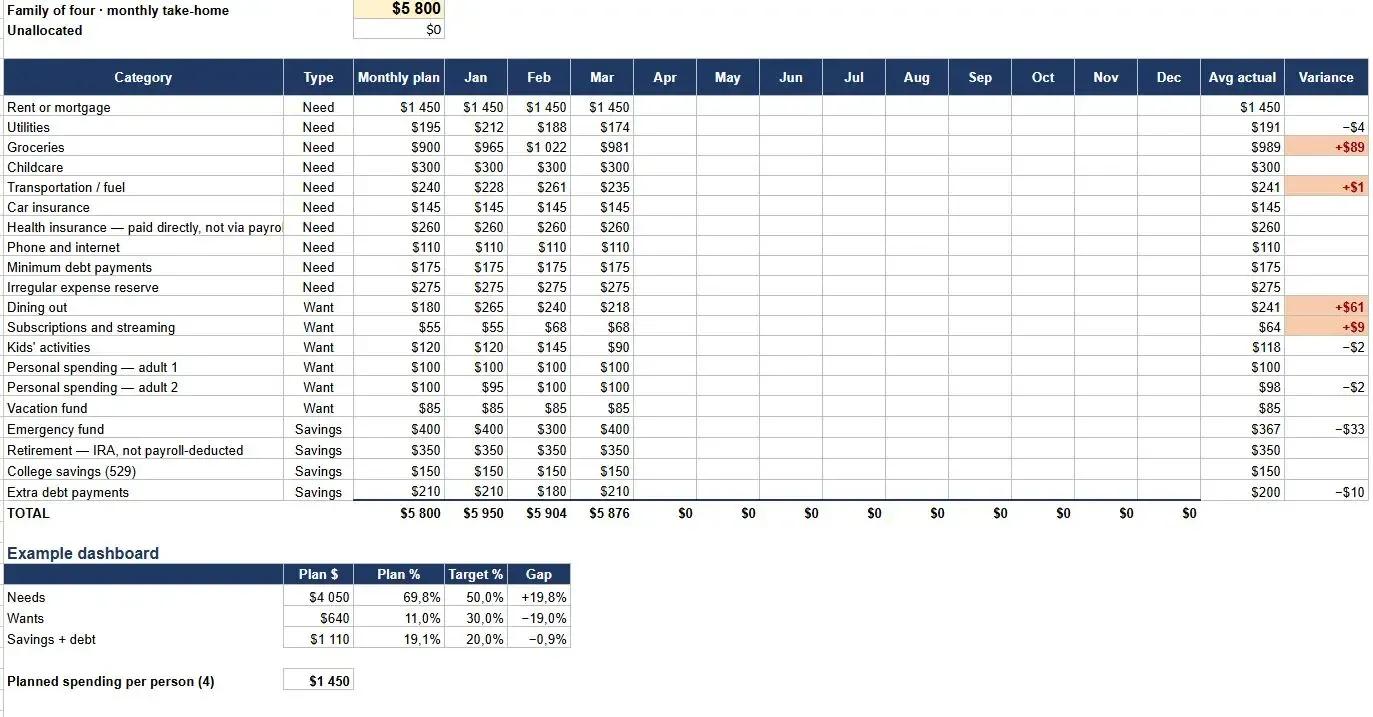
The 50/30/20 rule divides after-tax income into three buckets: 50% for needs, 30% for wants, and 20% for savings and debt repayment. It's a macro framework, not a spending control system.
The envelope method and 50/30/20 work well together: use the 50/30/20 rule to set your overall allocation targets, then use envelopes to manage spending within the "wants" category where overspending concentrates. The 50/30/20 rule tells you your grocery budget should sit within the "needs" 50%; the envelope enforces the specific dollar limit.
For someone new to budgeting, 50/30/20 is the right starting point – it's simple enough to implement immediately without detailed tracking. Envelopes become useful once you've identified which specific categories consistently blow past their targets.
Sinking Funds Explained: The Secret Weapon Inside Cash Stuffing
A sinking fund is a dedicated savings envelope for a known future expense. It converts irregular, potentially disruptive costs into predictable monthly contributions. Car insurance due in December stops being a crisis if you've been adding $58 to its envelope every month since January.
The sinking fund concept is arguably the most underutilized component of the cash stuffing system. Most users focus on controlling current spending; sinking funds address the irregular expenses that blow up well-managed monthly budgets. Seven categories worth building sinking funds for: car maintenance, annual insurance premiums, vacation, holiday gifts, property taxes, medical/dental, and technology replacement.
PayPal's 2024 budgeting guide recommends setting aside three to six months' worth of living expenses in a dedicated savings account – the same logic applies to building an emergency sinking fund before tackling discretionary ones.
Dave Ramsey Baby Steps: Where the Envelope System Fits In
Dave Ramsey's Baby Steps program is a seven-stage debt elimination and wealth-building framework. The envelope system is the spending control mechanism that funds the program's early stages:
- Baby Step 1: Save a $1,000 starter emergency fund – envelope surpluses accelerate this
- Baby Step 2: Pay off all non-mortgage debt using the Debt Snowball – envelope discipline generates the extra monthly payment
- Baby Step 3: Build a 3-6 month emergency fund – sinking fund mechanics apply here
The envelope system doesn't appear explicitly as a Baby Step, but it's the operational engine that makes Steps 1 through 3 achievable on a middle-income budget. Ramsey's EveryDollar app is built to support this integration.
If you're currently in Baby Step 2 and working through a debt payoff sequence, the Bromoney debt payoff calculator can help you model how much faster you'll complete the Snowball by adding $200, $300, or $500 in monthly envelope surplus to your smallest balance.

Denis Goncharenko
Managing Editor & FinTech Content Strategist
Editorial Policy: Denis ensures every financial claim is backed by institutional data sources.
Was this article helpful?
Same blogs
How Your Budget Changes After Having a Baby: Real Numbers for U.S. Families
A practical U.S. guide to the monthly budget shock after having a baby, including childcare, healthcare, tax benefits, and first-year planning.

The Real Cost of Elder Care: How Caring for Aging Parents Affects Your Family Budget
A practical guide to the real cost of elder care in the U.S., including home care, assisted living, nursing homes, hidden income loss, taxes, and family budgeting.

Financial Arrangements in a Prenup: What You Can (and Can't) Include
A practical guide to financial clauses in U.S. prenuptial agreements: assets, debts, alimony, business ownership, disclosure, state law, and what courts will not enforce.