

Logo
Get Started
Denis Goncharenko
By Denis GoncharenkoManaging Editor & FinTech Content Strategist

Cash Stuffing for Undocumented Workers: A Complete Guide to Budgeting Without a Credit History

4.6/5 (11 ratings)
July 16, 2026Updated: July 16, 202614 min read5 views
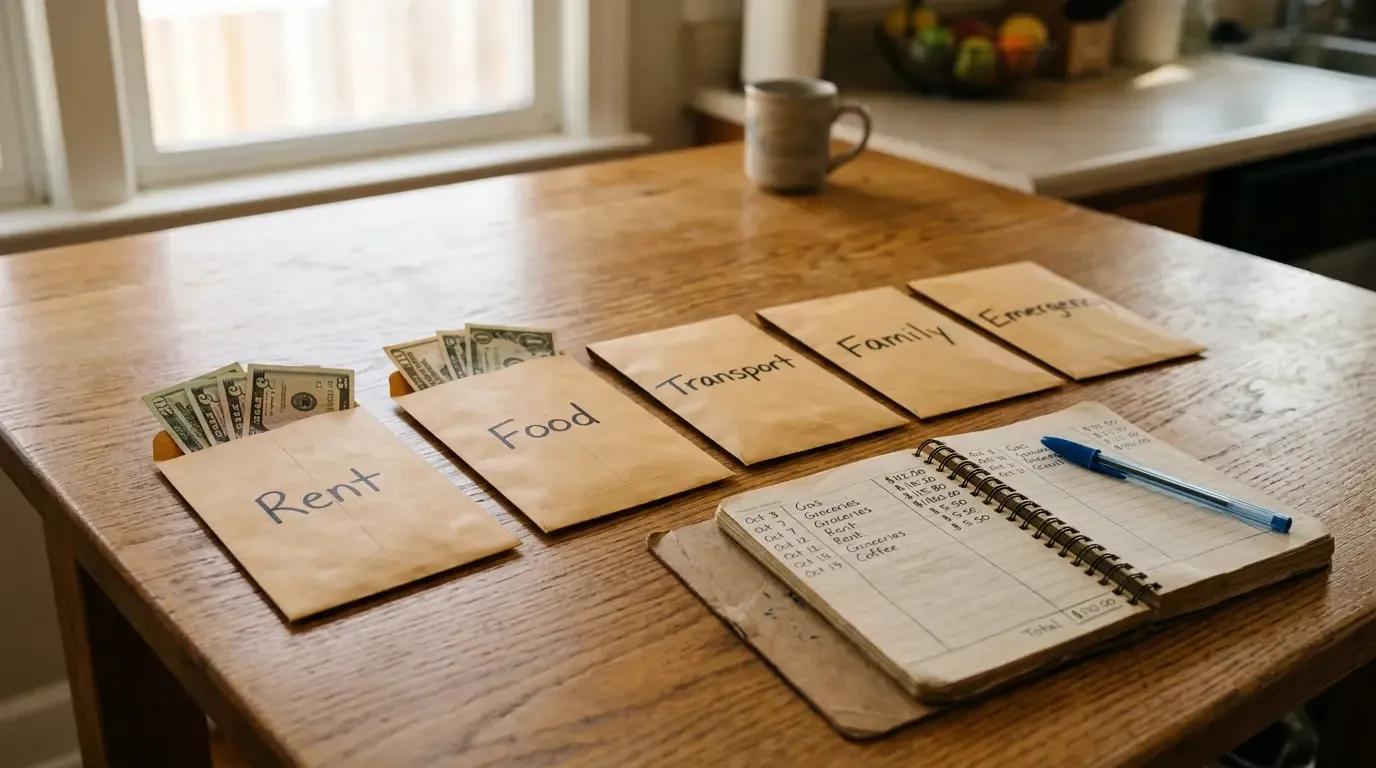
Five labeled kraft paper envelopes for rent, food, transport, family, and emergency fund with U.S. dollar bills on a wooden kitchen table next to a handwritten budget notebook

If you earn cash, have no Social Security Number, and no credit history, the envelope budgeting method gives you full control over your money – no bank required. This guide covers every practical step, from setting up your first envelopes to building toward long-term financial stability.


What Is Cash Stuffing (and Why It Works Even Without a Credit Score)?

Cash stuffing is a zero-based budgeting method built entirely around physical cash. You divide your income into labeled envelopes – one for rent, one for groceries, one for transportation – and spend only what's inside each envelope. When an envelope is empty, spending in that category stops until the next pay period.

The method traces back to the Great Depression era, when families had no choice but to manage physical dollars with precision. It gained a second wave of popularity through Joe Dominguez's money philosophy and has since become one of the most-searched personal finance approaches on social media, with approximately 15% of American adults using some form of cash stuffing in 2025.

For undocumented workers specifically, this method solves a structural problem: the entire American budgeting infrastructure – apps, online banking, credit cards – assumes you have an SSN and a bank account. Cash stuffing assumes neither.

How the Envelope Budgeting Method Works

Here is how the process works in practice:

  1. Count your income. Add up every dollar you earned this pay period – day labor, tips, cleaning jobs, restaurant work.
  2. List your categories. Rent, food, transportation, remittances, emergency savings, medical, children's expenses.
  3. Assign amounts. Give every dollar a job. Total assigned must equal total income – zero left over.
  4. Fill the envelopes. Place the physical cash in each labeled envelope.
  5. Spend from the envelope only. When the grocery envelope hits zero on day 22, you cook from what you have – not from the rent envelope.

The behavioral mechanism is well-documented. Research in behavioral economics on the "pain of paying" effect shows that physically handing over cash creates a stronger psychological signal of loss than swiping a card, which reduces impulse spending. Studies on mindfulness in cash spending confirm that cash stuffers in the first three months typically cut discretionary overspending by 20–25%.

Why Cash Stuffing Does Not Require a Bank Account or SSN

Cash is legal tender in the United States. No federal law requires individuals to conduct personal budgeting through a financial institution. The method operates entirely outside the banking system – no account opening, no identity verification, no credit check.

For managing cash without a bank account, this distinction matters enormously. Credit scores are used only in lending decisions. They have no role in a system where you are allocating money you already hold in your hands.

"For workers without documents, often excluded from the traditional banking system and paid in cash, budgeting is not just advice – it is a survival tool. It provides complete control over finances in conditions of economic instability and helps avoid predatory lending."

– Elena Rodriguez, Alianza Financiera para Nuevos Americanos, Pathways to Prosperity Annual Report, 2024


Key Financial Barriers Undocumented Workers Face

Before building a budget, it helps to understand exactly which doors are closed – and which ones are not. The barriers are real, but they are not total.

No Social Security Number (SSN): What It Means for Your Finances

The SSN is the primary identifier in the U.S. financial system. Without one, access to standard financial products becomes restricted. Here is the practical breakdown:

What is unavailable without an SSN:

  • Social Security retirement and disability benefits
  • Standard credit products (mortgages, auto loans, unsecured personal loans) from most major banks
  • Investment accounts on most brokerage platforms
  • Federal student loans

What remains accessible – typically with an ITIN (Individual Taxpayer Identification Number):

  • Checking and savings accounts at banks that accept ITIN plus a foreign passport
  • Tax filing with the IRS (ITIN's primary purpose)
  • Secured credit cards for building a credit history
  • Specialized ITIN-based mortgages from select credit unions
  • Access to remittance services, money orders, and prepaid debit cards

The ITIN is issued by the IRS to people who have a tax obligation but are not eligible for an SSN. Getting one does not change immigration status – it is a tax tool, not an immigration document.

No Credit History or Credit Score

According to research from Urban Institute and Pew (2024–2025), approximately 68% of undocumented workers are "credit invisible" – meaning the three major credit bureaus (Equifax, Experian, TransUnion) have no file on them whatsoever. A FICO score cannot be generated without at least one account reporting for six months.

This creates a catch-22 for traditional lending: no score means no loan approval, and no loan means no score. Cash stuffing sidesteps this entirely. You are not borrowing. You are managing what you already earn.

Unbanked or Underbanked Status in the U.S.

The numbers here are stark. The FDIC's 2023 National Survey of Unbanked and Underbanked Households reports that 4.2% of all U.S. households are unbanked – but among Hispanic households, that figure rises to 9.5%. Among households headed by non-citizens, the Federal Reserve Bank of Philadelphia's 2025 working paper "Who Remains Unbanked in the United States and Why?" found that foreign-born non-citizens are roughly three-fifths as likely to be banked as citizens – a gap driven by documentation barriers, distrust of institutions, and language access.

"Further progress in financial inclusion may also depend on progress in digital inclusion and on addressing challenges faced by the expanding, foreign-born non-citizen population."

– Federal Reserve Bank of Philadelphia, Working Paper 25-02, 2025

The practical consequences are immediate: without a bank account, you pay to cash your paycheck (1–5% at check cashing services), pay higher fees to send money home, and carry physical cash that cannot be insured or recovered if stolen.

Why Traditional Budgeting Apps Don't Work for Undocumented Immigrants

Mint, YNAB, EveryDollar, and similar apps are built around one core function: automatic transaction syncing from a bank account. Without a U.S. bank account – which requires an SSN at most major institutions – that function does not exist. Manual entry is technically possible but defeats the automation advantage.

The privacy risk is the deeper problem. These apps collect geolocation data, spending patterns, and personal identifiers. Under a valid legal request – a subpoena, a court order – that data can be disclosed to government agencies, including immigration enforcement. For an undocumented individual, a digital trail of financial activity is a liability, not a convenience.

The Federal Reserve Bank of St. Louis noted in its 2024 analysis that approximately two-thirds of unbanked households already "primarily use cash" for their financial needs. A cash-based envelope system is not a workaround for this population – it is a formalization of what they already do, with structure added.


How to Start Cash Stuffing as an Undocumented Worker: Step-by-Step

Step 1 – Calculate Your Monthly Take-Home Cash Income

Start with what actually lands in your hands. Not the gross figure, not what you were promised – the cash you received.

Income SourceLow Estimate (Monthly)High Estimate (Monthly)Notes
Construction (day labor / hourly)$2,500$3,800Seasonal variation; peak spring-fall
Cleaning / housekeeping$2,000$3,000More stable year-round
Agricultural work$2,200$3,200Highly seasonal; plan for off-months
Restaurant / food service (with tips)$1,900$2,800Tips vary weekly
Multiple jobs combined$2,800$4,500Add each source separately
Total estimated take-home$1,900$4,500Use your actual number

Source: Estimates based on informal labor market data, 2024–2026. Official BLS data does not segment by documentation status.

How to use this table: Write down every income source from last month. Use the low estimate for planning – always budget conservatively. If you earned more, that surplus goes directly into your emergency envelope.

For workers with variable income – construction, agriculture – budget based on your lowest month of the past three. That way, a slow week does not break your entire system. The Federal Reserve Bank of Philadelphia's 2025 working paper confirms that households with highly variable incomes are significantly more likely to remain unbanked and face financial instability, making a conservative baseline even more critical.

Step 2 – Set Up Your Cash Envelopes: Categories That Fit Your Real Life

Label one envelope per spending category. Use basic survival budget categories as your starting point, then add what fits your situation.

Core envelopes for undocumented workers:

  • Rent / Housing
  • Food & Groceries
  • Transportation
  • Remittances (money sent home)
  • Emergency Fund
  • Medical / Health
  • Children / School
  • Personal / Miscellaneous

Assign a dollar amount to each. Every dollar of your income goes into an envelope. If the total exceeds your income, reduce amounts in lower-priority envelopes first – never the rent envelope.

Step 3 – Where to Get and Store Your Cash Safely

Getting cash: If you receive a paper check, cash it at a check cashing service (expect a 1–3% fee), a Walmart Money Center ($4 flat fee for checks up to $1,000), or a bank branch if you have an ITIN-based account.

Storing cash at home: Keep only what you need for the current spending period. The rest goes in a fire-resistant, waterproof safe bolted to a wall or floor – not in a drawer, under a mattress, or in a freezer. Those locations are the first places experienced thieves check.

According to the FBI and FTC's joint 2024 report on household property crime, cash remains the most frequently stolen item in residential burglaries precisely because it is untraceable. Standard renters' or homeowners' insurance policies typically cover only $200–$500 in cash losses, according to major U.S. insurance associations' 2025 industry report. For undocumented workers without any insurance coverage, the risk of total loss is higher – plan accordingly.

The practical rule: keep no more than two weeks of living expenses in physical envelopes at any one time. The rest goes somewhere harder to access – and harder to lose.

For a full breakdown of security risks of keeping cash at home, including how to assess your specific situation, see our detailed guide.

Step 4 – How to Track Spending Without a Bank App

You do not need an app. You need a small notebook or a printed sheet kept with your envelopes.

For each envelope, record:

  • Date of purchase
  • Amount spent
  • Amount remaining

That is the entire system. At the end of each week, count the cash in each envelope and compare it to your running total. If they do not match, find the discrepancy before the next pay period.

Some people use a simple color-coding system: a green marker on envelopes with more than 50% remaining, yellow for 25–50%, red for under 25%. A glance tells you where you stand without opening a single app.

Step 5 – What to Do When an Envelope Runs Out

Do not borrow from another envelope. That is the rule that makes the system work. When the food envelope runs out on day 26, you cook from what is already in your kitchen.

If a genuine emergency occurs – not a want, an actual emergency – two options exist:

  1. Pull from the Emergency Fund envelope. This is exactly what it exists for.
  2. Reduce a lower-priority envelope for the remainder of the period and document the transfer in your notebook.

What you do not do: take out a payday loan to cover a cash shortfall. According to FDIC data, underbanked households that rely on payday loans pay an effective APR of 300–400% on those products. One envelope shortfall solved with a payday loan costs $60–$90 in fees on a $300 advance.


Best Envelope Categories for Undocumented Workers

Rent and Housing (Cash-Pay Situations)

Rent is the non-negotiable envelope. Fund it first, every single pay period, before any other category receives a dollar. Many landlords who rent to undocumented tenants accept cash – always get a written receipt with the date, amount, and landlord's signature. That paper trail protects you in a dispute.

Typical range: $400–$800/month for shared housing arrangements in most U.S. metro areas.

Food and Groceries

Budget $250–$400/month per adult for groceries. Buying in bulk at stores like Costco or Restaurant Depot (if you have access) reduces per-unit costs significantly. Avoid convenience stores for staple items – the markup on basics like rice, beans, and cooking oil runs 40–60% higher than a grocery store.

Transportation

If you drive, this envelope covers gas, insurance (if you carry it), and basic maintenance. If you use public transit, load a monthly pass. Budget $100–$300/month depending on your commute distance and city.

Sending Money Home (Remittances)

Remittances from the U.S. reached $162 billion in 2025. For many undocumented workers, this is not optional spending – it is a financial obligation to family members who depend on it. The World Bank's Migration and Development Brief 40 (2024) recorded year-over-year remittance growth of 12% to Nicaragua, 14% to Colombia, and 9% to Guatemala – driven in significant part by workers in the U.S.

Key data point: FXCintel's 2026 research report "Cash premiums on remittances" found that cash payout transfers cost an average of $3.47 more per $500 sent compared to bank-to-bank transfers. In March 2024, that gap was $5.55. If you send $400/month, switching from cash pickup to a bank deposit for the recipient saves $40–$65/year – real money.

Comparison of top remittance services (2026):

  • Remitly / Xoom: Best for digital transfers, competitive rates, mobile-friendly
  • Western Union / MoneyGram: Best for recipients with no bank account; higher fees, often embedded in exchange rate
  • Wise: Lowest fees for bank-to-bank; limited cash pickup options

Budget $200–$500/month for this envelope based on your obligations. Treat it as fixed, not discretionary.

Emergency Fund Envelope

This envelope has one rule: it never gets spent on anything that was predictable. Groceries running short is not an emergency. A medical bill from an unexpected injury is.

Build this envelope to $500 first, then to $1,000, then to one month of living expenses. Deposit a fixed amount from every paycheck – even $20 per period. For workers with variable income in agriculture or construction, the emergency fund is the difference between a bad week and a financial crisis.

The FDIC data is clear: underbanked households that lack any savings buffer are the primary users of payday loans, pawn shops, and auto title loans – all products with APRs that exceed 300%. If you are working toward your first credit product and want to understand what options exist for people with no credit history, bad credit loan options through Bromoney's marketplace are worth reviewing once your emergency fund is established.

Medical and Health Costs Without Insurance

Most undocumented workers have no health insurance. Budget $50–$150/month for this envelope and use it for preventive care at Federally Qualified Health Centers (FQHCs), which charge on a sliding scale regardless of immigration status. A $30 visit at an FQHC is a far better use of this envelope than a $1,200 emergency room bill for something that could have been treated earlier.

Children's Expenses and Education

School supplies, clothing, activity fees, and childcare. Budget based on your actual costs – track what you spent last month and use that as your baseline. Public school education is constitutionally guaranteed to all children in the U.S. regardless of immigration status (Plyler v. Doe, 1982).


Cash Tools You Can Use Without a Credit History or SSN

Check Cashing Services: How They Work and What They Cost

Check cashing services convert paper checks to cash immediately, without a bank account. The fee structure:

  • Payroll checks: 1–3% of the check amount
  • Government checks: 1–2%
  • Personal checks: 3–5% (higher risk for the cashing service)

On a $1,200 paycheck, a 2.5% fee costs $30. Over 12 months, that is $360 in fees just to access your own wages. This is the real cost of being unbanked – and one reason building toward an ITIN-based bank account makes financial sense over time.

Locations: Walmart Money Centers ($4 flat for most checks), ACE Cash Express, Check Into Cash, many grocery stores.

Money Orders: A Safe Way to Pay Rent and Bills Without a Bank

A money order is a prepaid payment instrument – essentially a guaranteed check. You pay cash, receive a money order made out to your landlord or utility company, and they cash it. It creates a paper record of payment.

Where to buy and cost:

  • USPS: Up to $1,000 per money order, fee of $2.35
  • Walmart: Up to $1,000, fee of $1.00
  • 7-Eleven / convenience stores: Higher fees, up to $1.50–$2.00

Always keep your receipt stub. It is your proof of purchase if the money order is lost or stolen – you can request a replacement (expect a $15–$20 replacement fee and a 30–60 day processing time).

Prepaid Debit Cards With No Credit Check Required

Prepaid debit cards let you make electronic payments – online bills, phone plans – without a bank account or SSN. You load cash onto the card and spend up to that balance.

Options with no SSN or credit check required:

  • Green Dot: Available at Walmart, CVS, Walgreens. Monthly fee: $7.95 (waived with $1,000+ monthly direct deposit)
  • NetSpend: Available at many retailers. Fee plans vary; watch for per-transaction fees of $1–$2 if not on a monthly plan
  • Bluebird by American Express (at Walmart): No monthly fee, no minimum balance

The limitation: prepaid cards do not build credit history. They are a bridge tool, not a long-term solution.

ITIN-Based Bank Accounts and Credit Unions

An ITIN (Individual Taxpayer Identification Number) is issued by the IRS to non-citizens who have a U.S. tax obligation. It does not affect immigration status. With an ITIN, several banks and credit unions will open a full checking and savings account.

According to the Federal Reserve Bank of Philadelphia's 2025 working paper, non-citizen immigrant status is one of the strongest predictors of being unbanked – but the same research identifies ITIN-based account access as a primary pathway toward financial inclusion for this population.

Institutions that accept ITIN (as of 2026):

  • Bank of America, Citibank, Chase (vary by branch; call ahead)
  • Self-Help Credit Union
  • Latino Credit Union
  • Credit unions in the Juntos Avanzamos network (specifically designed for immigrant clients)

Documents typically required:

  • IRS ITIN confirmation letter
  • Foreign passport
  • Proof of U.S. address (lease agreement or utility bill)
  • In-person visit to a branch

The primary limitation at this stage: access to unsecured credit products is restricted. Most ITIN account holders start with a secured credit card, which requires a cash deposit.


Is Cash Stuffing Safe? Privacy and Security Tips for Undocumented People

How to Store Cash at Home Safely

The practical rules:

  • Use a fire-resistant, waterproof safe rated for at least 30 minutes of fire exposure. Bolt it to a floor joist or wall stud so it cannot be carried out.
  • Store only current-period spending cash in your envelopes. Keep larger reserves – emergency fund, rent buffer – in the safe.
  • Never tell people outside your household that you keep cash at home. This includes casual conversation.
  • Photograph your cash (a picture of the bills fanned out) before storing large amounts. It does not help with recovery, but it supports insurance claims.

Standard renters' insurance covers only $200–$500 in cash losses. If you rent and can afford a $15–$20/month renters' policy, it still makes sense for other property coverage – but do not assume it covers your envelope system.

What to Do If Your Envelope Cash Is Stolen or Lost

If stolen during a burglary: File a police report immediately. The report is required for any insurance claim and creates an official record. Cash itself is almost never recovered.

If lost: Retrace your steps. Cash has no tracking mechanism – if it is gone, it is gone. This is the core argument for keeping only what you need in active envelopes and storing the rest securely.

Going forward: Rebuild the stolen envelope from the next paycheck before funding lower-priority categories. If the emergency fund was stolen, rebuilding it becomes the top priority after rent.

Your Financial Privacy Rights as an Undocumented Person in the U.S.

Your financial data has legal protections regardless of immigration status. The Gramm-Leach-Bliley Act (GLBA) prohibits financial institutions from voluntarily sharing your nonpublic personal information with third parties, including ICE.

However, banks are required to comply with valid legal process – a court-issued subpoena or warrant. Additionally, the Bank Secrecy Act (BSA) requires banks to file Suspicious Activity Reports (SARs) with FinCEN for unusual transactions. ICE has access to the FinCEN database.

The practical implication: cash stuffing, by operating outside the banking system, generates no financial data trail. There is nothing to subpoena from a bank, no transaction record to analyze. For undocumented individuals, this is not just a financial benefit – it is a privacy one.

Organizations that protect immigrant financial rights (free consultations):

  • CFPB (Consumer Financial Protection Bureau) – Guides for immigrants on opening bank accounts, building credit, and sending remittances. Available in Spanish. consumerfinance.gov/immigrants | consumerfinance.gov/es
  • National Immigration Law Center (NILC) – Defends immigrant access to public benefits and fights discriminatory financial practices. nilc.org
  • UnidosUS – Financial counseling, homebuying assistance, and credit-building programs through a nationwide partner network. unidosus.org
  • Immigrant Legal Resource Center (ILRC) – Legal guidance on the Public Charge rule and how government program use affects immigration status. ilrc.org

Cash Stuffing vs. Other Budgeting Methods for the Unbanked

MethodBank Account RequiredSSN RequiredWorks With Cash IncomePrivacy LevelCostBest For
Cash Stuffing (physical envelopes)NoNoYes – built for itHighNear zero (cost of envelopes)Undocumented workers, unbanked households
Budgeting Apps (YNAB, Mint, EveryDollar)Yes (for auto-sync)Typically yesPoor – manual entry onlyLow (data stored on third-party servers)$0–$15/monthBanked users with stable income
50/30/20 RuleNoNoYes – it is a principle, not a toolN/AZeroCombining with cash stuffing as a framework
Digital Envelope Method (apps like Goodbudget)RecommendedRecommendedPartial – manual cash tracking possibleMedium$0–$8/monthBanked users who want envelope logic digitally
Money Order + Ledger SystemNoNoYesHigh$1–$2 per money orderPaying bills without a bank account

Accessibility note: Table compares methods on five dimensions relevant to unbanked users. Cash stuffing is the only method requiring no financial infrastructure.

The Federal Reserve Bank of St. Louis confirmed in its 2024 analysis of FDIC data that approximately two-thirds of unbanked households already "primarily use cash" for their financial needs.

"Among unbanked households, about one-third primarily use a combination of prepaid bank or debit cards and online payment services…while about two-thirds primarily use cash."

– Federal Reserve Bank of St. Louis, Open Vault Blog, 2024


Building Toward Financial Stability: What Comes After Cash Stuffing?

Cash stuffing is a foundation. It teaches discipline, eliminates debt accumulation, and builds a savings habit. But it has a ceiling: physical cash does not earn interest, does not build credit, and is vulnerable to theft and disaster. The goal is to move from cash-only to cash-plus-banking.

How to Open a Bank Account With an ITIN (No SSN Required)

The ITIN opens the door to the banking system. Here is the sequence:

  1. Apply for an ITIN through the IRS (Form W-7). You need a federal tax return, proof of identity (foreign passport), and proof of foreign status. Processing takes 7–11 weeks.
  2. Gather your documents: ITIN confirmation letter, foreign passport, U.S. address proof (lease or utility bill).
  3. Visit a branch in person. Call ahead to confirm the specific branch accepts ITIN – policies vary even within the same bank.
  4. Start with a basic checking account. Avoid accounts with monthly fees above $5 or minimum balance requirements above $25.

Banks and credit unions accepting ITIN accounts in 2026 include Bank of America, Citibank, Chase, Self-Help Credit Union, Latino Credit Union, and Juntos Avanzamos network members.

Starting to Build Credit as an Undocumented Immigrant

Three tools work for building a credit file with an ITIN:

1. Secured credit card. You deposit $200–$500 as collateral; that becomes your credit limit. The bank reports your payment history to the credit bureaus. Pay the full balance every month. After 12–18 months of on-time payments, your FICO score becomes scoreable.

2. Credit-builder loan. Offered by credit unions. The loan amount is held in a locked savings account while you make monthly payments. When the loan is paid off, you receive the funds – and 12–24 months of payment history on your credit report.

3. Alternative credit tools:

  • Nova Credit allows immigrants to import their home-country credit history for use with select U.S. lenders (including American Express).
  • Experian Boost lets you add utility, phone, and streaming payment history to your Experian report, which raises a thin-file score by 10–20 points.

The path from cash-only to credit-visible typically takes 18–24 months of consistent, documented financial behavior. It is slow. It works.

For a detailed roadmap on how to rebuild credit history step-by-step, including which secured cards report to all three bureaus, see our full guide.

Using a Credit Union as a Safe and Accessible Banking Option

Credit unions structured for immigrant communities operate differently from large banks. They use relationship-based underwriting – meaning your history with the institution, your employment stability, and your community ties carry weight alongside your credit score (or lack of one).

The Juntos Avanzamos network designates credit unions that specifically serve Hispanic and immigrant communities, accept ITIN and Matricula Consular as identification, and offer products designed for members without U.S. credit history. There are over 100 Juntos Avanzamos-designated credit unions across the U.S.

When you walk into a credit union with 12 months of documented cash stuffing records – a notebook showing consistent rent payments, zero payday loan use, and a growing emergency fund – that is evidence of financial responsibility. It is not a credit score, but it is something a relationship-based lender works with. If an unexpected expense comes up before you reach that stage, emergency loan options are available through Bromoney's marketplace for people at various points in their financial journey.

Last updated: June 2026. ITIN banking policies, remittance fees, and prepaid card terms are subject to change. Verify current terms directly with financial institutions.


Frequently Asked Questions

Do I need a bank account to do cash stuffing?

No. Cash stuffing requires only physical cash and labeled envelopes. The entire system operates outside the banking infrastructure. A bank account is useful for safety and long-term goals, but it is not a prerequisite for starting the method today.

Cash stuffing itself is completely legal for everyone, including undocumented individuals. It is a personal financial management tool, not a regulated financial activity. However, the IRS requires that all income earned in the United States – regardless of immigration status – be reported and taxed. Earning and budgeting cash is legal. Failing to report that income to the IRS is a separate issue.

What if I get paid partially in cash and partially by check?

Deposit the check into a bank account if you have one, or cash it at a check cashing service. Once you have the cash in hand, combine it with your direct cash income and distribute the full amount across your envelopes as normal. The source of the cash does not change how the envelope system works.

How do I budget for sending money to family abroad (remittances)?

Treat remittances as a fixed expense – not discretionary. Create a dedicated "Remittances" envelope and fund it every pay period before funding lower-priority categories. Decide on a fixed monthly amount you can sustain even in a slow work month, and stick to it. For choosing the lowest-cost transfer service, compare Remitly, Xoom, and Wise for your specific destination country. Per FXCintel's 2026 research, choosing bank-to-bank transfer over cash pickup saves an average of $3.47 per $500 sent – roughly $40–$85/year on a typical remittance budget.

What is ITIN and do I need it to start cash stuffing?

An ITIN (Individual Taxpayer Identification Number) is a tax processing number issued by the IRS for people who have a U.S. tax obligation but are not eligible for a Social Security Number. You do not need an ITIN to start cash stuffing. The envelope method works with zero documentation. You do need an ITIN if you want to file U.S. tax returns, open an ITIN-based bank account, or apply for a secured credit card to begin building a credit history. Starting cash stuffing and applying for an ITIN are two independent steps – begin budgeting now, pursue the ITIN when you are ready for the next stage.

Denis Goncharenko

Denis Goncharenko

Managing Editor & FinTech Content Strategist

Editorial Policy: Denis ensures every financial claim is backed by institutional data sources.

Was this article helpful?

Same blogs