


Sinking Funds: How to Budget for Costs That Aren't Monthly
Sinking Funds: How to Budget for Costs That Aren't Monthly
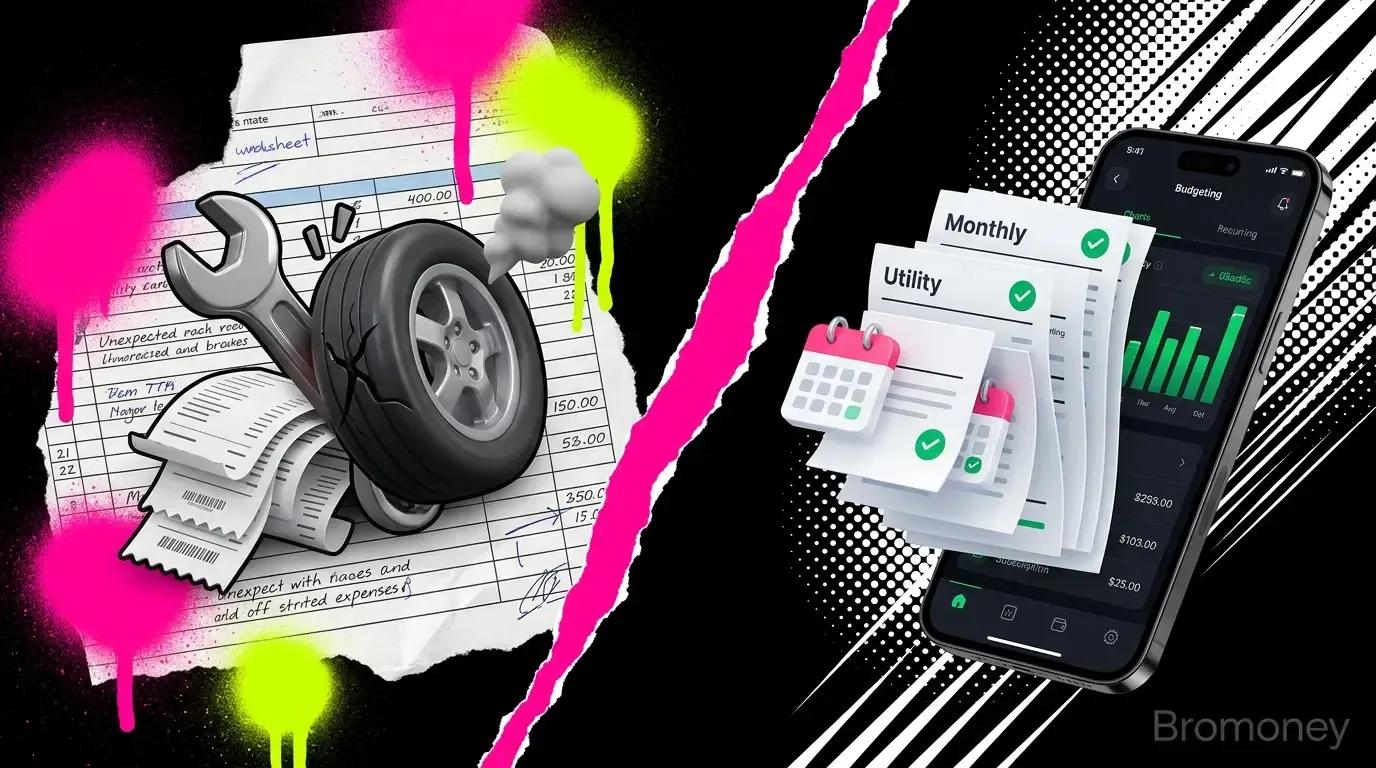
Most budgets are built around costs that repeat every month. The costs that break them arrive once a year.
What is a sinking fund?
A sinking fund is money set aside every month for future expenses you know are coming but won't pay monthly. You name the fund, estimate the total, divide by the months until it's due, and move that amount aside on a schedule. When the bill lands, the money is already there.
The word "sinking" comes from corporate finance, where companies set aside cash over time to retire a bond at maturity. The household version works the same way: convert one large future payment into a series of small present ones.
A sinking fund is not savings in general. It is savings with a name, a target number, and a date.
Why do budgets break on non-monthly expenses?
Monthly expenses get budgeted because they show up in every statement you look at. Rent, utilities, insurance, subscriptions - you see them twelve times a year, so you plan for them.
An annual cost shows up once. It is invisible in eleven of the twelve months you spend reviewing your spending, so it never becomes a budget line. Then it arrives at full size against a budget that has no room for it.
That is the whole mechanism. The problem is not that these costs are large. It's that their size is concentrated into one month while your income is spread evenly across twelve.
What counts as a recurring expense?
A recurring expense repeats on a known schedule with a known or estimable amount. Rent or a mortgage, utility bills, insurance premiums, debt payments, groceries, and subscriptions all qualify. If you can name the vendor and the interval, it's recurring.
Recurring expenses split into fixed (same amount each cycle - rent, car payment) and variable (repeats but fluctuates - electricity, groceries). Both belong in the standard monthly budget. If you're building that baseline from scratch, start with how to build a family budget.
Annual bills are still recurring. The interval is twelve months instead of one, but the obligation repeats on schedule. This is where most misclassification happens.
What counts as a one-time or irregular expense?
A one-time expense happens once and isn't expected to repeat - a home down payment, a wedding, an interstate move. Irregular expenses like annual insurance renewals, vehicle registration, holiday spending, school fees, and veterinary care repeat, but on no monthly rhythm.
The distinction matters because it decides which tool you use. Irregular expenses are predictable in category even when the exact timing is loose, so they can be pre-funded. True one-time surprises can't be.
Sinking funds cover the irregular group. The emergency fund covers the rest.
Sinking funds vs emergency funds: what is the difference?
A sinking fund is for a cost you can name. An emergency fund is for a cost you can't. That single difference drives everything else about how the two are structured.
A sinking fund has a target amount, a deadline, and a purpose. It is meant to be spent, and spending it is a success, not a loss. When the fund empties on schedule, it worked.
An emergency fund has no deadline and no named purpose. It sits in savings at a general level tied to your monthly essentials, and drawing on it is an exception. Spending it means something went wrong.
How do you calculate a monthly sinking fund contribution?
Take the total cost, divide by the number of months until it's due, and move that amount every month. A $1,200 annual insurance bill is $100 a month. A $600 vehicle registration due in six months is $100 a month.
Three inputs are needed: the estimated total, the due date, and the current balance in the fund. If you already have $200 set aside toward that $1,200 bill and nine months remain, the monthly figure is $1,000 divided by 9, or about $111.
Round up, not down. An estimate that's slightly high leaves a buffer; an estimate that's slightly low means a shortfall in the month you can least handle one.
Which sinking funds do most households need?
The list below covers the expenses that most reliably arrive without a monthly line item. The dollar figures are illustrative round numbers, not averages - replace each one with your own bill.
| Fund | Illustrative annual cost | Monthly set-aside | Timing |
|---|---|---|---|
| Auto insurance (paid in full) | $1,200 | $100 | Fixed renewal date |
| Vehicle registration and inspection | $240 | $20 | Fixed renewal date |
| Car maintenance (tires, brakes, fluids) | $840 | $70 | Spread through the year |
| Holidays and gifts | $540 | $45 | Concentrated in one quarter |
| School fees, supplies, activities | $720 | $60 | Two or three spikes |
| Veterinary care | $480 | $40 | Unscheduled but expected |
| Medical deductible | $2,400 | $200 | Unscheduled, capped by the plan |
| Home maintenance | $1,800 | $150 | Unscheduled but expected |
| Annual software and memberships | $360 | $30 | Fixed renewal dates |
Total those monthly figures and you get the real cost of the non-monthly side of your budget. In this illustration it's $715 a month - money that was never in the budget but was always being spent.
Most households don't need all nine. Start with the two or three that have actually caused a financial problem in the past year.
Where should sinking fund money sit?
Money set aside for a sinking fund belongs in a savings account separate from your checking balance. Money that shares an account with grocery money gets spent on groceries.
A single dedicated savings account can hold several funds at once if you track the balances separately in a spreadsheet. That avoids opening nine savings accounts while still keeping the money out of daily reach. Your bank may also allow named sub-accounts or savings goals inside one account, which does the same job without manual tracking.
The requirement is friction, not complexity. The money needs to be one bank transfer away from spendable - not zero, not three days.
How many sinking funds is too many?
Too many is the point where you stop updating them. There is no fixed number, but most households lose track somewhere past six or seven.
The failure mode is granularity: separate funds for tires, oil changes, brakes, and wipers instead of one car maintenance fund. Each split adds tracking work without improving the forecast.
Group by the month the money leaves, not by the item. If four costs land in the same season and come from the same category, run one fund.
Where do irregular expenses sit in any budgeting method?
Every budgeting framework has a place for them, but none of them create it automatically. In percentage-based allocation, sinking fund contributions sit inside the needs or savings share depending on whether the cost is an obligation or a choice - the mechanics are covered in the 50/30/20 rule.
In a system where every dollar gets an assignment before the month starts, each sinking fund is its own line and gets funded like any bill. That structure handles irregular costs better than most, and the setup is walked through in the zero-based budgeting guide.
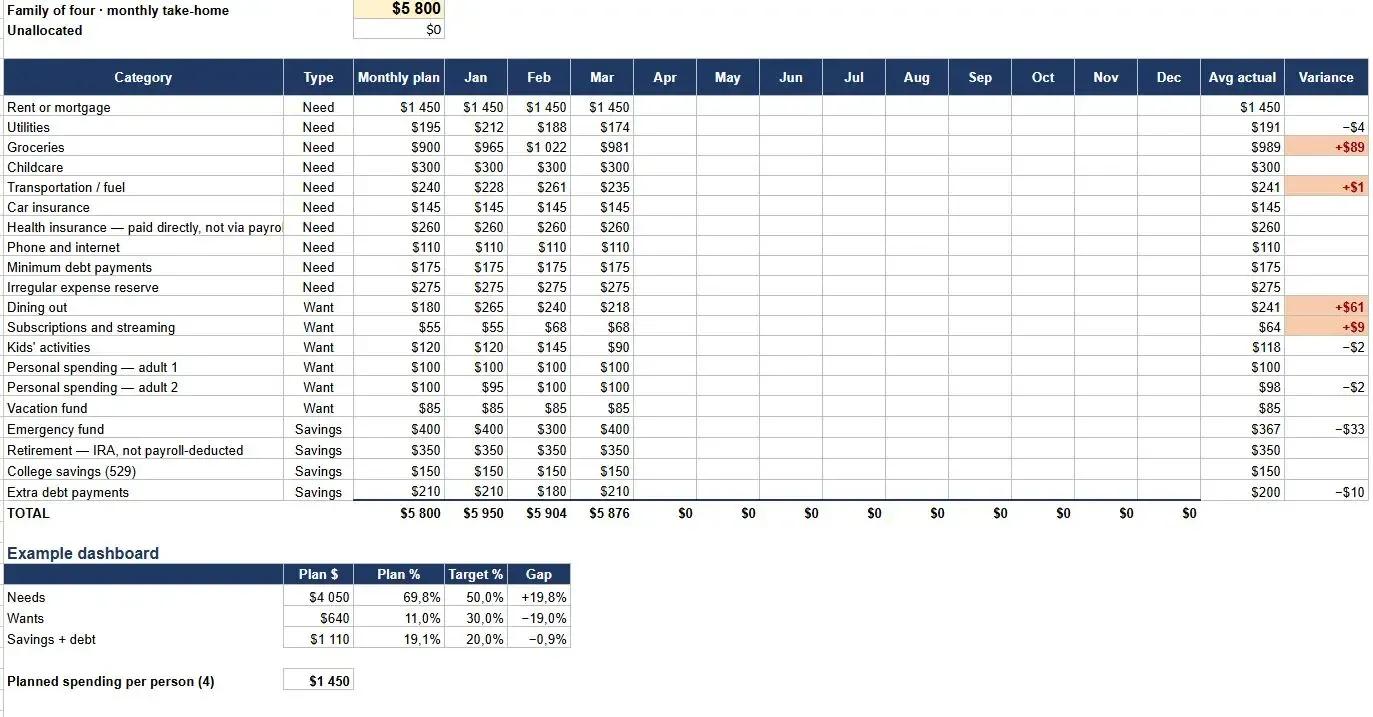
If you'd rather not build the sheet yourself, the family budget template includes a tab for irregular costs with the monthly division already set up.
How do sinking funds compare with monthly category funding?
They're the same idea at a different time scale. The envelope method assigns money to named categories for the current month; a sinking fund assigns money to a named category across many months. If you already run envelopes, a sinking fund is an envelope you don't empty. The method itself is covered in the envelope system guide.
The practical difference is that sinking funds should not be held in cash. Amounts this large, held this long, belong in a savings account.
How do you start a sinking fund when the bill is already close?
Divide by the months you actually have, not by twelve. If a $1,200 bill is four months out, the figure is $300 a month, and you need to decide now whether that's fundable.
If it isn't, the gap is information. Fund what you can, cover the remainder from the emergency fund, and reset the fund to a full twelve-month cycle the day after the bill is paid.
The first cycle of any sinking fund is the hardest one. Every cycle after that starts from a full year of runway.
What happens when a sinking fund runs short?
Pay the difference from the emergency fund, then raise the monthly contribution for the next cycle. A shortfall means the estimate was low, and the estimate is the part you fix.
Do not pull from another sinking fund to cover it. That converts one shortfall into two, and the second one arrives with less warning than the first.
Log the actual amount paid. Next year's estimate should be built from what the cost actually was, not from what you guessed it would be.
When is a sinking fund the wrong tool?
The cost is unavoidable and close. A sinking fund needs months of runway to work. If the transmission failed this week, dividing by twelve solves nothing - that's what the emergency fund exists for.
There is no margin at all. If income doesn't cover current monthly bills and debt payments, opening a sinking fund just moves the shortfall to a different line. The contribution has to come from somewhere, and taking it from groceries or a utility bill makes the situation worse. Fix the monthly baseline first.
The cost isn't actually one-off. If the same "unexpected" expense appears three or four times a year, it isn't irregular - it's a recurring cost you haven't budgeted. Move it into the monthly baseline where it belongs.
The shortfall is structural. Sinking funds smooth timing. They don't create money. If total annual obligations exceed total annual income, no amount of scheduling fixes that, and pre-funding a vacation fund while carrying high-rate credit card debt costs more in interest than the fund earns.
How do you keep sinking funds from being spent on something else?
Automate the deposits for the day after payday, before the money is visible in checking. A transfer you have to remember is a transfer you'll skip in a tight month.
Keep the funds in a savings account without a debit card attached. The extra step of moving money back to checking is usually enough to interrupt an impulse purchase.
Name each fund for its purpose, not its amount. "Auto insurance" is harder to spend on something else than "savings."
How often should you review sinking fund amounts?
Once a quarter for the balances, once a year for the targets. Balances drift when a contribution gets skipped; targets drift when prices move.
The annual review is the one that matters. Insurance premiums, registration fees, and maintenance expenses all move over time, and a target set three years ago is almost certainly low.
Reset each target using last year's actual figure plus a margin. That single habit removes most sinking fund shortfalls.
Is a car repair a sinking fund expense or an emergency?
Both, depending on the repair. Routine maintenance - tires, brakes, fluids, scheduled service - covers predictable expenses even when the timing is loose, so it belongs in a car maintenance sinking fund funded monthly.
A major failure is different. Engine or transmission work is large, unscheduled, and outside any reasonable annual estimate, so it comes from the emergency fund.
The line between them is whether the cost appears on a maintenance schedule. If it does, pre-fund it. If it doesn't, reserve for it.
Are annual subscriptions a sinking fund expense?
Yes, if you pay them yearly. An annual software license or membership renewing at a fixed date with a known amount is exactly the shape a sinking fund handles - divide by twelve and set it aside.
The alternative is switching to monthly billing, which usually costs much more in total but removes the planning problem. That trade is worth running the numbers on before you build the fund.
Either way, list every annual renewal in one place first. Most households can't name all of theirs without checking a full year of statements.
How do sinking funds work on irregular income?
Fund them by percentage of each payment received rather than by fixed monthly amount. If your sinking funds total 15% of a typical month's income, move 15% of every payment as it arrives.
That keeps contributions proportional to what actually came in, instead of setting a fixed figure that fails in a slow month. Broader mechanics for variable earnings are covered in budgeting for irregular income.
Front-load in strong months. Getting a fund fully funded early removes it from the list of things a weak month can break.
What sinking fund should you start first?
The one tied to the bill that caused the most financial disruption in the last twelve months. That cost is already proven to exceed your monthly margin, and it will arrive again on roughly the same schedule.
Set up one fund, automate one transfer, and leave it alone for a full cycle. A single fund that survives twelve months teaches more than six funds that quietly stop getting funded by March.
Add the second only after the first one has paid a bill.

Denis Goncharenko
Head of Content
Editorial Policy: no secondary statistics. Every claim is linked to an official source and dated — datasets and methods are open for review.

Was this article helpful?
Same blogs

Saving Money on Groceries Is Not a Test of Willpower
Federal data shows six grocery categories moving at different rates, not one bill rising evenly. Why the national CPI, the CES spending survey, and USDA's own forecast are each the wrong number to budget against - and how to build your own monthly figure from 8 to 12 weeks of receipts instead.
Free Family Budget Template for Excel and Google Sheets
A free household budget spreadsheet for families of three to five, with categories pre-filled and a separate tab that spreads yearly bills like insurance and registration across all twelve months. No email, no sign-up, works in Excel and Google Sheets.
Why Parent PLUS Loans Have Become a Hidden Retirement Crisis for American Parents
Parent PLUS loans can follow parents into retirement, reduce savings, and expose Social Security benefits to offset after default. Here is what near-retirement borrowers should know.