

Digital Envelope Apps vs. Physical Cash Envelopes: Which Budgeting System Is Right for You?

About 15% of people who actively budget use the envelope method – and that number splits sharply: 11% go digital, only 4% stick with physical cash. That gap tells you something important about where the method is heading. But "popular" doesn't mean "right for you." This guide breaks down both systems so you can pick the one that actually fits how you spend money.
If you're just starting to explore choosing a budgeting system, the envelope method is one of the most proven entry points – simple enough to start today, powerful enough to change your financial behavior long-term.
What Is the Envelope Budgeting Method? (Quick Overview)
The Core Idea Behind Envelope Budgeting
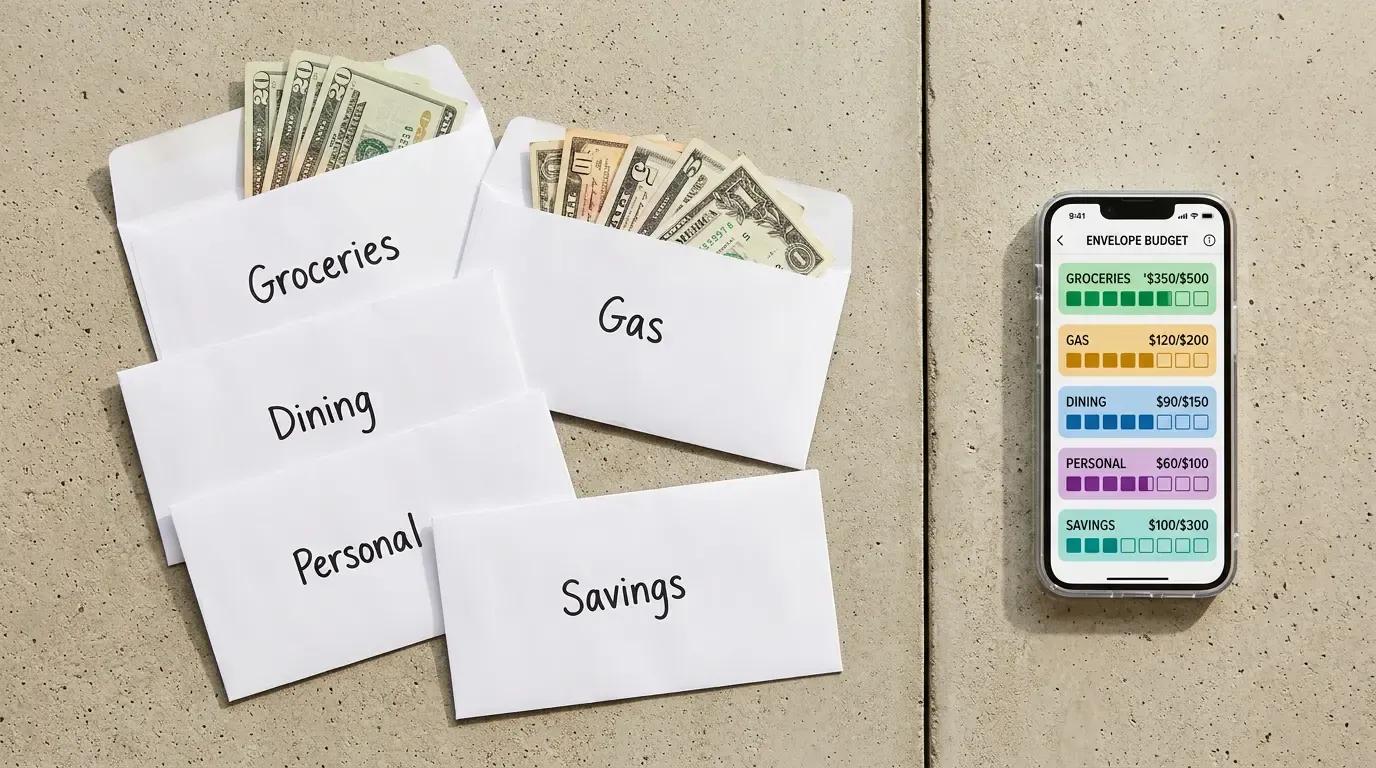
Envelope budgeting divides your income into separate spending categories before a single dollar leaves your account. Each category gets a fixed allocation – its own "envelope." When the envelope is empty, spending in that category stops until the next pay cycle.
The timing is what makes it work. Most budgeting failures happen because people track spending after the fact – they see the damage at month's end. Envelope budgeting forces the decision before the purchase. That shift alone changes behavior.
As Plan & Multiply noted in their 2026 analysis: "Envelope budgeting forces spending decisions before you spend – that timing difference is what makes it work." (Envelope Budgeting Apps in 2026: Digital Evolution)
Zero-Based Budgeting and How Envelopes Fit In
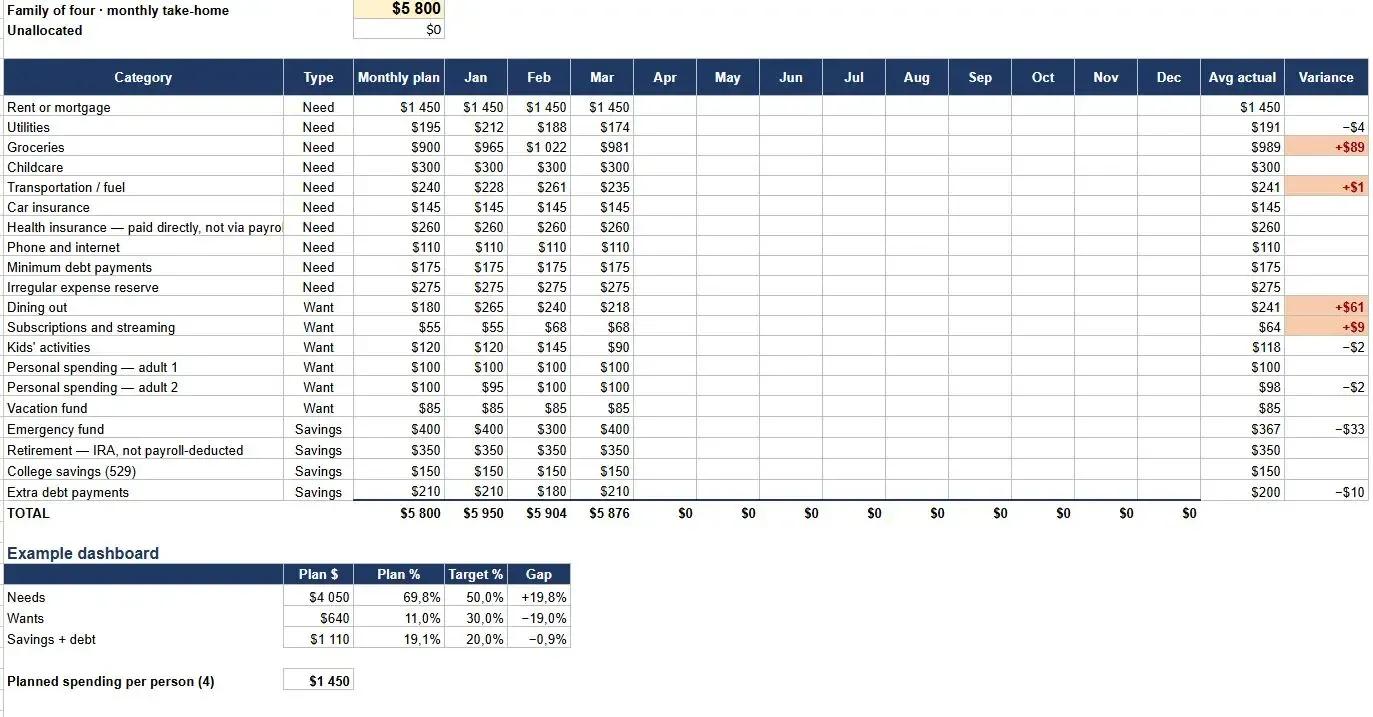
Zero-based budgeting (ZBB) is the financial framework underneath the envelope method. The formula: Income − Expenses = $0. Every dollar gets assigned a job – spending, saving, or debt repayment – before the month begins.
Envelope budgeting is ZBB made physical (or digital). Instead of a spreadsheet with category totals, you have discrete containers – either literal envelopes or virtual ones in an app – each holding exactly what you planned to spend.
The data supports this approach. A 2024 National Bureau of Economic Research study found that households using zero-based budgeting cut discretionary spending by 15–20% in the first six months. A 2025 Bank of America report found that 68% of ZBB users built or grew an emergency fund within a year, compared to 41% of those who didn't use the method.
How the Physical Cash Envelope System Works
Step-by-Step – Setting Up Your Cash Envelopes
The methodology was popularized by Dave Ramsey in The Total Money Makeover and remains largely unchanged. Here's how it works in practice:
The five steps:
- Build your monthly budget. List all income sources, then subtract fixed expenses (rent, insurance, car payment). What remains is your variable spending pool.
- Identify 5–10 variable categories. Groceries, gas, dining out, personal care, household supplies – the categories where you actually overspend. Fixed bills don't belong in envelopes.
- Withdraw cash on payday. Pull the full variable spending amount from your bank account in cash, once or twice a month.
- Label and fill each envelope. Write the category name and budgeted amount on each envelope. Stuff it with the exact cash allocated.
- Spend only from the correct envelope. Groceries come from the grocery envelope. When it's empty, grocery spending stops until next payday.
For leftover cash at month's end, Ramsey recommends directing it toward your current financial priority – debt payoff or building savings, following his Baby Steps framework. Financial educator Kumiko Love ("The Budget Mom") suggests rolling surpluses into sinking funds for planned future purchases like car repairs or holiday gifts.
Common Budget Categories for Physical Envelopes
Percentages below reflect recommended allocation of monthly take-home pay, based on guidance from NerdWallet, Dave Ramsey Solutions, and the CFPB:
| Category | Recommended % of Net Income | Notes |
|---|---|---|
| Groceries | 10–15% | Home food only – excludes restaurants |
| Transportation | 10–15% | Gas, parking, transit passes – not car payments or insurance |
| Dining Out & Entertainment | 5–10% | Highest-impact category for impulse control |
| Personal (clothing, hobbies) | 5–10% | Haircuts, cosmetics, small personal purchases |
| Household Supplies | 2–5% | Cleaning products, paper goods, home consumables |
Fixed expenses – rent, mortgage, utilities, insurance – are paid separately and don't belong in physical envelopes. The envelope system targets the variable, discretionary spending where most budget leakage occurs.
Pros of Using Physical Cash Envelopes
The core advantage is neurological. fMRI research from UC Berkeley shows that paying with cash activates the anterior insula – the brain region associated with pain and loss – at a rate 42% higher than card payments. That activation correlates directly with lower subsequent spending, according to Alibaba Product Insights' 2026 behavioral finance analysis (AI-Powered Budgeting Apps vs. Envelope Cash System).
A Copenhagen Business School experiment confirmed the mechanism from the other direction: willingness to pay is measurably higher when subjects use debit cards compared to cash (Do consumers pay more using debit cards than cash?). Dun & Bradstreet research found people spend 12–18% more with credit cards than with cash. An MIT study found buyers were willing to pay nearly twice as much for the same item when paying by card.
Practical benefits that follow from this:
- Hard spending limits. When the envelope is empty, the category is closed. There's no overdraft, no "I'll pay it back next month" – the physical constraint is absolute.
- Zero new debt accumulation. You can't spend money you don't have. For anyone working through debt repayment through envelope categories, this is the system's most powerful feature.
- Immediate visual feedback. Watching an envelope thin out creates real-time awareness that no app notification replicates.
- Near-zero cost. Envelopes and a pen. Total setup cost: under $5, or $30–$50 for a reusable cash organizer system.
According to the National Foundation for Credit Counseling, users who stick with the physical envelope system past the 3-month mark have an 83% probability of continuing for at least 12 months.
Cons of Using Physical Cash Envelopes
The system's biggest structural weakness is security. Cash has no FDIC insurance, no fraud protection, no recovery path. Lose the envelopes or get robbed, and that month's discretionary budget is gone. As Quorum Federal Credit Union states directly in their Digital Envelope Budgeting System guide: "You could lose your entire month's budget if you misplace your envelopes or they're stolen."
The other critical flaw: incompatibility with modern payment infrastructure.
- Online purchases require workarounds – prepaid cards, manual reconciliation, or separate tracking
- Subscriptions and automatic payments can't run from a cash envelope
- An increasing number of merchants, parking systems, and transit networks no longer accept cash at all
The Economist's 2025 analysis of cashless payment adoption highlights that physical-cash-only users face growing friction in daily commerce. There's also a credit-building cost: cash transactions generate no credit history, which affects future loan and mortgage eligibility.
For a full breakdown of where this system breaks down in practice, see tracking errors in budgeting apps – many of the same failure patterns apply to physical systems too.
How Digital Envelope Apps Work
Step-by-Step – Setting Up a Digital Envelope Budget
Digital envelope apps replicate the cash system's logic inside software. You create virtual categories – "envelopes" – and assign a dollar amount to each from your income. Transactions automatically pull from the corresponding envelope, and you see the real-time balance in each category.
The key technology: bank synchronization via secure API connections (most commonly through Plaid or similar aggregators). When you swipe your card at a grocery store, the transaction imports automatically and deducts from your Groceries envelope. No manual entry required – unless you prefer it that way.
The setup process mirrors the physical method:
- Connect your bank account(s) to the app
- Enter your monthly income
- Create spending categories (your virtual envelopes)
- Assign a dollar amount to each category until income reaches $0
- Spend normally – the app tracks every transaction against the correct envelope in real time
According to Global FinTech Insights' Q1 2026 report, the digital budgeting app market grew its user base by 18% year-over-year between 2024 and 2026, driven by demand for automated personal finance control during a period of economic uncertainty.
Top Digital Envelope Budgeting Apps in 2026
YNAB (You Need A Budget)
YNAB is the most methodologically rigorous envelope app available. It runs on four rules – Give Every Dollar a Job, Embrace Your True Expenses, Roll with the Punches, Age Your Money – that together build a proactive budgeting habit rather than a passive tracking tool.
Pricing: $15.99/month or $110.99/year. No permanent free tier – 34-day trial only.
Key features: Direct bank sync, goal tracking, detailed reporting, YNAB Together for shared household budgets, and the "Age of Money" metric that shows how many days pass between earning and spending a dollar (a proxy for financial buffer).
Active users: Over 1.5 million. Ratings: 4.8 on the App Store, 4.7 on Google Play.
Verdict from independent reviewers: Forbes and Wirecutter both call it "life-changing" for spending control. The consistent criticism: steep learning curve and the highest subscription cost in the category.
Goodbudget
Goodbudget is the closest digital analog to the physical cash system. It uses manual transaction entry by design – you record each purchase yourself, which preserves the mindfulness of physically handling money.
Pricing: Free tier with limited envelopes; Plus plan at $8/month or $70/year.
Key features: Manual entry focus, shared envelope access for couples and families, web + iOS + Android. No automatic bank sync – that's intentional.
Best for: Couples managing a joint budget, or anyone who wants the psychological engagement of manual tracking without carrying cash.
Mvelopes
Mvelopes shut down for consumer users in 2023 and is no longer available as of 2026. If you encounter references to it in older articles, they're outdated. Don't attempt to sign up.
EveryDollar
EveryDollar is Dave Ramsey's official budgeting app, built on the same zero-based framework as his Baby Steps debt payoff plan.
Pricing: Free version with manual entry; premium (via Ramsey+) at $18/month with automatic bank sync.
Key features: Zero-based budget structure, Baby Steps integration, debt snowball tracking, iOS + Android + web.
Best for: Ramsey followers working through debt elimination, or anyone who wants their budgeting app to align with a structured debt payoff sequence.
App Comparison Table
| Feature | YNAB | Goodbudget | EveryDollar |
|---|---|---|---|
| Monthly price | $15.99 | ~$8 (Plus) | ~$18 (Ramsey+) |
| Annual price | ~$110.99 | ~$70 | ~$130 (Ramsey+) |
| Free tier | No (34-day trial) | Yes (limited) | Yes (no bank sync) |
| Bank sync | Yes | No | Yes (paid only) |
| Platforms | iOS, Android, Web | iOS, Android, Web | iOS, Android, Web |
| Shared budgets | Yes | Yes | Yes |
| Unique feature | Age of Money metric + 4 Rules methodology | Manual-entry focus for maximum mindfulness | Dave Ramsey Baby Steps + debt snowball integration |
| Status (2026) | Active | Active | Active |
Note: Mvelopes is excluded from this table – the service closed in 2023 and is not operational.
Pros of Digital Envelope Apps
The data here is consistent across multiple sources. From Forbes Advisor and The Balance reviews (2025–2026):
- Automation saves real time. Automatic transaction categorization saves users an average of 3–5 hours per month compared to manual tracking.
- Mobile-first access. 85% of budgeting app users manage their finances primarily from a smartphone (Forbes Advisor, 2026). For couples, this means both partners see the same real-time envelope balances simultaneously.
- Better financial outcomes. A study published through Theseus (University of Applied Sciences, 2023) found that budgeting app users reported better financial outcomes, greater perceived financial control, and stronger behavioral improvements than users of traditional methods (Students' Perceptions of Budgeting Apps).
- Meaningful savings lift. Plan & Multiply's 2026 analysis found that digital envelope app users save an average of 20% more per year than those using pen-and-paper or no system at all.
- Spending clarity. Investopedia's 2026 analysis found that users of apps with detailed reporting were twice as likely to have a clear picture of their financial position, cutting unplanned spending by an average of 15%.
As of 2026, 45.3% of people who actively manage their finances use a digital tool or app to do it, according to Academy Bank's survey data (The Role of Budgeting Apps in Personal Finance).
Cons of Digital Envelope Apps
The most significant risk is data security. Most apps connect to your bank through third-party aggregators like Plaid – creating a single point of failure. If that aggregator is breached, attackers gain a complete view of your financial life. Security research from Positive Technologies and similar firms documents ongoing vulnerabilities in fintech data pipelines even when apps themselves use encryption.
Specific policy notes for 2026:
- YNAB retains data while your account is active and deletes it within 90 days of account closure.
- EveryDollar (Ramsey Solutions) may retain anonymized data indefinitely for analytics, deleting personal information on request after account closure.
Other real drawbacks:
- High abandonment rate. NerdWallet's 2024 survey found that 57% of users stop using budgeting apps within 90 days. The apps don't fail – the habit does.
- Subscription cost. At $80–$130/year for premium tiers, the app itself becomes a budget line item.
- Setup friction. Connecting accounts, creating categories, and learning the app's logic takes meaningful time upfront.
- Reduced "pain of paying." Digital interfaces don't replicate the neurological friction of handing over cash. The spending feels less real – which partially undermines the envelope method's core behavioral mechanism.
For anyone concerned about non-bank budgeting tools and their impact on credit-building, digital apps do preserve your card usage and transaction history – an advantage over pure cash systems.
Digital Envelope Apps vs. Physical Envelopes – Side-by-Side Comparison
| Criterion | Digital Envelope Apps | Physical Cash Envelopes |
|---|---|---|
| Ease of use | High – automation handles tracking | Moderate – requires cash handling and manual discipline |
| Annual cost | $0–$130 (subscription tiers) | $0–$50 (one-time organizer purchase) |
| Security | Strong (encryption, 2FA, FDIC-backed funds) | Low (cash is uninsured; theft = total loss) |
| Online/card payments | Full compatibility | Incompatible without workarounds |
| Psychological impact | Moderate – digital abstraction reduces "pain of paying" | Strong – cash triggers 42% higher loss-aversion response |
| Shared budgets (couples) | Excellent – real-time sync across devices | Difficult – requires physical coordination |
| Beginner-friendly | Yes – guided setup, automated tracking | Yes – simple concept, zero tech required |
| Long-term scalability | High – adapts to income changes, multiple accounts | Low – manual reconfiguration required |
Key Differences That Actually Matter
The Psychology of Spending – Cash vs. Digital
This is where the two systems diverge most sharply, and where the research is most definitive.
Paying with cash activates the anterior insula – the brain region tied to pain and negative emotion – at a rate 42% higher than card payments, according to fMRI research from UC Berkeley cited in Alibaba Product Insights' 2026 behavioral finance analysis. That neural friction translates directly into lower spending. The Copenhagen Business School experiment confirmed it from the demand side: willingness to pay is statistically higher when subjects use debit cards instead of cash.
Behavioral economists note that Buy Now, Pay Later (BNPL) services amplify this effect further by breaking the temporal link between purchase and payment – removing what researchers call "transactional friction" and making digital spending feel psychologically painless.
"Cash stuffing (physical envelopes) is powerful for building spending awareness – physically handing over bills creates a 'pain of paying' that debit cards don't." – Plan & Multiply, Envelope Budgeting Apps in 2026: Digital Evolution
Digital apps compensate with a different mechanism: visibility and pre-commitment. You've already decided how much goes to dining out before you sit down at the restaurant. The app shows you the live balance. The decision was made in advance, under calmer conditions – which is its own form of behavioral control.
The distinction matters for how you choose. If impulse control is your primary challenge, cash creates stronger friction at the point of purchase. If you need automation and long-term consistency, digital systems produce better outcomes over 12+ months.
Understanding the tactile feedback of cash stuffing and why it works at a neurological level can help you decide whether that friction is something you need – or whether pre-commitment through an app is sufficient.
Handling Cashless and Online Payments
Physical envelopes don't handle online payments natively. Three workarounds exist, each with trade-offs:
- Paper trail method: After any card or online transaction, immediately subtract the amount from the relevant envelope's written balance. Keeps the mental accounting intact without requiring cash.
- Reimbursement method: After a cashless transaction, physically pull the equivalent cash from the envelope and set it aside. Preserves the tactile "pain of paying" effect.
- Dedicated debit account: Maintain a separate checking account for online spending, funded strictly to the budgeted amount for cashless categories.
Digital apps have no equivalent problem. Bank sync means every online purchase, subscription, and automatic payment deducts from the correct virtual envelope in real time. This is the clearest functional advantage of the digital approach – as Quorum Federal Credit Union notes, digital systems "apply category-based spending limits to all transactions, including online purchases, subscriptions, and automatic payments."
Cost – Free Physical Envelopes vs. App Subscriptions
Here's the 2026 annual cost breakdown:
| System | Year 1 Cost | Year 2+ Cost |
|---|---|---|
| Physical envelopes (DIY) | $0 | $0 |
| Physical cash organizer (reusable) | $30–$50 | $0 |
| Goodbudget Plus | ~$70/year | ~$70/year |
| YNAB | ~$111/year | ~$111/year |
| EveryDollar (Ramsey+) | ~$130/year | ~$130/year |
Physical systems win on cost – decisively. The one-time investment of $30–$50 for a quality cash organizer is the entire lifetime cost. Digital subscriptions run $70–$130 annually, indefinitely.
That said, if a $111 YNAB subscription produces even a modest improvement in savings behavior – and the data suggests it does – the math can still favor the app. A 20% savings increase on a $500/month discretionary budget generates $1,200/year in additional savings. The subscription pays for itself many times over.
Security and Privacy Considerations
Physical cash: no protection. Lost or stolen envelopes mean lost money, period. There's no fraud claim, no insurance, no recovery.
Digital apps: layered protection with specific vulnerabilities. Bank-held funds remain FDIC-insured regardless of app activity. The risk isn't losing the money – it's exposing the data. Third-party aggregators like Plaid have been involved in data incidents, and phishing attacks targeting financial app credentials increased in 2024–2025.
Expert recommendations for 2026:
- Enable multi-factor authentication (MFA) on every financial app – non-negotiable
- Use unique, complex passwords for each financial service
- Regularly audit and revoke third-party app access in your bank's settings
- Never access financial apps on public Wi-Fi
Using Envelope Budgeting as a Couple or Family
Digital apps handle shared budgets far better than physical envelopes. YNAB and Goodbudget both support multi-user access with shared envelope visibility. Apps like Honeydue and Co-Pilot, which gained traction in 2024, add relationship-specific features like shared goals and in-app communication.
For physical envelopes, shared budgeting requires physical coordination – both partners need access to the same cash, which creates logistical friction in dual-income households.
The payoff from getting this right is significant. A 2025 study from the National Institute of Financial Well-Being found that couples who practice regular joint budgeting reduce financial disagreements by 35–40%, driven by increased transparency and shared accountability.
Financial advisors consistently recommend two practices for couples using any envelope system:
- Weekly "money dates" – brief check-ins to review envelope balances and adjust for the coming week
- Personal autonomy envelopes – each partner gets a discretionary envelope with no-questions-asked spending, which prevents the system from feeling punitive
Which Option Is Best for You?
Choose Physical Cash Envelopes If...
- Impulse spending is your primary financial problem and you need maximum friction at the point of purchase
- You already use cash for most daily transactions
- You want zero ongoing cost and zero technology dependency
- You're new to budgeting and want the simplest possible starting point – no apps, no accounts, no setup complexity
- You respond better to tangible, visual cues than digital notifications
- You want a screen-free approach to money management
The origins of the envelope system go back decades precisely because the tactile, physical constraint works – and it still does for the right person.
Choose a Digital Envelope App If...
- You rarely use cash and most spending happens on cards or online
- You want automatic tracking without manual reconciliation
- You're managing a budget with a partner and need shared, real-time visibility
- You travel frequently or work remotely – cash management becomes impractical
- You want detailed reporting and trend analysis over time
- You're comfortable with the subscription cost and view it as an investment in better financial outcomes
Can You Use Both? A Hybrid Approach
Yes – and for many people, a hybrid system outperforms either method alone.
The logic: use cash envelopes for your highest-impulse categories (dining out, entertainment, personal spending), where the pain-of-paying effect does the most behavioral work. Use a digital app for everything else – fixed bills, subscriptions, online purchases, savings goals – where automation and bank sync are genuinely superior.
"AI budgeting apps excel at clarity, foresight, and scale. The envelope system excels at interruption, consequence, and presence." – Alibaba Product Insights, AI-Powered Budgeting Apps vs. Envelope Cash System, 2026
In practice: carry a cash envelope for restaurants. Let your app handle the mortgage, Netflix, and Amazon. You get the neurological brake where you need it most, and the automation everywhere else.
Frequently Asked Questions
Are digital envelope apps as effective as physical envelopes?
Digital envelope apps are highly effective – and in several measurable ways, more effective than physical envelopes for long-term use. App users save an average of 20% more per year than those using manual methods (Plan & Multiply, 2026), and research consistently shows better financial outcomes and stronger behavioral improvement among app users (Theseus, 2023).
Physical envelopes retain one specific advantage: stronger "pain of paying" at the moment of purchase. fMRI data shows 42% higher loss-aversion activation when paying with cash versus cards. If impulse control at the point of sale is your core challenge, physical envelopes may produce better short-term results. For long-term consistency and compatibility with modern payment methods, digital apps outperform.
What is the best free digital envelope budgeting app?
Goodbudget offers the most complete free tier for envelope-style budgeting. The free plan includes a limited number of envelopes, manual transaction entry, and shared access for couples – enough to run a functional envelope budget at no cost.
EveryDollar's free version also works, though it requires manual entry and lacks bank sync. If you follow Dave Ramsey's Baby Steps framework, EveryDollar's free tier is a natural fit.
YNAB offers only a 34-day trial – it's not a free option for ongoing use.
Is cash stuffing the same as the envelope method?
Yes. "Cash stuffing" is the social media name – popularized on TikTok in 2024–2025 – for the traditional envelope budgeting method. The mechanics are identical: withdraw cash, distribute it into labeled categories, spend only what's in each category. The term rebranded an old technique for a new audience, which drove a significant resurgence in physical cash budgeting among younger demographics.
Can I use envelope budgeting without carrying cash?
Completely. Digital envelope apps like YNAB and Goodbudget apply the same category-based logic to card and online spending. You never touch cash – every transaction is tracked automatically against the correct virtual envelope. The core principle (pre-allocate income to categories; stop spending when a category is empty) remains intact.
You can also replicate the method with multiple bank accounts – one account per major spending category – and fund each to its budgeted amount at the start of the month.
Do digital envelope apps connect to my bank account?
Most do – with important differences. YNAB and EveryDollar (premium) connect via Plaid or similar aggregators, which read your transaction data and import it automatically. Goodbudget deliberately does not offer bank sync; it uses manual entry to preserve the mindfulness element.
Bank sync is read-only – apps cannot move money or initiate transactions. The security risk is data exposure, not fund access. Enabling MFA and using a unique password for your budgeting app are the two most important steps to mitigate that risk.
Final Verdict – Digital vs. Physical Envelope Budgeting
Both systems work. The research is unambiguous on that point. The question is which one fits your actual spending patterns, tech comfort level, and behavioral weak points.
Physical cash envelopes win on psychological impact, cost, and simplicity. The neurological friction of handling cash is real and measurable – it creates spending resistance that no app fully replicates. For anyone with serious impulse-spending patterns, chronic overspending in discretionary categories, or a preference for low-tech solutions, cash envelopes remain a powerful tool. The 83% retention rate among users who make it past three months suggests that once the habit forms, it sticks.
Digital envelope apps win on compatibility, automation, and scalability. They work with how most Americans actually spend money in 2026 – on cards, online, through subscriptions. They support shared budgets for couples. They generate the reporting that helps you spot patterns over months and years. And the data shows they produce meaningful savings improvements: 20% more per year on average compared to unstructured or manual methods.
The hybrid approach captures the best of both: cash for your highest-impulse categories, digital tracking for everything else. It's not a compromise – it's a deliberate system design.
If you're carrying debt and trying to build a budget that actually stops the bleeding, the Bromoney debt payoff calculator can show you exactly how much faster you pay down balances when you redirect even small amounts from discretionary envelopes to debt. The envelope method creates the surplus – the calculator shows you what to do with it.
Whatever system you choose, the critical variable isn't the method. It's the 90-day commitment. NerdWallet's data shows 57% of app users quit before that threshold. The NFCC shows 83% of physical envelope users who cross it stay for a year. Pick the system you'll actually use past month three – that's the one that will change your finances.
Last reviewed and updated: July 2026. Data points reflect available research and app pricing as of Q2 2026.

Denis Goncharenko
Managing Editor & FinTech Content Strategist
Editorial Policy: Denis ensures every financial claim is backed by institutional data sources.
Was this article helpful?
Same blogs
How Your Budget Changes After Having a Baby: Real Numbers for U.S. Families
A practical U.S. guide to the monthly budget shock after having a baby, including childcare, healthcare, tax benefits, and first-year planning.

The Real Cost of Elder Care: How Caring for Aging Parents Affects Your Family Budget
A practical guide to the real cost of elder care in the U.S., including home care, assisted living, nursing homes, hidden income loss, taxes, and family budgeting.

Financial Arrangements in a Prenup: What You Can (and Can't) Include
A practical guide to financial clauses in U.S. prenuptial agreements: assets, debts, alimony, business ownership, disclosure, state law, and what courts will not enforce.