

Fun Money in Your Budget: Why This Category Is Non-Negotiable for Long-Term Financial Sanity

A budget that forbids every small pleasure is not a financial plan. It's a countdown to a breakdown. In my experience working with clients across income brackets, the budgets that survive – the ones people actually stick to past month three – are the ones that build in room to enjoy life. That room has a name: fun money.
This guide breaks down what fun money is, why behavioral science says it belongs in every serious budget, and how to set it up without guilt or overspending.
What Is 'Fun Money' – and Why Most Budgets Get It Wrong
Fun money is a pre-decided, fixed line in your budget for spending on whatever brings you joy – no justification required, no guilt attached. It's not a vague "misc" category. It's a deliberate allocation, planned before the month starts, sized to your income, and protected from raids by your other financial goals.
Most budgets get this wrong in one of two ways. Either they skip the category entirely – treating every non-essential purchase as a moral failure – or they lump it into a sprawling "discretionary" bucket that's too large to track and too vague to control.
The result is the same either way: the budget feels punishing, adherence drops, and eventually the whole system collapses in a single weekend of unplanned spending. This is one of the core disadvantages of personal budgeting done without a psychological safety valve – the math works on paper but breaks down in real life.
Fun Money vs. Impulse Spending: A Critical Distinction
The line between fun money and impulse spending is planning. That's it. One decision separates a healthy financial habit from a destructive one.
Fun money is:
- Allocated in the budget before the month begins
- Capped at a predetermined amount
- Spent without guilt because it was already approved by your plan
- A tool for long-term budget adherence
Impulse spending is:
- Triggered by emotion: stress, boredom, social pressure
- Unplanned and uncapped
- Often followed by buyer's remorse and financial setbacks
- A symptom of a budget that's too restrictive to sustain
The psychological mechanism differs completely. Fun money is controlled reward – your brain gets the dopamine hit of a purchase without the cortisol spike of guilt. Impulse spending delivers a short burst of relief followed by anxiety. As the University of Phoenix notes in their analysis of overspending behavior, "impulse spending may result in short-term satisfaction but may enhance long-term financial stress."
When I review spending patterns with clients, the people who track fun money as a named category consistently report fewer guilt-driven financial conversations with their partners and fewer "mystery" transactions on their statements. The money went somewhere planned. That clarity alone changes the emotional relationship with spending.
Where Fun Money Fits in Popular Budget Systems (50/30/20, Zero-Based)
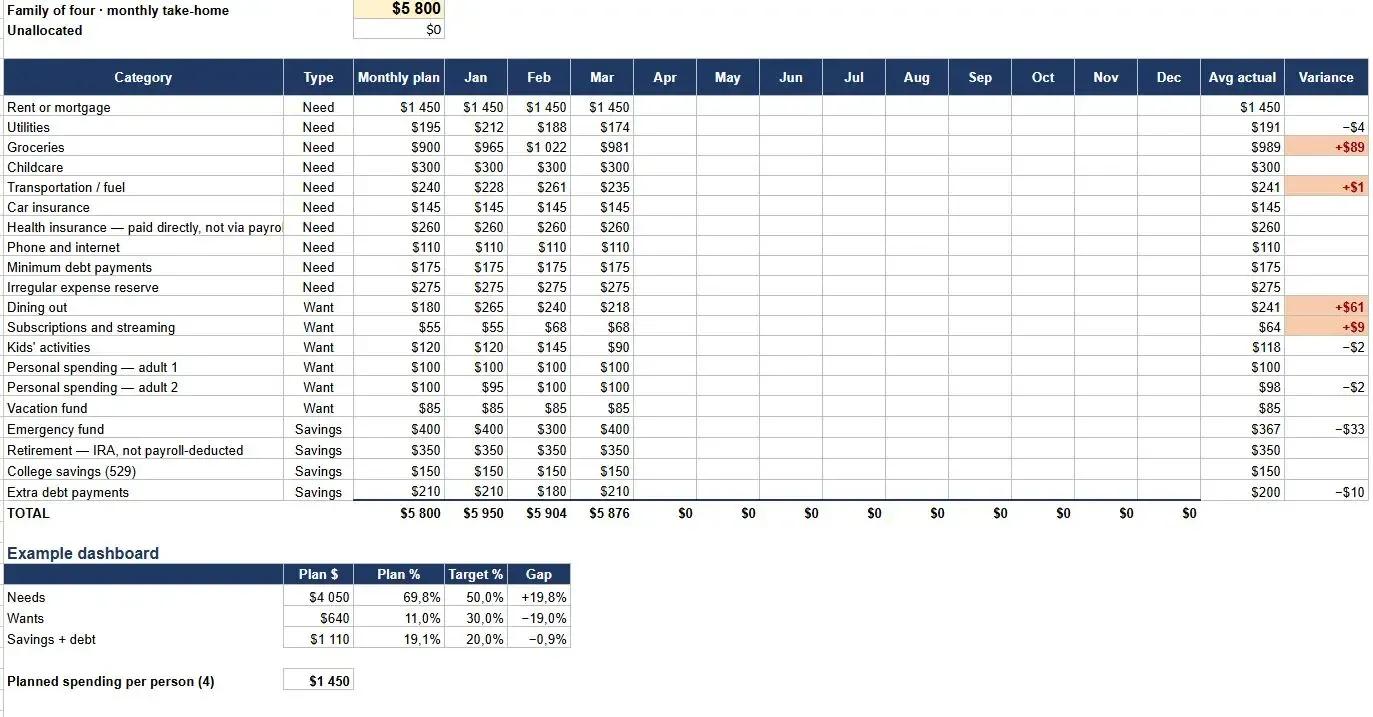
Fun money doesn't require a new budgeting system. It slots neatly into the frameworks you already know:
| Budget System | Where Fun Money Lives | Typical Allocation |
|---|---|---|
| 50/30/20 Rule | "Wants" bucket (30%) | Up to 30% of after-tax income |
| Zero-Based Budget (ZBB) | Dedicated line item (e.g., "Entertainment," "Hobbies") | Determined individually after needs + savings |
| Envelope Method | Separate physical or digital envelope | Fixed monthly amount, set at planning stage |
In the 50/30/20 framework – one of the most widely cited budgeting percentage rules in personal finance – the 30% "wants" category is explicitly designed for this purpose. Citizens Bank describes it as covering "nonessential expenses like clothing, restaurants, monthly streaming subscriptions, gyms, etc." Fun money is the discretionary heart of that bucket.
Zero-based budgeting gives more precision: you name the category, set the exact dollar amount, and assign every dollar a job. There's no default percentage – you decide based on what's left after needs and savings goals are funded. This approach works well for anyone who wants to track recurring costs vs impulse buys separately, since ZBB forces you to classify every dollar before the month starts.
The envelope method enforces the cap mechanically. When the envelope is empty, spending stops. No willpower required.
The Psychology Behind Why Fun Money Is Non-Negotiable
This is where most personal finance advice falls short. It treats budgeting as a math problem. It's not. It's a behavior management problem dressed in a spreadsheet. The math is easy. The human brain is the hard part.
The Budget Deprivation Effect: What Happens When You Cut All 'Wants'
When a budget eliminates every non-essential purchase, it doesn't create discipline. It creates pressure. And pressure, sustained long enough, produces a blowout.
A 2024 Stanford University study found that completely cutting "unnecessary" spending categories – coffee, entertainment, small treats – leads to a rebound effect in 7 out of 10 cases. The eventual impulse purchase exceeds the saved amount by 40-60%. The budget "saved" $50 on coffee and then lost $90 on an unplanned shopping trip.
The Federal Reserve's 2024 Report on the Economic Well-Being of U.S. Households reinforces this pattern: 68% of people who abandoned their budget within the first three months cited "excessive strictness and unrealistic expectations" as the primary reason. Of those, 45% made a large unplanned purchase immediately after quitting – a pattern behavioral economists call revenge spending.
The deprivation effect is not a character flaw. It's a predictable cognitive response to sustained restriction.
Ego Depletion and Willpower Fatigue in Budgeting
Roy Baumeister's research on ego depletion established a foundational principle: willpower is a finite resource. Every act of self-control draws from the same cognitive pool. When that pool runs low – after a hard day at work, a difficult conversation, a sleepless night – financial discipline is one of the first casualties.
Baumeister and Kathleen Vohs demonstrated that people in a depleted state make worse financial decisions: they favor immediate rewards over long-term gains, spend more impulsively, and struggle to stick to plans they set when they felt strong. This is why the monthly budget you built on a calm Sunday morning fails on a stressed Wednesday evening.
The practical implication is significant. A budget that requires constant willpower to maintain is structurally fragile. Fun money reduces the willpower load by pre-approving certain spending decisions. You don't have to fight the urge to buy that book or try that new restaurant – it's already in the plan. That decision was made in advance, from a position of strength.
As Harvard FCU's analysis of behavioral economics and financial habits puts it: "Emotion-driven tendencies regularly don't line up with the systematic nature of finance." The solution isn't to demand more willpower. It's to design a system that requires less of it.
The Guilt-Free Spending Principle: Permission as a Psychological Tool
Ramit Sethi, author of I Will Teach You to Be Rich, built an entire financial philosophy around this idea. His guilt-free spending principle works like this: automate savings and investments first, cover essential expenses, then spend the remainder – including a designated fun money amount – without apology.
The psychological mechanism is permission. When spending is pre-authorized by your own budget, it stops triggering the guilt-shame cycle that makes budgeting feel punishing. The budget transforms from a list of prohibitions into a set of choices you already made.
This matters more than it sounds. Guilt is cognitively expensive. Every purchase that triggers guilt forces a mini-trial in your head: Was this okay? Should I have? What does this mean about my financial future? That trial burns cognitive energy and creates a negative emotional association with your budget. Over time, people avoid the budget entirely – not because they're irresponsible, but because it feels bad every time they open it.
Pre-planned fun money eliminates that trial. The verdict was already delivered: this spending is approved. For anyone using manual tracking for better discipline, having a named fun money category also prevents the cognitive drain of re-categorizing the same types of purchases every month.
How Fun Money Prevents Binge Spending and Budget Relapses
A 2024 INSEAD study on behavioral economics found that allocating 5-10% of a budget to a planned fun money category reduced the probability of binge spending episodes by 35-50%. The mechanism is the same one that makes a pressure valve useful: controlled release prevents catastrophic failure.
Financial consultants report similar findings from client work. Budgets that include a planned discretionary allowance are adhered to 60% more often than fully restrictive plans. The key variable isn't the amount – it's the planned and controlled nature of the spending.
A meta-analysis of financial self-control strategies covering 29 studies, published in PMC, found that structured self-control strategies reduced spending and increased saving with a medium effect size. The most effective strategies were not the most restrictive – they were the ones that reduced decision fatigue and built in structured permission to spend.
"I say to clients that a budget without a 'fun fund' is like a diet without a single cheat meal. You create unrealistic expectations and guilt for any deviation. By allocating a specific amount for spontaneous purchases or hobbies, you give yourself permission to enjoy life, which paradoxically strengthens financial discipline rather than weakening it."
– David Chen, CFP, Founder of Clarity Wealth Partners (The Wall Street Journal, "Wealth Advisor" panel, October 2024)
Fun Money and Budget Psychological Resilience: The Core Connection
What 'Budget Psychological Resilience' Actually Means
Budget psychological resilience is the capacity to absorb financial shocks – an unexpected car repair, a medical bill, a job disruption – and return to your financial plan without abandoning it entirely. It's not about having perfect numbers. It's about maintaining cognitive control and rational decision-making under financial stress.
Behavioral economists like Shlomo Benartzi frame this as overcoming present bias – the human tendency to overweight immediate rewards relative to future ones. A psychologically resilient budgeter feels the pull of present bias and still acts in alignment with long-term financial goals.
That resilience doesn't come from deprivation. It comes from a budget that feels sustainable – one that accounts for human psychology, not just arithmetic. Financial security isn't only about the size of your savings account. It's about whether your system holds up under real-world pressure.
Fun Money as a Stress Buffer in Personal Finance
Financial stress is not just uncomfortable. It's cognitively damaging. Behavioral economists Sendhil Mullainathan and Eldar Shafir demonstrated in Scarcity: Why Having Too Little Means So Much (2013) that resource scarcity – including money scarcity – narrows cognitive bandwidth. People under financial strain develop tunnel vision: they focus intensely on the immediate problem and lose the mental capacity to plan for the long term.
This creates a vicious cycle. Financial stress impairs decision-making. Impaired decision-making produces worse financial outcomes. Worse outcomes increase stress.
Fun money interrupts this cycle by reducing the psychological pressure of the budget itself. A 2025 HILDA-based study published in PMC found that stable financial behavior significantly improves mental health, and that regular savings habits and controlled spending had measurable positive effects on psychological well-being. The inverse is equally true: a budget so tight it generates constant anxiety is itself a source of financial instability.
The University of Michigan's 2024 National Poll on Healthy Aging found that 53% of older adults reported financial stress in the past year – a figure that underscores how pervasive financial anxiety is across demographics. A budget that builds in permission to enjoy life, even modestly, is a direct intervention against that stress.
Long-Term Budget Adherence: The Evidence Behind Planned Discretionary Spending
The numbers on long-term budget adherence are sobering. Research from 2024-2025 shows that only 18% of people stick to a budget for more than a year, and roughly 35% maintain one past the six-month mark.
The single strongest predictor of sustained adherence is the presence of planned discretionary spending. Budgets that include a fun money or wants category show 40% higher success rates at the 12-month mark compared to fully restrictive plans.
The PMC meta-analysis of financial self-control strategies – covering 29 studies and 12 distinct intervention types – confirmed that self-control strategies reduced spending and increased saving with a medium effect size. The most effective strategies were not the most restrictive. They were the ones that reduced decision fatigue and built in structured permission to spend.
"Strict budgets without planned 'joy spending' are doomed to fail. This is not a question of willpower – it's a cognitive trap. The brain perceives constant restriction as deprivation, which leads to 'rebellion' and impulsive breakdowns. The 'fun money' category is a necessary pressure-release valve that makes a financial plan sustainable long-term."
– Dr. Anya Sharma, Behavioral Economist, Author of The Dopamine Dollar (Forbes Money, January 2025)
How to Set Your Fun Money Amount Without Guilt or Overspending
Percentage-Based Approaches (and Why They Work)
The most widely cited starting point is the 50/30/20 budgeting rule, which allocates 30% of after-tax monthly income to wants – the category that includes fun money. John Hancock's analysis of the framework confirms that this bucket covers "the 30% for everything else: nonessential expenses like clothing, restaurants, monthly streaming subscriptions, gyms, etc."
That 30% is a ceiling, not a mandate. Adjust it based on your situation:
| Situation | Recommended Fun Money Range |
|---|---|
| High-interest debt present | 5-15% of after-tax income |
| Aggressive savings goal (down payment, early retirement) | 10-15% |
| Stable income, debts managed | 15-30% |
| Variable or irregular income | % of each paycheck, not monthly average |
The CFPB's guidance on emergency savings doesn't prescribe a fixed percentage for discretionary spending – it acknowledges that "the amount depends on your situation." The same logic applies here. A budgeting percentage rule gives you a framework. Your specific numbers depend on your take-home pay, obligations, and goals.
One practical cap worth noting: Money with Katie recommends keeping fun spending below 20% of take-home pay as a reasonable upper bound for most income levels. That's a useful guardrail when the 30% figure feels too generous given your debt load or savings targets. If you're carrying high-interest debt and want to see exactly how much discretionary room you have after debt payments, the Bromoney debt payoff calculator gives you a clear picture of your payoff timeline at different payment levels.
Fun Money for Couples: Individual Allowances as a Relationship Finance Tool
Financial disagreements are the leading source of relationship conflict. Research from 2023-2025 shows that up to 70% of couples identify money as a primary stressor. The root cause is almost never the amount of money – it's the loss of autonomy and the perception of unfairness in how it's allocated.
Individual fun money allowances solve this directly. The structure is simple: after joint expenses are covered and savings goals are funded, each partner receives an equal personal allowance to spend without discussion or justification.
A 2024 study published in the Journal of Financial Therapy found that couples using this system reported a 40% reduction in money-related conflicts. The mechanism is autonomy: neither partner has to defend their purchases or seek approval for small pleasures. The money is theirs, pre-approved, and free of negotiation.
For couples managing a shared budget, the guide on fair household spending distribution covers how to structure individual allowances within a joint financial plan in more detail.
Adjusting Fun Money During Tight Months – Without Eliminating It
When an unexpected expense hits – a medical bill, a car repair, a slow freelance month – the instinct is to cut fun money to zero. That instinct is wrong.
Eliminating the category entirely removes the psychological safety valve at the exact moment you need it most. Financial stress peaks during tight months. Removing the one budget line that provides relief compounds the pressure.
Instead, adjust rather than eliminate:
- Substitute: Replace a $60 dinner out with a $15 home-cooked version. The category survives; the cost drops.
- Prioritize: Choose one small pleasure for the month – a book, a movie, a good coffee – and let the rest go.
- Draw from a reserve: If you've accumulated a fun money buffer in previous months by spending less than the cap, this is exactly when to use it.
The psychological minimum is not a dollar amount. It's the preservation of the permission to spend. Even $10 spent freely, without guilt, maintains the cognitive function of the category. That's enough to prevent the "what the hell" effect – the mental surrender that turns a tight month into a financial disaster.
Common Objections (and Why They Don't Hold Up)
'I Can't Afford Fun Money' – Reframing the Scarcity Mindset
This objection misunderstands how fun money works. It doesn't require a large budget. It requires a deliberate one.
Mullainathan and Shafir's research on scarcity shows that the feeling of not being able to afford something is often a product of how money is mentally organized, not just how much exists. When every dollar is already spoken for by obligations, any discretionary spending feels like theft from necessities.
The reframe: fun money isn't taken from your needs. It's carved from what's left after needs and savings are funded. Even $20 a month spent without guilt is more financially stabilizing than $0 with constant deprivation.
The Federal Reserve's 2024 report on household economic well-being found that 13% of adults couldn't cover a $400 emergency by any means. For households in genuine financial crisis, priorities shift – needs and debt repayment come first. But for the majority of people who object to fun money, the constraint is psychological, not arithmetic.
'Isn't Fun Money Just Bad Financial Discipline?'
No. It's the opposite.
Financial discipline is not the ability to deny yourself everything. It's the ability to make intentional decisions about money and follow through on them over time. Fun money is intentional. It's planned, capped, and tracked. That's more disciplined than the alternative – a vague "I'll try not to spend much" that collapses the moment you're tired or stressed.
Alero Financial's 2025 analysis of budgeting benefits frames it clearly: "A budget pre-decides your financial choices for you." Fun money is a pre-decided financial choice. It's discipline by design, not its absence.
The rules for budgeting that actually work long-term aren't the strictest ones. They're the ones that account for human behavior. A budget that acknowledges you'll want to spend on things you enjoy – and plans for it – is a stronger system than one that pretends you won't.
When Fun Money Feels Wrong: Overcoming the Frugality Guilt Trap
Frugality guilt – the anxiety that comes from spending money on yourself even when you can afford it – is a real psychological phenomenon. It's particularly common among people who grew up in financially stressed households, or who have internalized the belief that every dollar not saved is a dollar wasted.
The CFPB's definition of financial well-being, as summarized by Denison Edge, explicitly includes the ability to "make choices that allow them to enjoy life." Enjoyment is not a financial sin. It's part of the definition of financial health.
If guilt persists even when spending is planned and affordable, the issue isn't the spending – it's the belief system around money. That's worth examining, and often worth discussing with a financial therapist or CFP.
Practical Implementation: Adding Fun Money to Your Budget Today
Step-by-Step: Creating Your Fun Money Category
Step 1: Calculate your after-tax monthly income. Use your net take-home pay – the number that hits your bank account, not your gross salary. This is your monthly after-tax income, and it's the only figure that matters for budgeting percentages.
Step 2: Fund your non-negotiables first. Cover essential expenses – rent or mortgage, utilities, groceries, transportation, insurance premiums, minimum debt payments. These come before fun money, always.
Step 3: Hit your savings targets. Automate transfers to your emergency fund, retirement savings account, or other savings goals. The CFPB recommends automatic transfers as "one of the easiest ways to make your savings consistent." Fund savings and debt repayment before fun money – not after.
Step 4: Assign your fun money percentage. Start with 5-10% of after-tax income if you're paying down debt. Move toward 15-20% once debt is under control. Use the 30% ceiling only if your needs genuinely cost less than 50% of net income and your savings goals are fully funded.
Step 5: Isolate the funds. Don't leave fun money sitting in your main checking account. Separation is what makes it real – and what makes it trackable.
Step 6: Spend without guilt. This is the step most people skip. Once the money is allocated and isolated, spending it is not a failure. It's the plan working exactly as designed.
Tracking Tools and Apps That Support Guilt-Free Spending
Three practical approaches, each with different trade-offs:
- Cash envelope: Withdraw the monthly amount in cash. When it's gone, it's gone. Zero tracking required. Works well for people who overspend with cards.
- Dedicated sub-account or debit card: Open a free checking account, set up an automatic monthly transfer, and use that card only for fun money. The balance is your remaining budget.
- Budgeting app: YNAB (You Need a Budget) and Monarch Money both support named categories with spending caps. Transactions auto-categorize; you see the remaining balance in real time.
For tracking personal spending money across categories, the Bromoney blog covers the trade-offs between dedicated budgeting software and spreadsheets in detail – including which approach works best by financial complexity and tech comfort level.
The Bromoney app (available on Google Play and App Store) includes a budget planner where you can set up named spending categories with monthly caps – including a dedicated fun money line – and track against them in real time.
Mistakes to Avoid When Setting Up Your Fun Money Category
Mistake 1: Funding it from what's left over. If fun money is an afterthought, it disappears first when the month gets tight. Allocate it deliberately, before the month starts, alongside your other budget categories.
Mistake 2: Making it too small to matter. A $5 monthly fun money budget doesn't provide psychological relief. It provides frustration. Size it to actually allow one or two genuine pleasures per month.
Mistake 3: Mixing it with bills or savings. When fun money lives in the same bank account as rent and groceries, you can't measure it. Without measurement, the category effectively doesn't exist. Separation is functional, not cosmetic.
Mistake 4: Feeling guilty for using it. This defeats the purpose entirely. If spending from the fun money category triggers guilt, the category isn't doing its job. The guilt is the bug, not the spending.
Mistake 5: Eliminating it during hard months instead of scaling it. A smaller fun money allocation is a healthy response to a tight month. Zero is a psychological risk.
Understanding the difference between allowance for kids and teenagers and adult discretionary budgets also helps – the same principle of pre-approved, guilt-free spending applies at every age, and building the habit early makes the adult version much easier to maintain.
FAQ: Fun Money and Budget Psychology
Q: Is fun money the same as an emergency fund? No. An emergency fund covers unexpected essential expenses – car repairs, medical bills, job loss. Fun money covers planned discretionary spending. The CFPB explicitly warns against spending emergency savings on non-emergencies. Keep them in separate accounts.
Q: What if my needs already exceed 50% of my income? Adjust the percentages. The 50/30/20 rule is a starting framework, not a law. If needs take 60% of net income, reduce wants to 20% and savings to 20% – or find ways to reduce essential costs over time. Fun money shrinks, but doesn't disappear.
Q: Can I roll over unused fun money to the next month? Yes. Rolling over creates a buffer for larger discretionary purchases – a concert ticket, a weekend trip – without blowing the monthly budget. This is a feature, not a loophole.
Q: How do I handle fun money when income is irregular? Calculate fun money as a percentage of each paycheck rather than a fixed monthly amount. When income is high, the category is larger. When it's low, it scales down automatically. This is more sustainable than a fixed dollar amount that becomes unaffordable in slow months.
Q: Should fun money cover gifts for others? That depends on your budget structure. Many planners put gifts in a separate "giving" or "gifts" category to prevent them from cannibalizing personal discretionary spending. If you're just starting out, including gifts in fun money is fine – just watch that the category doesn't get overwhelmed by others' occasions.
Key Takeaways: Why Fun Money Belongs in Every Serious Budget
- Fun money is planned, capped, and guilt-free. It's the opposite of impulse spending, not a synonym for it.
- Behavioral science backs it. A meta-analysis of 29 studies found that structured self-control strategies – including pre-planned discretionary spending – reduce overall spending and increase savings with a medium effect size.
- Deprivation backfires. Budgets that eliminate all discretionary spending fail at a 40% higher rate within 12 months compared to flexible models.
- Ego depletion is real. Willpower is finite. A budget that requires constant self-denial draws down that resource until it fails. Fun money reduces the willpower load.
- For couples, individual allowances reduce conflict by 40%. Personal autonomy within a shared budget is a relationship finance tool, not a luxury.
- In tight months, scale it – don't eliminate it. Even a token amount preserves the psychological function of the category.
- The minimum viable fun money isn't a dollar amount. It's the preservation of permission: the right to spend something, guilt-free, every month.
A budget that accounts for human psychology isn't softer than one that doesn't. It's stronger. It's built to last.
What Is the 50/30/20 Budget Rule?
The 50/30/20 rule is one of the most widely taught budgeting percentage frameworks in personal finance. Senator Elizabeth Warren and her daughter Amelia Warren Tyagi popularized it in All Your Worth (2005). The core idea: divide your after-tax income into three categories – needs, wants, and savings – using fixed percentage targets. It's a budgeting rule that works precisely because it's simple enough to remember and flexible enough to adapt.
50% on Needs: Required Monthly Expenses
Needs are expenses you can't reasonably eliminate without disrupting basic functioning. They include:
- Rent or mortgage payments
- Utilities (electricity, water, heat)
- Groceries (basic, not premium)
- Transportation to work (car payment, gas, transit pass)
- Health insurance premiums
- Minimum debt payments (credit card minimums, student loan minimums)
- Basic phone plan
If your needs exceed 50% of after-tax income – common in high cost-of-living cities – the rule still applies as a target. The gap between your current allocation and 50% tells you where to focus cost-reduction efforts. Expenses like rent or mortgage and insurance health are the hardest to compress quickly, but they're the right place to start.
30% on Wants: Spending for Enjoyment
Wants are everything that improves quality of life but isn't strictly necessary. This is where fun money lives. The category includes:
- Dining out and coffee shops
- Entertainment (streaming subscriptions, concerts, movies)
- Hobbies and recreational activities
- Travel and vacations
- Shopping beyond basic clothing needs
- Gym memberships and wellness services
The 30% figure is generous by design. It acknowledges that a sustainable monthly budget must include enjoyment. Henrico HR's explanation of the rule confirms: "Wants are things like entertainment, eating out, vacations, recreation and hobbies." Wants and savings are not in competition – they're both planned categories within the same framework.
20% on Savings and Debt: Building Financial Security
The savings category covers everything that builds future financial security or accelerates debt payoff beyond the minimum:
- Emergency fund contributions (target: 3-6 months of expenses)
- Retirement savings contributions (401(k), IRA, Roth IRA)
- Investment accounts
- Extra debt payments above the required minimum
- Specific savings goals (down payment, education, major purchase)
The Federal Reserve's 2024 data shows that only 55% of U.S. adults have a three-month rainy-day fund, and 13% couldn't cover a $400 emergency by any means. Directing 20% of income to savings and debt each month directly addresses this vulnerability. The goal isn't perfection – it's consistency. Even partial contributions to a savings account each month compound into real financial stability over time.
How to Apply the 50/30/20 Rule: A Practical Calculation
Step 1: Find your monthly after-tax income – your net take-home pay.
Step 2: Multiply by 0.50 to get your needs budget.
Step 3: Multiply by 0.30 to get your wants budget (includes fun money).
Step 4: Multiply by 0.20 to get your savings and extra debt payment target.
Example at $5,000/month after-tax income:
| Category | Percentage | Monthly Amount |
|---|---|---|
| Needs | 50% | $2,500 |
| Wants (incl. fun money) | 30% | $1,500 |
| Savings & debt | 20% | $1,000 |
Example at $7,500/month after-tax income:
| Category | Percentage | Monthly Amount |
|---|---|---|
| Needs | 50% | $3,750 |
| Wants (incl. fun money) | 30% | $2,250 |
| Savings & debt | 20% | $1,500 |
The rule works as a starting framework. Adjust percentages based on your debt load, income level, and financial goals – but keep all three categories present. Splitting income into three named buckets is itself the discipline: it makes wants and savings visible, not invisible.
Disadvantages and Limitations of the 50/30/20 Rule
The 50/30/20 rule is useful precisely because it's simple. That simplicity is also its main limitation. Understanding the disadvantages of this personal budgeting approach helps you adapt it rather than abandon it.
It assumes income stability. Freelancers, gig workers, and anyone with variable income find fixed percentages harder to apply month-to-month. A percentage-of-paycheck approach works better for irregular earners.
It doesn't account for high cost-of-living areas. In cities like New York, San Francisco, or Boston, housing alone consumes 40-50% of take-home pay for median earners. The 50% needs ceiling becomes mathematically difficult without a roommate, a long commute, or a significantly above-median income.
It doesn't differentiate between types of debt. Lumping a minimum credit card payment – high interest, should be prioritized – with a student loan minimum into the "needs" category slows debt payoff. High-interest debt often justifies temporarily compressing the wants category to accelerate repayment. The Bromoney debt payoff calculator helps model exactly how much faster you can eliminate debt by redirecting discretionary spending.
The 30% wants allocation is too high for some situations. If you're carrying significant high-interest debt or aggressively saving toward a near-term goal, 30% on wants may be more than your situation supports. A 50/20/30 flip – 30% to savings, 20% to wants – is a legitimate adjustment.
It doesn't address spending within categories. Knowing that $1,500 goes to "wants" doesn't tell you how to split that $1,500 across dining, entertainment, hobbies, and fun money. Zero-based budgeting provides more granularity if you need it. For anyone who wants to understand how their spending breaks down before applying a percentage rule, tracking personal spending money across categories first gives you a realistic baseline.
Despite these limitations, the 50/30/20 rule remains a strong starting point for anyone building a budget for the first time – or rebuilding one after a period of financial drift. Its greatest strength is that it legitimizes the wants category. It tells you, in percentage form, that enjoying your money is not a failure. It's part of the plan.
Sources: Federal Reserve – Report on the Economic Well-Being of U.S. Households in 2024; CFPB – An Essential Guide to Building an Emergency Fund; Citizens Bank – What Is the 50/30/20 Budget Rule?; John Hancock – Debunking the 50-30-20 Budgeting Rule; Henrico HR – The 50-30-20 Budget Rule Explained; Alero Financial – The Uncommon Benefits of Budgeting; Harvard FCU – Behavioral Economics and Your Money Habits; University of Phoenix – Tips to Stop Overspending; PMC – Meta-Analysis of Financial Self-Control Strategies; PMC – Understanding the Effect of Financial Behaviour on Mental Health (HILDA Study); University of Michigan IHPI – Making Ends Meet: Financial Strain and Well-Being Among Older Adults; Denison Edge – What Is Financial Wellness? 4 Areas of Focus
Was this article helpful?
Same blogs

One-Time vs. Recurring Expenses: Why Separate Categorization Is Critical for Your Budget
Mixing one-time and recurring expenses in a single budget category is the most common structural error in personal finance – and it silently breaks every downstream decision. Here's how to separate them, why it matters, and what to do with each type.

Budgeting as a Couple When You Live Together: A Conflict-Free Guide
Living together means merging two financial lives – different habits, different priorities, and different definitions of 'too expensive.' This guide walks you through every stage of couples budgeting: the first honest money conversation, choosing a model that fits your income split, splitting expenses fairly, picking the right tools, and building shared goals you'll actually hit.

Notification Fatigue in Budget Trackers: How Automation Causes Budget Blindness
Budget trackers promise financial control – but their notification systems often deliver the opposite. This guide breaks down how alert overload creates budget blindness, what the neuroscience says about habituation, and how to rebuild genuine financial awareness without ditching automation entirely.