


What a Baby Actually Costs in the First Year

What a Baby Actually Costs in the First Year
Is there an official number for a baby's first year?
No. There is no federal estimate of what a new baby costs in the first twelve months. The USDA runs the only federal series on what it costs to raise a child, and it reports yearly averages across ages 0 through 17 - not a first-year baby figure. Every "national average" for a baby's first year comes from a private survey, not from government data.
That matters more than it sounds. When a number has no public methodology behind it, you cannot tell whether it counted the birth itself, whether it counted infant care, or whose family it described. Two surveys can produce numbers thousands of dollars apart and both be honest.
Why did we remove the first-year average from this page?
An earlier version of this page presented a first-year range as a national average. It was not one. No federal source publishes that range, and the only federal series on child costs does not break out the baby's first year at all. Rather than swap in a different unverifiable number, we removed it.
What replaces it below is narrower but checkable: what the USDA actually published, what the Labor Department says about leave pay, and what the IRS says about the credits. There is no honest national figure for what you can expect to spend on a first-year baby - but there is an honest way to build your own. Where a number does not exist in public data, we say so instead of estimating.
What does the government estimate it costs to raise a child?
The USDA estimated $233,610 to raise one child from birth through age 17, in 2015 dollars, for a middle-income married couple with two children (USDA, Expenditures on Children by Families, 2015). That is the highest-quality federal figure that exists, and it comes with heavy conditions.
Read the conditions carefully. It covers ages 0 to 17, not a lifetime, and not college. It describes a specific family shape. And it is in 2015 dollars, so it understates today's price levels by whatever inflation has done since.
Why is the USDA figure a decade old?
Because the series stopped. The USDA states that "the most recent version of the report was published in 2017 and estimates the cost of raising children born in 2015," and that it is "evaluating the methods used to inform this report to ensure they reflect best practices in the field" (USDA Food and Nutrition Service). There is no newer edition.
So when an article cites "the USDA estimate" as current, it is citing 2015 data whether it says so or not. Any larger figure attributed to the USDA - including the one this page previously carried - is someone's inflation adjustment, not a USDA publication.
What is the USDA's yearly figure, and why is it low for a newborn?
The same report puts annual child-rearing costs at $12,350 to $13,900 per child for a two-child, middle-income married couple, again in 2015 dollars. That is an average per year across ages, and the range moves with the child's age rather than isolating infancy.
Two things push a newborn's first year above a smoothed average. One is the front-loaded costs - the initial setup purchases, one-time costs that never repeat. The other is that household income is most likely to drop in that year, which no average of expenses captures.
What is the biggest first-year expense most families underestimate?
Lost income during leave. Baby gear is visible and finite. Infant care is a bill you can look up. The income gap during unpaid weeks is invisible until it lands, because nothing arrives in the mail to announce it.
The federal leave law protects a job. It does not pay a wage. That single distinction reshapes a family's first-year costs more than any purchase decision new parents will make.
How long is FMLA leave?
Eligible employees are entitled to "twelve workweeks of leave in any 12-month period for: Birth and care of the employee's child, within one year of birth," according to the U.S. Department of Labor. Twelve weeks is the federal ceiling, and it is the same twelve weeks shared across other qualifying reasons in that period.
Twelve weeks is also roughly three months of a household budget. Whether that is survivable depends on the next question.
Is FMLA leave paid?
It is not. The Labor Department's language is blunt: the FMLA "entitles eligible employees of covered employers to take job-protected, unpaid leave for specified family and medical reasons." There is no federal paid parental leave for private-sector workers. The federal protection is that your job is still there when you return. New moms and dads learn this the hard way.
Pay during those weeks comes from somewhere else - accrued vacation or sick time, an employer's paid leave policy, short-term disability coverage, or a state program where one exists. The DOL notes that an employee may elect, or an employer may require, substitution of accrued paid leave. That is a transfer from time you already earned, not new money.
Who does not qualify for FMLA at all?
Coverage is narrower than most parents assume. The Labor Department's conditions are twelve months of employment with that employer, at least 1,250 hours worked, and an employer with 50 or more employees within 75 miles. Miss any one of those and the federal job protection does not reach you.
Part-time workers, recent hires, and anyone at a small business frequently fall outside all three. If one parent is in that position, the leave conversation is a negotiation rather than a right, and it is worth having early, months before the due date.
What does twelve unpaid weeks cost a typical household?
Use the median as a yardstick. The Census Bureau reports median household income of $83,730 in 2024 (Income in the United States: 2024). Divided across 52 weeks, that is roughly $1,610 a week before tax - our arithmetic, not a Census figure.
On that basis, six unpaid weeks is about $9,700 of pre-tax income, eight weeks about $12,900, and twelve weeks about $19,300. If both parents take unpaid time, the gap widens accordingly. Run the same division on your own gross pay.
How much is the Child Tax Credit worth?
"The Child Tax Credit is worth up to $2,200 per qualifying child," the IRS states, for tax year 2025. The child generally must be under 17 at the end of the tax year. That is the headline figure, and it is real.
It is a credit against tax owed, not a payment. What lands in your bank account is a different number.
How much of the Child Tax Credit comes back as cash?
Not the full $2,200. The IRS says that if you have little or no federal income tax liability, you may qualify for the Additional Child Tax Credit, "up to $1,700 per qualifying child depending on your income." That refundable portion is the ceiling on what can be paid out when the credit exceeds what you owe.
There is also a floor. The IRS requires earned income of at least $2,500 to be eligible for the refundable portion. A parent who took a long unpaid leave can end up below both thresholds - owing little tax and therefore claiming little credit, precisely in the year money is tightest.
Who qualifies for the full credit?
The IRS says you qualify for the full amount "if you meet all eligibility factors and your annual income is not more than $200,000 ($400,000 if filing a joint return)." Above those thresholds the credit phases down.
Two families can both be "eligible" and receive very different amounts: one gets the full $2,200 against tax owed, another a refundable amount capped at $1,700. The credit behaves differently depending on what you owe.
What is the Child and Dependent Care Credit worth?
It covers care that lets you work or look for work. IRS Publication 503 for 2025 says "the credit can be up to 35% of your employment-related expenses," and Topic no. 602 caps the expenses you may count at $3,000 for one qualifying individual or $6,000 for two or more.
At the top percentage, that arithmetic gives a maximum credit of $1,050 for one child and $2,100 for two - our calculation from the two IRS figures, not an IRS-published total. The percentage falls as adjusted gross income rises, so most households land below the maximum.
Should you use a Dependent Care FSA or the credit?
If your employer offers one, the FSA lets you exclude up to $5,000 from income for dependent care, or $2,500 if married filing separately, per Publication 503. It comes out pre-tax, which is why it often beats the credit for higher earners.
The rule that catches people: you cannot count the same expenses twice. Dollars run through the FSA cannot also count toward the credit. Decide which bucket each expense goes into before the year closes.
When do these tax benefits actually arrive?
At filing, not monthly. Every figure above shows up once a year, after the year in which you spent the money. The daycare deposit in September is paid with September's cash.
This is the most common planning error in the first year: counting a credit as if it were income. Build the budget per month on wages and leave pay only, and treat the refund as a lump sum that arrives months later.
How much does childbirth itself cost?
We are not putting a number here. There is no current federal figure for the out-of-pocket costs of giving birth that we could verify, and private estimates vary too widely to be useful as a plan.
You can still get a specific answer for your own situation. Call the number on your insurance card while you are still pregnant and ask three things: your remaining deductible, your out-of-pocket maximum for the plan year, and whether your due date falls in the same plan year as your prenatal care during pregnancy. If not, you may hit two deductibles.
Ask on the same call how the baby is added to your insurance plan after the birth, and what the premium becomes per month - that answer belongs in the budget before the baby arrives.
Which first-year costs are one-time and which are permanent?
Sort your baby-related costs into two columns before you buy anything. The car seat, crib, stroller, baby monitor, and nursery furniture you buy once are one-time costs - painful once, then done. Diapers, baby supplies, insurance premiums, and child care behave like utilities: those costs recur per month, they rise, and they reset your baseline spending permanently.
Whether you are breastfeeding or buying formula sits in the second column too, because it changes what you spend on groceries per month rather than once. Our guide to one-time versus recurring expenses walks through that sorting. The distinction tells you whether you have a savings problem or a structural one.
What do you actually need to buy before the baby arrives?
Less than the checklists aimed at new parents suggest. Babies require very little in week one - a car seat, somewhere safe to sleep, diapers, and a few sets of baby clothing. The nursery and the rest can wait until you see how your own baby behaves. Buy the full list in advance and the initial costs double.
Set up a baby registry early in the pregnancy, because a gift is a baby-related expense your family does not pay. You do not have to buy new either: borrowed and secondhand baby gear covers much of the rest, and the nursery is the easiest place to spend more than you meant to. None of these baby items changes the two numbers that decide the budget - leave pay and care costs.
Why does childcare deserve its own plan?
Because it is usually the largest new recurring line, and because it starts on a date you can predict. Infant care prices vary enormously by state, by care type, and by the child's age, which is why a national figure would not help you set a budget anyway.
Get a price quote from two or three centers near you and treat the number as a fixed obligation per month, not a variable. Our childcare cost planning guide covers how to compare center care, licensed home care, and relative care on total costs rather than sticker price.
What is the single worst month of the first year?
The month leave ends and care begins. Income has not fully recovered, the first child care invoice lands, and any medical costs from the birth are often just arriving. Three financial pressures in one billing cycle.
Mark that month on a calendar now and build the budget for it specifically. Anything optional - a babysitter for an evening, a weekend away - waits. If it works in that month, it works in the other eleven.
How should the emergency fund change?
Upward, and measured against the new fixed budget rather than the old one. A cushion sized for two adults who could cut what they spend quickly does not fit a family with care costs, insurance copays, an occasional babysitter, and less flexibility to pick up extra hours.
A practical target is enough cash to cover the post-daycare fixed budget for several months. Build it from the higher-income months before leave begins - the last stretch when your finances have slack.
How do you rebuild the budget as a couple?
Split child care as an obligation between parents rather than assigning it to whoever earns less or takes more leave. That turns a shared decision into one person's deficit, and it surfaces later as resentment rather than as a problem with the family finances.
If your incomes are uneven, our guide to budgeting with an income disparity covers proportional splits. If you are starting the budget from scratch, build the family budget first and layer the baby costs onto it.
Where your first year will look different
Every figure on this page has boundaries, and most of them will not describe you exactly. Your costs may land well outside all of them.
The USDA numbers are 2015 dollars for a married couple with two children - a single parent, a one-child household, or anyone reading in 2026 is outside that frame. The median income figure is a national midpoint. The credit amounts assume the child meets IRS residency, relationship, and age tests, and the refundable portion assumes earned income above $2,500.
Leave is the widest variable. Twelve unpaid weeks and twelve weeks at partial state wage replacement produce entirely different first years, and which you get depends on your state, your employer's size, your tenure, and your hours. Check your state's paid family leave program and your employer's handbook.
What should you do this month?
Three things, in order. If you are pregnant now, start with the income gap: divide your gross annual pay by 52 and multiply by the weeks you expect to be out. That is usually the biggest number in the plan. Confirm with your employer whether you meet the FMLA conditions and what paid time you have accrued. Then get a real child care price quote and add it to your fixed costs per month.
Once those three numbers exist, the rest of the financial planning is arithmetic, and your total first-year costs stop being a guess. Our family budget template gives you somewhere to put them.

Denis Goncharenko
Head of Content
Editorial Policy: no secondary statistics. Every claim is linked to an official source and dated — datasets and methods are open for review.

Was this article helpful?
Same blogs

Saving Money on Groceries Is Not a Test of Willpower
Federal data shows six grocery categories moving at different rates, not one bill rising evenly. Why the national CPI, the CES spending survey, and USDA's own forecast are each the wrong number to budget against - and how to build your own monthly figure from 8 to 12 weeks of receipts instead.
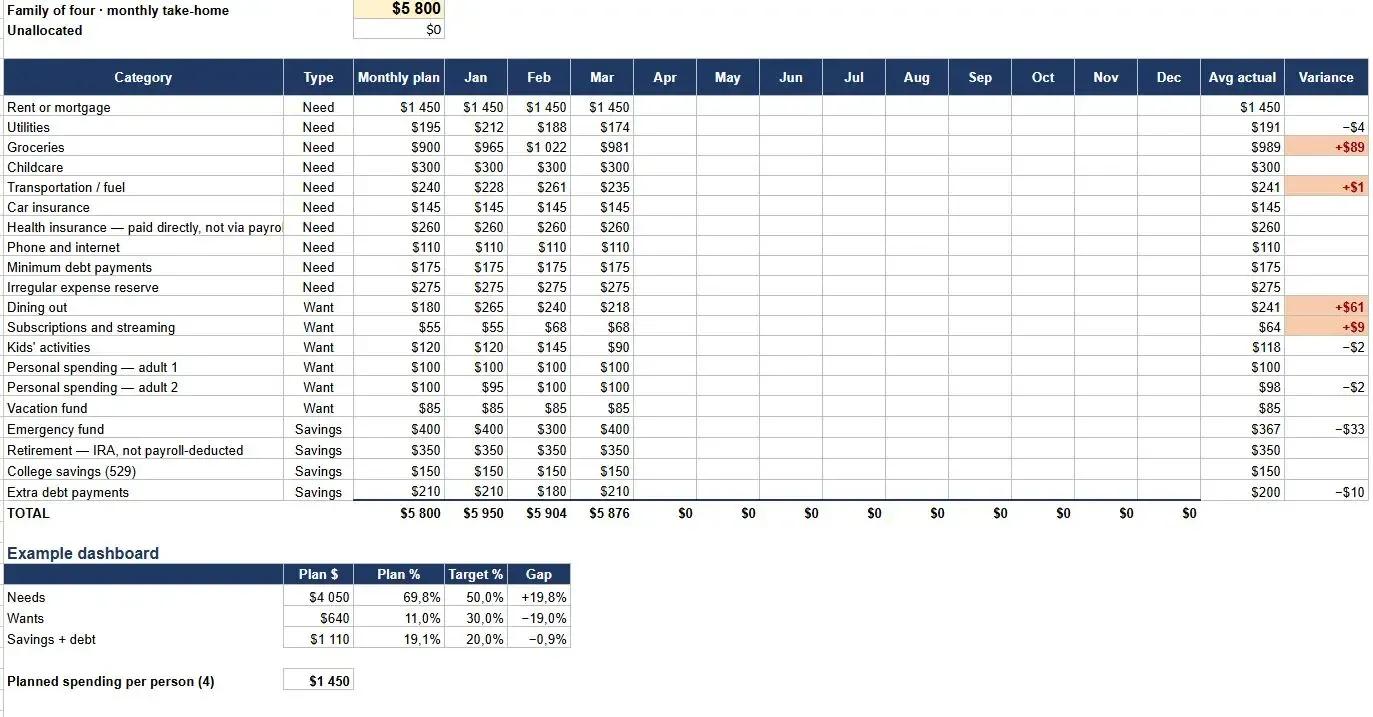
Free Family Budget Template for Excel and Google Sheets
A free household budget spreadsheet for families of three to five, with categories pre-filled and a separate tab that spreads yearly bills like insurance and registration across all twelve months. No email, no sign-up, works in Excel and Google Sheets.

Why Parent PLUS Loans Have Become a Hidden Retirement Crisis for American Parents
Parent PLUS loans can follow parents into retirement, reduce savings, and expose Social Security benefits to offset after default. Here is what near-retirement borrowers should know.