


Six Months After Switching Budget Methods: What Changes

Six Months After Switching Budget Methods: What Changes
Is this a real person's story or a model?
This is a model, not a personal account. Every figure below is a round number chosen to make the arithmetic easy to follow, and every table is a projection, not a record of what happened to someone. Nothing here was measured in a real household.
We built it this way on purpose. Stories about moving to a different budgeting method usually arrive as first-person reports with precise-looking totals that no reader can check. A model is weaker as a story and more useful as a tool: you can swap your own income and fixed costs into the same steps and see where your version lands.
Read the dollar amounts as placeholders: what matters is the shape of the six months, not the totals.
What are the starting numbers in this model?
In this model, take-home pay is $4,500 a month and fixed costs are $2,900 - rent, utilities, insurance bills, and minimum debt payments. Variable spending runs about $1,100. That leaves roughly $500 a month going to savings and extra debt payments, with $10,000 in consumer debt outstanding and about $1,000 in an emergency fund.
Under percentage buckets, this household is already off-plan before the month starts. Fixed expenses are 64% of take-home, not 50%. The percentages do not fail because the arithmetic is wrong; they fail because the housing line does not care what the budgeting method recommends.
That gap is the whole reason the switch gets considered. If your fixed costs sit near 50%, a percentage budget is a good option - that budgeting style asks less of you every month - and the comparison between the two strategies is covered in more detail in 50/30/20 vs. zero-based budgeting.
What changes in the first two weeks?
The first two weeks are almost entirely bookkeeping. You pull two or three months of statements, sort every transaction into a named category, and discover that a handful of expenses you thought were small are not. Nothing about the actual spending changes yet.
Two things usually surface. First, subscriptions: in this model, a household finds around $80 a month it stops using - a streaming service nobody opens. Second, an unnamed pile of card spending, call it $150 a month, that no one can reconstruct at the end of the month because none of it was ever labeled.
Neither discovery requires the new budgeting method. The audit is what finds the money. That is worth saying plainly: the first visible win is not evidence that the method itself is doing anything yet.
How do you build the first month's plan?
You assign every dollar of expected income to a named line before the month begins, working from fixed costs outward, and they have to total exactly what you expect to receive. In this model that means $2,900 to fixed bills, roughly $1,000 to variable expenses with caps, $200 to sinking funds, and the remainder split between savings and extra debt payment.
The sinking funds are the part people skip. Car maintenance, annual renewals, and gifts do not arrive monthly, but they arrive on their own schedule. In this model, roughly $75 a month goes into that line so a typical repair bill in the neighborhood of $900 a year does not have to come out of nowhere. If your irregular costs are unclear, one-time vs. recurring expenses is a useful sorting exercise before you assign anything.
Expect the first plan to take a few hours. The mechanics of building it in a spreadsheet or app are covered in the zero-based budgeting setup guide.
What breaks in the first two months?
Three things break, and they break in a predictable order: the check-in habit lapses around week three, the first irregular expense lands before its sinking fund is funded, and category disputes start eating more time than they save. This is the least-documented part of switching and the part that decides whether the budgeting method survives.
The check-in lapse comes first. A daily review is unsustainable for most people, and once it is skipped twice it stops being a habit. A single fixed weekly slot of about 15 minutes survives better than a daily one: it is an appointment rather than a chore.
Irregular expenses are the second break. A $400 car repair in month two arrives when the sinking fund holds $75. The plan does not survive that intact, and it is not supposed to - you move money from groceries or another category and keep going. Treating that as failure is the actual failure.
Why do category disputes waste so much time?
Because the category label rarely changes any decision. Spending forty minutes deciding whether a $30 purchase belongs in personal care or miscellaneous produces no different outcome - the money is gone either way. The precision feels like diligence and functions as procrastination.
The practical fix is fewer categories, at least early on. Twelve to fifteen named lines in the first months is enough to see where the money goes - the setup guide covers when it is worth expanding toward thirty once you know where the disputes actually are. If one or two lines keep overrunning in the meantime, envelope budgeting - capping those lines by using cash - is a simpler option than another split.
What does the six-month picture look like in this model?
Below is a modeled trajectory, not measured data. It assumes no income change, one $400 unplanned repair in month two, and consistent weekly reviews from month two onward.
| Month | Modeled savings + extra debt payment | Modeled emergency fund | Modeled consumer debt |
|---|---|---|---|
| 0 | $500 | $1,000 | $10,000 |
| 1 | $700 | $1,150 | $9,600 |
| 2 | $400 | $1,150 | $9,400 |
| 3 | $750 | $1,400 | $9,000 |
| 4 | $750 | $1,650 | $8,600 |
| 5 | $750 | $1,900 | $8,200 |
| 6 | $750 | $2,150 | $7,800 |
Three features of the curve matter more than the totals. The month-one jump comes from the audit, not the budgeting method. Month two dips because of the repair. From month three the line flattens into a steady rate - which is the realistic long-run number, roughly $250 a month better than the starting point in this model.
Where does the extra money actually come from?
In this model it comes from three places: canceled subscriptions, small unlabeled spending that stops happening once it is labeled, and irregular costs that are pre-funded instead of absorbed at full price. None of it comes from income.
That is the honest accounting. A budgeting method redistributes attention, not earnings. If your variable spending is already thin, there is very little for it to recover, and the six-month curve will be much flatter.
How much time does the budgeting method take each week?
Plan on a few hours for the initial setup, about an hour of planning at the start of each month, and roughly 30 to 60 minutes a month after that for weekly check-ins and the reset - in line with the estimate in the setup guide. Percentage buckets, once configured, take closer to 20 minutes a month total.
That difference is the real trade-off. A budgeting method you maintain for three years beats a more precise one you abandon in month two. If you cannot afford the weekly slot in your schedule, that is a reason to stay with a simpler structure - percentage buckets, or envelope budgeting with cash caps on two categories - not a character flaw.
What switching does not fix
The budgeting method does not raise your income. Nothing in a budget changes what your employer pays you, and no amount of category discipline closes a gap caused by earnings.
It does not reduce fixed expenses. Rent, insurance premiums, and minimum debt payments are the same bills before and after the switch. If fixed expenses consume most of take-home pay, the budgeting method makes that fact visible in more detail - which is useful - but it does not change it.
It does not work without time. The whole mechanism depends on a recurring review, and if that review does not happen, the plan drifts within weeks into a spreadsheet nobody opens.
And it does not resolve a structural shortfall. If required spending exceeds income every month, the arithmetic will not balance to zero no matter how it is arranged. That needs a different response than a budgeting method.
What should you track to know whether it is working?
Track three numbers monthly: the share of income going to savings and extra debt payments, total consumer debt outstanding, and the variance between what you planned in each category and what you actually spent. Everything else is decoration.
The third one is the diagnostic. Persistent overage on groceries, month after month, means the cap is wrong, not that you lack discipline. Adjust the number and stop fighting reality.
How do you know when to stop tracking so closely?
When the variance number gets small and stays small. Once planned and actual spending land close together for three consecutive months, the detailed tracking has taught you what it was going to teach you, and the weekly review can shrink.
Most people who keep the method long-term simplify it: fewer categories, automatic savings transfers on payday, and a monthly review instead of a weekly one. The discipline stays; the friction drops.
What if the model does not fit your numbers?
Then rebuild it with yours. Put your actual take-home in place of $4,500, your actual fixed costs in place of $2,900, and run the same steps: audit, assign, prioritize savings first, fund the irregular items, review weekly, adjust the caps that are wrong.
If you are starting without any existing budget, how to build a family budget covers the groundwork, and the family budget template gives you a structure to fill in.
What is the short version?
Six months of a zero-based approach, in this model, moves roughly $250 a month from unlabeled spending into savings and debt payments, costs about 30 to 60 minutes a month to maintain, and breaks at least twice before it settles.
It is a bookkeeping change, not a change in your finances. That is a modest claim, and it is the accurate one.
This article is general information, not financial advice. Consider your own circumstances or consult a qualified professional before making financial decisions.

Denis Goncharenko
Head of Content
Editorial Policy: no secondary statistics. Every claim is linked to an official source and dated — datasets and methods are open for review.

Was this article helpful?
Same blogs

Saving Money on Groceries Is Not a Test of Willpower
Federal data shows six grocery categories moving at different rates, not one bill rising evenly. Why the national CPI, the CES spending survey, and USDA's own forecast are each the wrong number to budget against - and how to build your own monthly figure from 8 to 12 weeks of receipts instead.
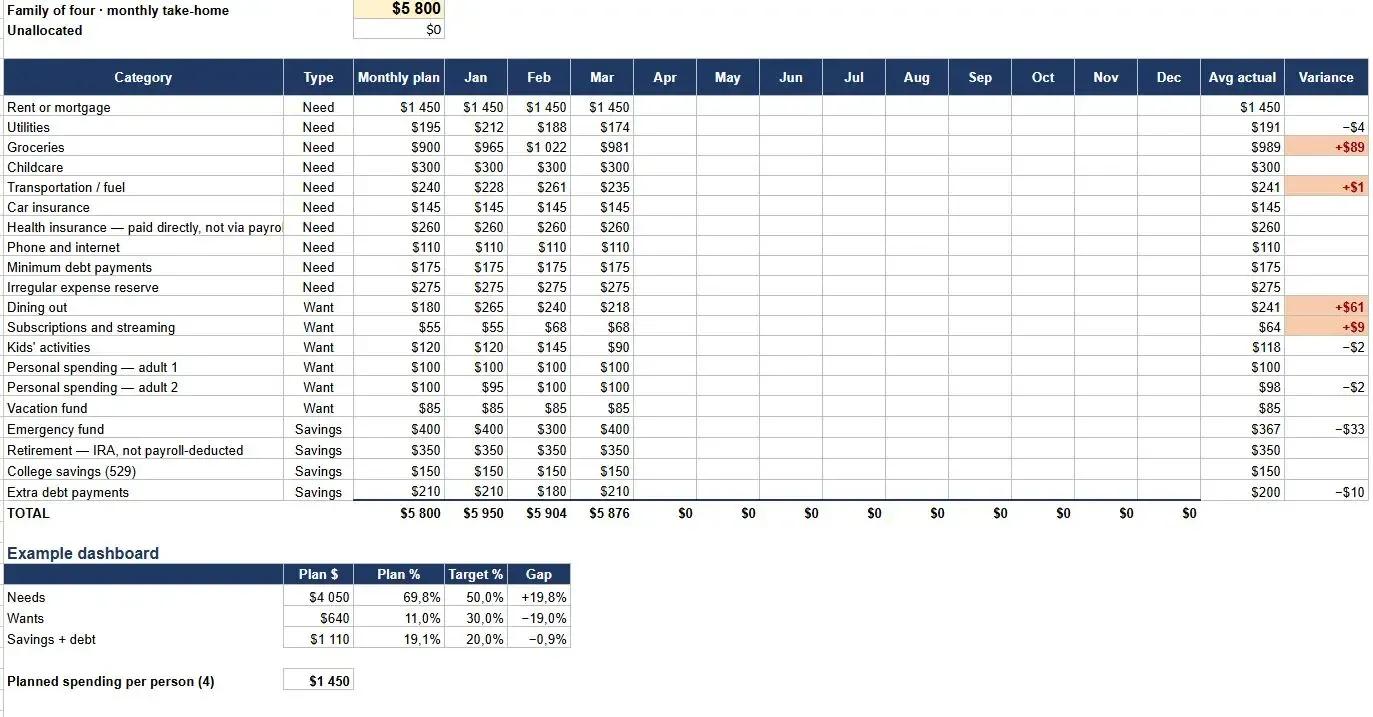
Free Family Budget Template for Excel and Google Sheets
A free household budget spreadsheet for families of three to five, with categories pre-filled and a separate tab that spreads yearly bills like insurance and registration across all twelve months. No email, no sign-up, works in Excel and Google Sheets.

Why Parent PLUS Loans Have Become a Hidden Retirement Crisis for American Parents
Parent PLUS loans can follow parents into retirement, reduce savings, and expose Social Security benefits to offset after default. Here is what near-retirement borrowers should know.