


Joint Account vs. Separate Accounts: When and How to Combine Them

Managing money as a couple is practical, emotional, and easy to overcomplicate. The account setup matters because it decides who sees the cash, who can move it, and who carries the risk.
The clean answer: use a joint account when money is truly shared, keep separate accounts when autonomy matters, and use a hybrid system when both are true.
What Is a Joint Bank Account? Key Features and How It Works
A joint bank account has two or more owners. Each owner has full access to the balance. Either person can deposit, withdraw, pay bills, or close the account under the bank’s account agreement.
In the U.S., many joint accounts use Joint Tenancy with Right of Survivorship. If one owner dies, the balance transfers to the surviving owner outside probate. Some accounts use Tenancy in Common, where the deceased owner’s share passes through the estate.
The trend is moving away from fully merged money. The U.S. Census Bureau reported that 77% of married couples with financial-institution assets held at least one joint account in 2023, down from 85% in 1996; the share with all accounts joint fell to 40%, and 23% had no joint accounts.
Benefits of a Joint Account for Couples
A joint account works best for shared obligations. Rent, mortgage payments, utilities, groceries, insurance, and family expenses all come from one place. That reduces transfers and missed payments.
It also creates transparency. Both partners see the same balance and the same transaction history. In practice, that cuts down on “I thought you paid it” problems.
Research supports the relationship side. In Common Cents, the Journal of Consumer Research found that married participants reported fully separate, partially merged, and fully merged accounts at different rates, and joint-account use was associated with stronger relationship quality.
Drawbacks and Risks of Joint Accounts
Full access cuts both ways. Either partner can withdraw the full balance without asking. During a breakup, proving who contributed what gets messy fast.
The larger risk is debt exposure. If one partner has unpaid judgments or account overdrafts, the joint account becomes easier to reach. I often see couples merge cash before they discuss old credit card balances, student loans, or tax debts. That is backwards.
If hidden debt is already part of the picture, treat it as a trust problem first. This guide on financial infidelity and hidden accounts is a useful next step before combining balances.
Legal Implications: Liability, Ownership, and Beneficiary Rules
Joint owners usually share responsibility for overdrafts and fees. The bank does not care which partner created the negative balance.
FDIC coverage also changes. For qualifying joint accounts, the FDIC insures each co-owner up to $250,000 per insured bank, per ownership category. That creates higher coverage for properly titled joint accounts, but it does not reduce access risk.
Beneficiary rules matter, too. Payable-on-death instructions help with estate planning, but survivorship rights on a joint account often control first. State law also matters. Community property states and tenancy-by-the-entirety states treat ownership and creditor claims differently.
What Are Separate Accounts? Financial Independence in a Relationship
Separate accounts keep ownership individual. Each partner controls their own money, sees their own transactions, and carries their own account-level liability.
This setup fits couples who value independence, entered the relationship with different debts, or need time before merging money. It also works for partners with different spending styles.
Benefits of Keeping Separate Accounts
Separate accounts protect autonomy. Each person keeps personal spending money without requesting approval for small purchases.
They also keep debt boundaries cleaner. Old credit card debt, student loans, or business expenses remain easier to track when the accounts stay separate. If a couple later separates, account ownership is clearer.
You still need communication. Separate does not mean secret. In a healthy system, partners can keep private spending room while sharing the numbers that affect joint goals.
Drawbacks: What You May Miss Out On
The tradeoff is coordination. Shared bills need transfers, reimbursements, or category splits. Without a system, one person becomes the unpaid household accountant.
Separate accounts also reduce visibility. If one partner quietly falls behind on payments or carries high balances, the other may not see the problem until it affects a mortgage application or shared plan.
How Separate Accounts Affect Credit Scores and Financial Goals
Checking and savings accounts do not appear on credit reports. The CFPB explains that credit reports focus on credit accounts, payment history, collections, and public-record information.
Joint credit products are different. A shared mortgage, auto loan, or credit card can affect both credit files. The bank account used to pay the bill matters less than whether the loan is paid on time.
For shared goals, lenders usually review income, assets, debt, and payment history. Separate accounts do not block a mortgage. Poor coordination does.
Joint Account vs. Separate Accounts: Side-by-Side Comparison
Key Differences at a Glance [Comparison Table]
| Parameter | Joint Account | Separate Accounts |
|---|---|---|
| Financial control | Full access for both owners | Each partner controls their own funds |
| Transparency | All activity is visible to both | Partner activity is not visible by default |
| Legal liability | Shared exposure to account fees and overdrafts | Liability stays tied to the individual account |
| Credit score impact | No direct impact from checking or savings | No direct impact from checking or savings |
| Ease of management | Easier for shared bills | Requires transfers or category rules |
| Risk at separation | Higher access risk | Cleaner ownership record |
| Best for | Shared bills, family cash flow, common goals | Autonomy, new relationships, different debts |
Which Model Fits Your Financial Situation?
A joint account fits shared cash flow. Separate accounts fit individual control. A hybrid setup fits most couples who need both.
Use the account structure to match the job. Do not force all money into one account just because the relationship is serious. Do not keep everything separate if you already share rent, childcare, and debt payoff.
When to Use a Joint Account: Scenarios and Life Stages
Newly Married Couples: Merging Finances
Marriage is still a common trigger, but it should not be the only one. Open a joint account when you have recurring shared obligations and both partners understand the access rules.
Start with bills, not every dollar. Put shared expenses into one account and keep personal accounts active until the system proves stable.
Long-Term Cohabiting Partners
Unmarried couples can open joint accounts, but the risk profile is different. There may be less legal structure around breakup, property division, and support obligations.
A joint account for rent and utilities makes sense when both partners contribute regularly. Keep a written agreement on what the account pays for and how you will close it if the relationship ends.
One-Income Households
A joint account can protect day-to-day access when one partner earns the income and the other manages caregiving, household work, or a career pause.
The risk is control. The non-earning partner should not have to ask for basic spending money. The cleaner setup is a joint operating account plus personal transfers for each partner.
Saving for a Shared Goal: Home, Vacation, Emergency Fund
A separate joint savings account works well for goals. Keep it away from daily checking. That makes progress visible and prevents grocery spending from mixing with house, vacation, or emergency savings.
If children are part of the plan, budget early. Childcare changes the math more than most couples expect, and this guide explains how budgets shift after a baby.
The Hybrid Approach: How to Combine Joint and Separate Accounts
What Is the 'Yours, Mine, and Ours' Method?
The hybrid model uses three buckets: yours, mine, and ours. Each partner keeps an individual account. Both fund a joint account for shared bills and goals.
This model is now mainstream. A Bankrate survey found that 38% of couples fully combine finances, 26% keep everything separate, and 36% use a hybrid setup; among Gen Z couples, 51% keep finances fully separate.
The appeal is simple. The joint account handles obligations. The separate accounts preserve autonomy.
Step-by-Step: How to Set Up a Combined Account System
Set the system before money moves.
- Open one joint checking account for shared bills.
- Keep individual checking accounts for personal spending.
- List shared expenses: housing, utilities, insurance, groceries, debt payments, savings goals.
- Choose a funding rule.
- Automate transfers after payday.
- Review the setup monthly until it feels boring.
A budgeting app helps only if the rules are clear. Bromoney’s app can help couples track cash flow without turning every purchase into a debate: iOS and Android.
How to Split Contributions: 50/50 vs. Proportional to Income
An equal split works when incomes are close and both partners have similar debt loads. It is simple and easy to audit.
A proportional split works better when one partner earns more. Each person contributes based on their share of household income, so the lower earner does not lose all discretionary cash. For the full math, see proportional income split methods.
Common Mistakes to Avoid When Combining Accounts
The most common mistake is merging money without rules. Define “shared” and “personal” before the account opens.
The second mistake is ignoring debt. Use a payoff plan before old balances start draining shared savings. A debt payoff calculator makes the tradeoff visible.
The third mistake is skipping legal planning. If assets, children, a business, or family support obligations are involved, discuss a prenup or financial agreement before conflict starts.
Choosing the Right Model: Decision Framework for Couples
Questions to Ask Before Deciding
Start with the uncomfortable questions. They reveal the account model.
Ask: Do we think of money as shared, individual, or both? What debts existed before the relationship? Who pays which bills today? What spending needs privacy? What goals require pooled savings?
Also ask what happens if income changes. Job loss, caregiving, illness, and parental support all change contribution fairness. If older relatives depend on you, elder care belongs in the budget conversation before the joint account absorbs everything.
Decision Flowchart: Joint, Separate, or Hybrid?
Use this practical rule.
Choose joint if most expenses are shared, both partners want full transparency, and debt risk is low.
Choose separate if the relationship is new, debt histories differ, or autonomy is the priority.
Choose hybrid if you share bills but still want personal spending room. In my work with household budgets, this is the setup that creates the least friction. It gives the couple one operating system without erasing individual control.
Frequently Asked Questions
Can unmarried couples open a joint bank account?
Yes. U.S. banks generally allow unmarried partners, relatives, or non-family members to open a joint account if they meet identification requirements. Each owner receives access under the bank’s account agreement.
What happens to a joint account if we break up?
Each owner usually has full access until the account is closed or restricted. The safest path is a written agreement, then closing the account and splitting the funds. If the breakup is hostile, speak with the bank and a qualified attorney before moving money.
Does a joint account affect my individual credit score?
No. A joint checking or savings account does not directly affect your credit score. Joint loans and credit cards can affect both partners because payment history reports to credit bureaus.
Can I have both a joint and a separate account at the same bank?
Yes. Many couples keep individual checking accounts and a joint checking account at the same bank. Linked transfers make the hybrid system easier to run.
Is the hybrid system better than fully joint accounts?
It depends on the couple. Fully joint accounts improve visibility and teamwork for some households. Hybrid accounts work better when both partners need shared bill pay and personal autonomy. The best system is the one both partners understand, fund, and review.
Sources used: U.S. Census Bureau, Bankrate, Journal of Consumer Research, Kellogg Insight, FDIC, and CFPB.

Denis Goncharenko
Head of Content
Editorial Policy: no secondary statistics. Every claim is linked to an official source and dated — datasets and methods are open for review.

Was this article helpful?
Same blogs

Saving Money on Groceries Is Not a Test of Willpower
Federal data shows six grocery categories moving at different rates, not one bill rising evenly. Why the national CPI, the CES spending survey, and USDA's own forecast are each the wrong number to budget against - and how to build your own monthly figure from 8 to 12 weeks of receipts instead.
Free Family Budget Template for Excel and Google Sheets
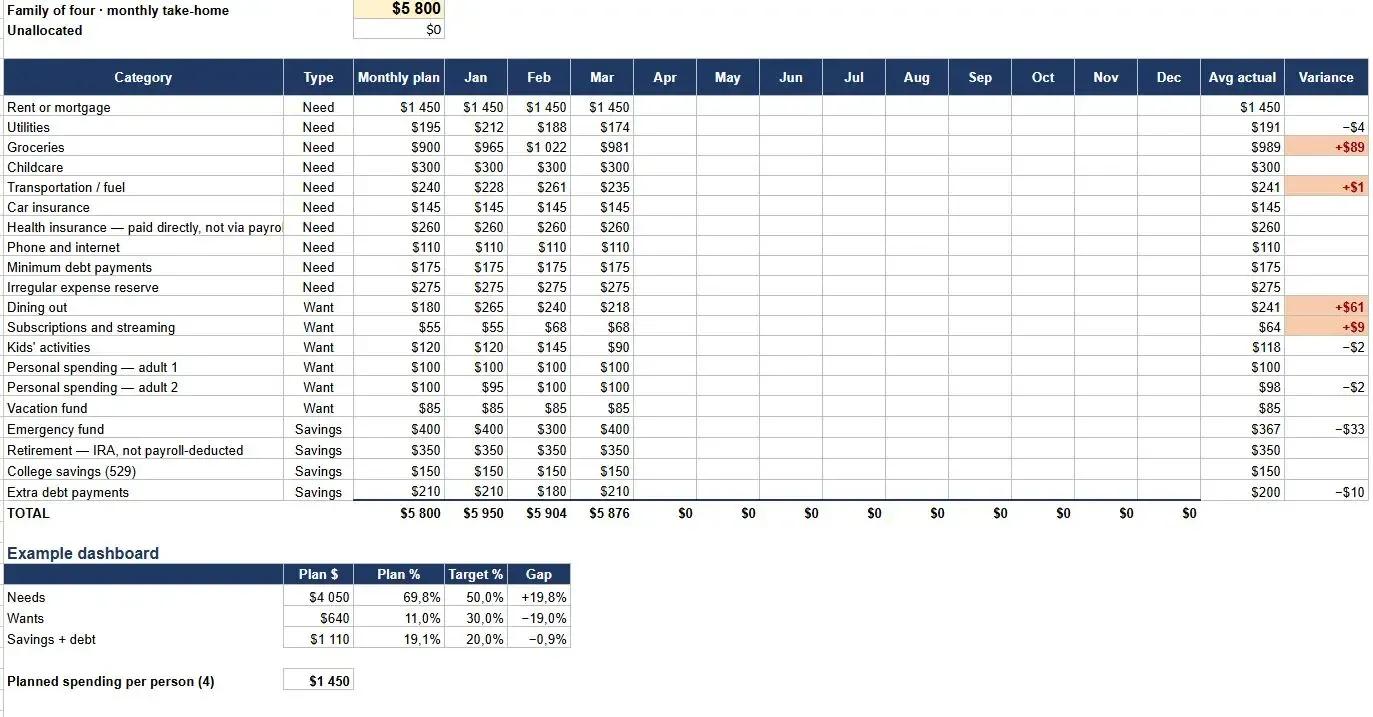
A free household budget spreadsheet for families of three to five, with categories pre-filled and a separate tab that spreads yearly bills like insurance and registration across all twelve months. No email, no sign-up, works in Excel and Google Sheets.

Why Parent PLUS Loans Have Become a Hidden Retirement Crisis for American Parents
Parent PLUS loans can follow parents into retirement, reduce savings, and expose Social Security benefits to offset after default. Here is what near-retirement borrowers should know.