


50/50 Split vs. Proportional Income Split: Which Method Is Fairer for Couples?
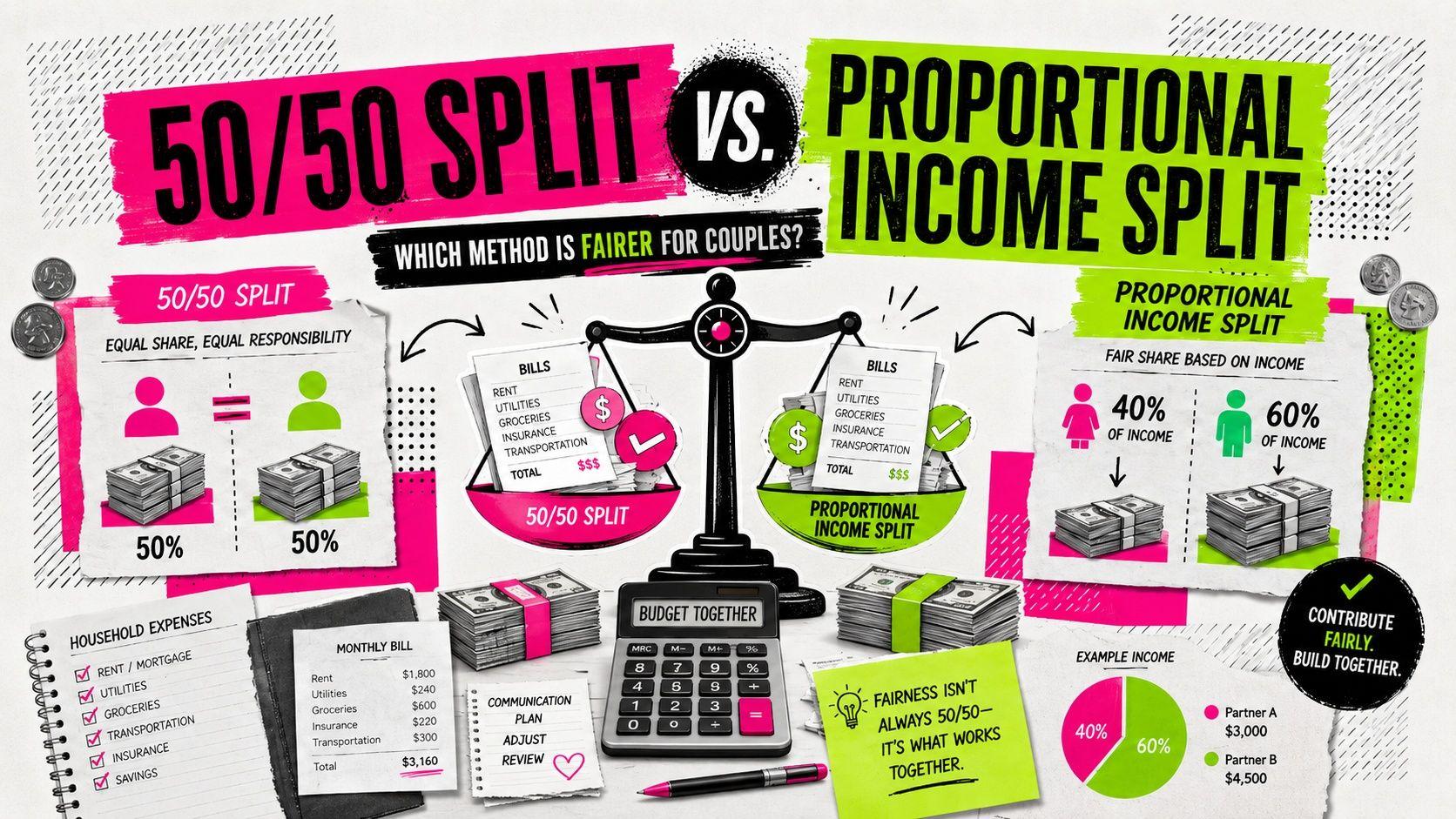
Choosing how to divide shared expenses is not just a math problem. It shapes stress, savings, autonomy, and power inside the relationship. A Fidelity study cited by Yahoo Finance found that 58% of couples do not contribute equally to household finances, and nearly 1 in 4 say the imbalance affects the relationship.
The clean answer: 50/50 works best when incomes are similar. Proportional splitting works better when incomes differ. In practice, many couples use a hybrid: one shared account for household bills, plus personal accounts for autonomy.
What Is the 50/50 Expense Split?
The 50/50 method means both partners pay the same dollar amount toward shared costs.
How the Equal Split Works
Most couples use it through a joint checking account. Each partner transfers the same amount every month. That account covers rent or mortgage, utilities, internet, groceries, and other shared bills.
Personal spending stays separate. Clothing, hobbies, individual medical bills, gifts, and personal debt payments usually stay on personal cards.
The appeal is obvious. Add the shared bills. Divide by two. Transfer your half.
Pros of Splitting Bills Equally
- Clear math. No percentage formulas or income tracking.
- Simple boundaries. Shared expenses stay shared. Personal expenses stay personal.
- Easy setup. It works well before couples start merging household finances.
- Strong fit for early cohabitation. It feels clean when partners still want financial independence.
Cons of the 50/50 Method (Especially With an Income Gap)
The problem starts when equal dollars create unequal pressure. If one partner earns far less, the same bill takes a larger share of that partner’s income.
That pressure matters. The Federal Reserve’s 2025 report on U.S. household economic well-being found that 34% of adults with family income under $25,000 could not pay all bills in the prior month, compared with 7% of adults with income of $100,000 or more.
A strict 50/50 split pushes the lower earner closer to that edge. Savings shrink first. Then retirement contributions. Then emergency cash.
What Is a Proportional Income Split?
A proportional split ties each partner’s contribution to income share. The higher earner pays more dollars, but both partners pay the same share of their income.
How to Calculate Your Proportional Contribution
Use this formula:
- Add both incomes.
- Divide each partner’s income by the combined income.
- Multiply shared expenses by each partner’s percentage.
This is the same structure described in 24/7 Wall St.’s overview of proportional contribution: total shared expenses first, then income shares, then transfers into the shared account.
Example: Proportional Split With Different Incomes
Partner A earns $5,000 per month. Partner B earns $3,000. Combined income is $8,000. Shared monthly expenses are $2,400.
- Partner A earns 62.5% of household income and pays $1,500.
- Partner B earns 37.5% of household income and pays $900.
Both partners contribute the same percentage of income. That is the key difference.
Pros of Income-Based Expense Splitting
Proportional splitting protects the lower earner’s cash flow. It leaves more room for savings, debt payoff, and personal spending.
It also scales better. If one partner gets a raise, loses a job, or goes back to school, the formula adjusts. The couple does not need to rebuild the whole budget.
This matters when one partner already carries debt. Before setting the split, discuss balances, minimum payments, and repayment plans. Hidden debt turns a fair formula into a trust problem, especially when couples are already addressing debt in relationships.
Cons of the Proportional Method
Proportional splitting requires income transparency. Bonuses, freelance income, commissions, and raises need rules.
The higher earner may also feel punished for earning more. That reaction is common. The fix is not to shame it. Define the system clearly: shared bills are shared, personal money remains personal, and lifestyle upgrades need joint consent.
50/50 vs. Proportional Split: Side-by-Side Comparison
| Criterion | 50/50 Split | Proportional Split |
|---|---|---|
| Calculation | Simple: divide shared bills in half | Requires income percentages |
| Best fit | Similar incomes, roommates, early cohabitation | Unequal incomes, long-term partners, career breaks |
| Fairness with equal incomes | Strong | Strong |
| Fairness with unequal incomes | Weak | Stronger |
| Income transparency | Limited | Required |
| Flexibility | Low when income changes | High when income changes |
| Main emotional benefit | Feels equal and clean | Feels fair and sustainable |
| Main conflict risk | Lower earner feels squeezed | Higher earner feels overcharged |
Neither model is morally superior. The right model fits the couple’s income gap, trust level, and goals.
When Does the 50/50 Split Make Sense?
The 50/50 split is not broken. It is just narrow.
Similar Incomes Between Partners
When partners earn similar amounts, 50/50 keeps the system clean. Both people feel they contribute equally. Neither partner needs to disclose every raise or bonus.
In my reviews of household budget setups, this works best when the shared lifestyle fits the lower earner without strain. If the lower earner has to use savings to keep up, the split is already failing.
Short-Term Living Arrangements and Roommates
For new couples living together, 50/50 creates a clean starting point. It also works for roommates because the arrangement is closer to a business agreement.
Rent, utilities, and internet split down the middle. Personal costs remain separate. If the living arrangement ends, there is less to unwind.
When Simplicity Matters More Than Equity
Some couples choose 50/50 because they want fewer money conversations. That is valid if both partners can afford it.
The warning sign is lifestyle creep. If the higher earner keeps choosing more expensive apartments, restaurants, or trips, 50/50 stops feeling neutral. The lower earner starts funding a lifestyle chosen by someone else.
When Does the Proportional Split Make More Sense?
Proportional splitting works better when income differences are part of daily life, not a temporary rounding error.
Significant Income Disparity Between Partners
When one partner earns more, equal bills create unequal pressure. Reuters put it plainly: “Fairness does not always imply equality.”
Reuters also described a couple that split a $5,600 monthly mortgage and utilities equally, while dividing other expenses by income. That hybrid model is practical. It keeps some bills simple and makes the rest fairer.
Long-Term Relationships and Financial Fairness
Long-term 50/50 can compound inequality. The lower earner saves less, invests less, and has less emergency cash. The higher earner keeps more flexibility.
Proportional splitting helps both partners keep financial resilience. That matters for the relationship too. A partner with no savings has less freedom and more stress.
When One Partner Is in School or Between Jobs
If one partner is in school, on leave, or between jobs, 50/50 usually does not work. It turns a temporary income gap into debt or resentment.
The better frame is shared investment. One partner may contribute less cash for a season. The other may carry more of the household cost. The agreement should still name the change, set a review date, and respect nonfinancial labor.
This same logic applies when couples start sharing childcare expenses or planning a leave after birth. If a baby changes income, hours, and unpaid labor, budgeting for a new baby should include a new split.
According to Bankrate’s 2026 couples finance survey, 38% of couples fully combine finances, while 62% keep at least some money separate. That makes hybrid systems normal, not unusual.
How to Have the Money Talk With Your Partner
The split method matters less than the conversation behind it. Most conflicts come from hidden assumptions.
Steps to Agree on a Splitting Method That Works for Both
Start with full visibility. Each partner shares income, fixed bills, debts, savings goals, and required personal expenses.
Define shared expenses. Rent, utilities, groceries, insurance, and shared subscriptions usually count. Personal debt, hobbies, clothing, and individual health costs usually do not.
Run both models. Calculate 50/50 and proportional contributions. Put the dollar difference in front of both partners. Concrete numbers reduce emotional guesswork.
Set a review rule. Revisit the split after a major raise, job loss, school enrollment, birth, caregiving change, or move. Do not wait for resentment to build.
Use “I” statements. Try: “I feel anxious when I cannot save after shared bills.” That works better than: “You make me pay too much.”
Tools and Apps for Tracking Shared Expenses
Use tools to reduce memory fights. The tool does not solve trust, but it keeps receipts clear.
Splitwise works well for equal, unequal, and percentage-based splits. Honeydue focuses on couple visibility and shared budgeting. YNAB works for couples who want a full budget system, not just reimbursement tracking.
If you prefer a broader planner, the Bromoney budget planner helps track income, expenses, and goals in one place. Keep the tool simple enough that both partners use it.
Frequently Asked Questions
Is it normal to split bills proportionally based on income?
Yes. It is common, especially when incomes differ. The Newsweek and Redfield & Wilton poll found that 40% of Gen Z adults said couples should split expenses by income, while 31% favored equal splitting.
What if one partner's income changes significantly?
Recalculate the split. A raise, layoff, career break, or bonus changes the household math. The clean rule: disclose the change, update percentages, and set the next review date.
Should couples split all expenses or only shared ones?
Split shared expenses only. Personal expenses should stay personal unless both partners agree otherwise. The boundary protects autonomy and prevents monitoring.
How do you calculate a proportional expense split step by step?
Add both incomes. Divide each income by the combined total. Multiply shared monthly expenses by each percentage. The result is each partner’s contribution.
Is a 50/50 split fair if incomes are very different?
Usually not. Equal dollars are not always fair dollars. If one partner earns much less, 50/50 takes a larger share of that partner’s financial life. Use a proportional split, or test your current contribution against debt and savings capacity with the Bromoney DTI calculator.

Denis Goncharenko
Head of Content
Editorial Policy: no secondary statistics. Every claim is linked to an official source and dated — datasets and methods are open for review.

Was this article helpful?
Same blogs
Why Car Insurance Went Up and What Actually Moves the Premium
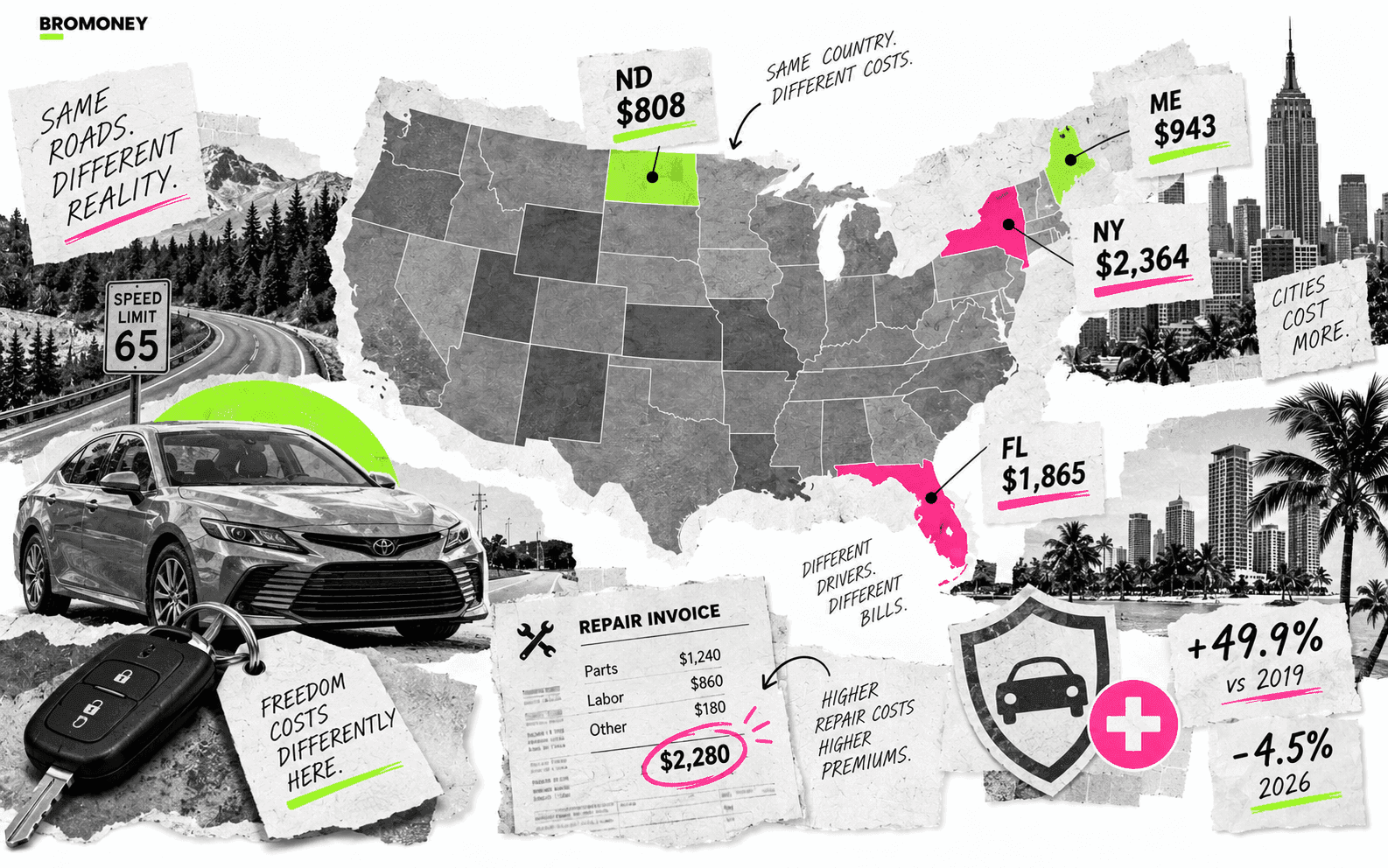
Car insurance spending rose 12.3 percent in 2024, one of only two costs BLS called statistically significant. NAIC's 2023 state averages, why rates are falling even as the level sits 49.9 percent above 2019, what actually drives claims costs, and which levers on your policy are worth checking.

Stop Blaming the Latte: Impulse Buying Isn't the Whole Budget Story
BLS data shows apparel and entertainment spending barely moved in 2024, while car insurance, housing and groceries rose - some by double digits. Why the numbers behind the top impulse-buying articles don't hold up, and a review method that starts with the bills, not the coffee.

Cost of Living by State: Prices, Rent and Wages
A 51-row table built from U.S. federal series (BEA, Census, HUD, EIA, DOL), not the private volunteer survey most rankings use. Housing costs vary six times more than goods across states, cheap states aren't always affordable, and minimum wage sits below a modelled living wage everywhere checked.