
What Is the "Lower Payment" Trap? How a Longer Term Can Cost More Interest
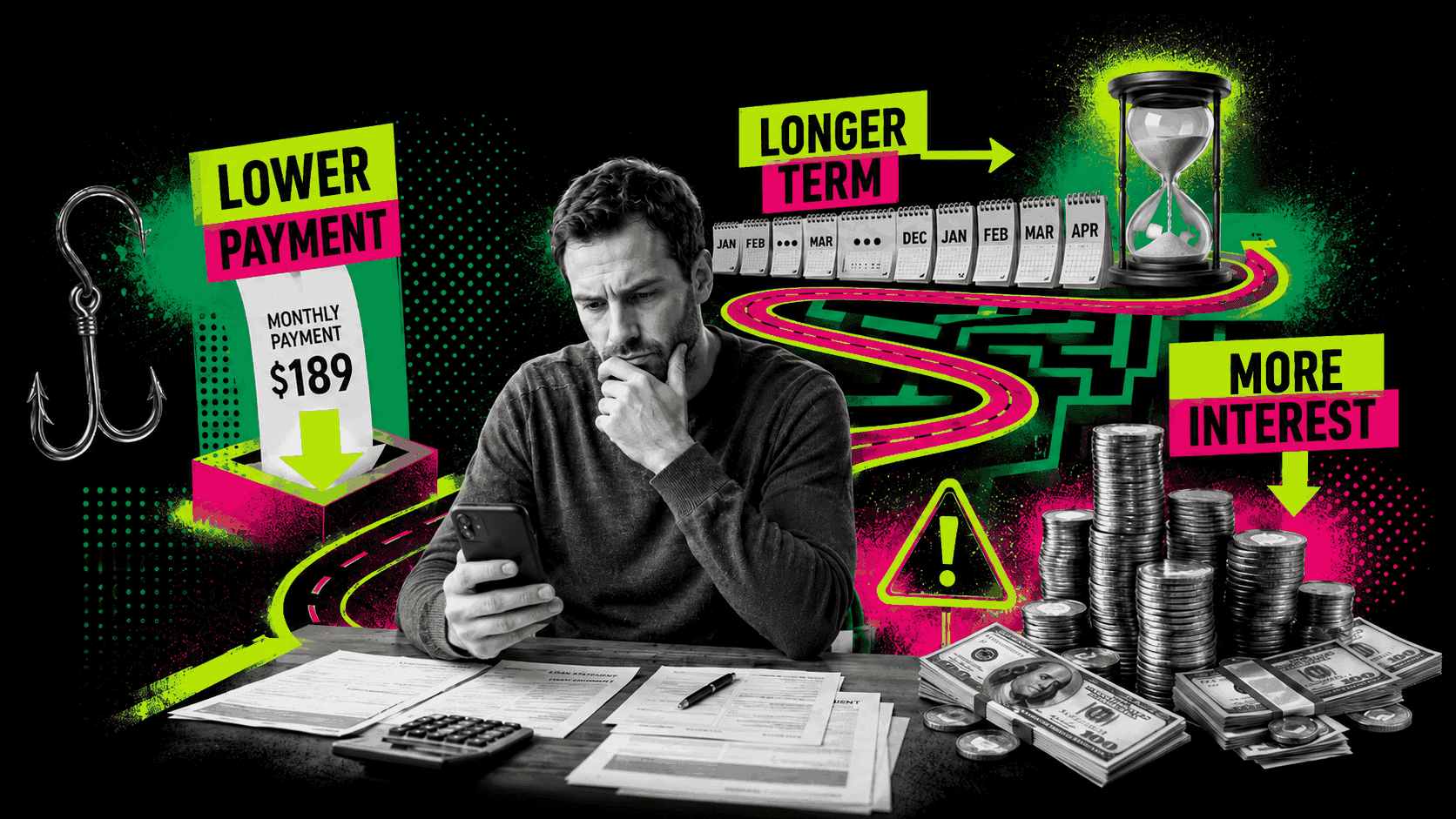
A lower monthly payment can feel like relief. It creates room in a strained budget and reduces the pressure of several credit card due dates. That relief is real. It is not always a saving.
Many debt consolidation offers lower the payment by extending the repayment term. The borrower pays less each month because the lender spreads the same balance across more months. Interest then has more time to accrue. The total cost often rises, even when the new rate is lower than the rate on the old debts. This is the lower payment trap. The payment looks friendlier, the payoff date moves farther away. And thus, the debt remains part of the household budget for years longer than expected.
Debt consolidation is not automatically a good or bad choice. It can simplify repayment and reduce the cost of expensive revolving debt. However, that consolidation does not erase debt and can leave a borrower paying more after debt is moved into a different loan.
The right comparison is not "Which offer has the smallest payment?" It is "Which offer costs less from the first payment through the final payment?"
Why a lower payment feels like a win
Monthly payments are easy to see – the total cost of a loan is harder to picture.
A lender may present a $250 payment beside a $500 credit card payment. The lower figure catches attention because it solves an immediate problem. The term that creates the lower figure may appear in smaller text.
A borrower facing a cash-flow emergency may need a lower payment to avoid missed rent, utility shutoffs, or new card borrowing. In that case, a longer term can serve a purpose. The borrower should still know the cost before signing.
The trouble starts when "affordable today" is presented as "cheaper overall." Those are different claims.
A simple example: same debt, four different outcomes
Consider a $15,000 unsecured consolidation loan at a fixed 14% APR. Assume there are no origination fees, no late payments, and every payment arrives on time.
A 36-month term produces a payment of $513. Total repayment equals $18,456. Interest costs $3,456.
A 60-month term lowers the payment to $349. Total repayment becomes $20,941. Interest costs $5,941.
An 84-month term lowers the payment to $281. Total repayment reaches $23,612. Interest costs $8,612.
A 120-month debt consolidation loan lowers the payment to $233. Total repayment rises to $27,948. Interest costs $12,948.
The 120-month payment is $280 lower than the 36-month payment. Yet the borrower pays $9,492 more in interest over the life of the loan. The balance also remains active for seven additional years.
The math does not require a higher rate to create a higher cost. Time alone creates it.
Expert tip: "I compare the final payment date before I compare the monthly payment. A lender who cuts the payment in half may simply be selling seven additional years of interest."
The loan term controls more than the payment
The repayment term changes the speed at which the principal balance falls.
At the start of a standard installment loan, interest is calculated on the outstanding principal. A longer schedule keeps that principal balance higher for more months. The first years may feel slow because a large share of each payment covers interest rather than reducing the amount owed.
That slower decline also increases exposure to disruption. A job loss, rent increase, medical bill, or car repair can arrive before the balance falls meaningfully. When old credit cards remain open, new charges can create two debts at once: the consolidation loan and fresh revolving balances.
That pattern deserves attention before signing. A consolidation loan reorganizes old debt. It does not change the spending gap or income shortfall that created it.
A lower payment only helps when the freed-up cash has a clear job. It might build a small emergency fund, cover a temporary income loss, or prevent further high-interest borrowing. Without a written purpose, the extra cash often disappears into routine spending.
APR matters, but it is not the whole story
A lower interest rate often supports consolidation. It does not guarantee savings.
APR includes the interest rate and certain loan fees. It gives a broader measure of the price of credit than the interest rate alone. Still, APR is only one part of the decision. The loan term determines how long the APR applies. A lower APR over 120 months can cost more than a higher APR over 36 months.
For this reason, debt consolidation loan payments should never be compared without the term and total repayment beside them.
A lender's disclosure should show the payment schedule, APR, finance charge, amount financed, and total of payments. The finance charge reflects the interest and certain charges paid across the life of the loan, assuming every scheduled payment is made.
The total of payments is the figure that cuts through a low-payment pitch.
Fees make the trap deeper
Origination fees can make a consolidation loan cost more than the payment table suggests.
A lender may approve a $15,000 loan but deduct a 6% fee before releasing funds. The borrower receives $14,100. If the goal is to pay $15,000 in card balances, the loan does not cover the full amount. The borrower must find the missing $900 or borrow a larger amount.
Borrowing more increases both the monthly payment and the total interest.
Some lenders add the fee to the loan balance instead. The borrower then pays interest on the fee as part of the principal.
This is why the advertised loan amount is not enough. Check the amount that reaches the bank account or creditors, the APR, the finance charge, and the total of payments.
Prepayment terms matter too. A borrower who selects a long term for safety may plan to pay extra each month. That plan works best when the loan permits extra principal payments without a penalty. Terms vary by lender and product.
Expert tip: "A long-term plan only works as a backup plan when the contract allows early payoff at no extra cost. Otherwise, the 'option' to pay faster may exist only in the sales pitch."
84 month debt consolidation loans: manageable payment, long exposure
84-month debt consolidation loans run for seven years. The term can make a large balance appear manageable. It also keeps the borrower exposed to interest and life changes for seven years.
An 84-month offer deserves a harder review when the debt being consolidated came from credit cards. Credit card balances often reflect a cash-flow problem, not one isolated purchase. A borrower who remains short every month can rebuild card debt while paying the new loan.
The seven-year term can also exceed the useful life of the expense that created the debt. A balance from travel, household purchases, or a past emergency may still be paid long after the benefit is gone.
A 10 year debt consolidation loan needs a specific purpose
A 10 year debt consolidation loan gives a borrower 120 monthly payments. The structure may help someone whose cash flow has suffered a temporary shock. It can also become a way to postpone an unaffordable debt decision.
Ten years is long enough for major changes in income, housing, family obligations, health, and employment. A loan that looks manageable at origination may not remain manageable halfway through the term.
Before accepting a 10-year term, calculate the payment required to finish in five or seven years. If that payment fits the budget, the long term can function as a safety net rather than the intended timeline.
The key question is simple: Is the long term a safety valve, or is it the only way the loan payment works?
If the contract payment is the only affordable payment, the household budget may remain too tight for consolidation.
A 15 year debt consolidation loan changes the nature of the debt
A 15 year debt consolidation loan is not a typical solution for unsecured credit card balances. It often appears when debt is secured by a home, refinanced through home equity, or bundled into another long-term credit structure.
The payment can look dramatically lower because the balance has 180 months to accrue interest. The lower payment should never hide the added risk of tying consumer debt to a home.
The CFPB warns borrowers considering cash-out refinancing for student debt that a lower rate can still raise the mortgage payment and put the home at risk if payments become difficult. The same reasoning applies when unsecured consumer debt becomes debt secured by a home.
A lower rate does not erase the risk created by collateral.
Long term debt consolidation loans can delay the finish line
Long-term debt consolidation loans often solve the wrong problem.
They solve the problem of a high monthly payment. They do not always solve the problem of total debt, unstable cash flow, or repeated card use.
A borrower who needs room in the budget should identify why. Was the debt caused by a one-time emergency? Is income expected to recover on a known date? Did a temporary expense end? Or does the household spend more than it earns each month?
The answer changes the right strategy.
A one-time emergency may justify a longer term followed by early repayment. A permanent monthly deficit calls for expense changes, income changes, hardship assistance, or nonprofit credit counseling. The CFPB notes that credit counseling organizations are usually nonprofits, while debt consolidation lenders and debt settlement companies are typically for-profit businesses that charge for services.
Borrowing more money to cover a persistent deficit does not create a payoff plan. It creates another due date.
How to compare two consolidation offers
Use the same starting balance for both offers. Then write down five numbers for each loan:
- Amount received after fees
- APR
- Monthly payment
- Number of payments
- Total of payments
Add one more line: the date of the final payment.
This comparison reveals the tradeoff immediately. A low payment often comes with a later finish line and a higher total cost.
Check whether the rate is fixed or variable. A variable rate can change future costs and may change the monthly payment or the length of repayment. The written contract matters more than a headline rate.
A safer way to use a long-term loan
A long-term debt consolidation loan can serve a limited purpose when the borrower treats the longer term as a contingency plan.
First, choose a payment that the budget can sustain during a difficult month. Second, set an automatic extra principal payment that targets a shorter payoff date. Third, keep paid-off credit cards out of routine use until the loan balance falls meaningfully. Fourth, build a cash buffer so the next car repair does not return to a credit card.
The lender's term is a ceiling, not a financial goal.
Frequently Asked Questions
Are 84 month debt consolidation loans bad?
Not automatically. They lower the required payment but often increase total interest and keep the borrower in debt for seven years. The loan fits only when the payment solves a real cash-flow need and a faster payoff plan is realistic.
Is a 10 year debt consolidation loan ever worth it?
It can be useful as a safety net after a temporary income shock. The total cost should be compared with shorter terms. A borrower should also confirm that extra principal payments are allowed without a prepayment penalty.
Why do long term debt consolidation loans have lower payments?
The lender spreads the principal across more months. Each payment is smaller, but interest accrues for longer. The lower payment is not proof that the loan costs less.
What should be checked before accepting debt consolidation loan payments?
Check the APR, fees, payment amount, number of payments, final payment date, total of payments, and whether the loan permits penalty-free early repayment. The full comparison shows whether the loan reduces debt cost or only stretches the debt out.

Denis Goncharenko
Head of Content
Editorial Policy: no secondary statistics. Every claim is linked to an official source and dated — datasets and methods are open for review.

Was this article helpful?
Same blogs
What Average Household Expenses Show About Price Pressure - and What They Can't
The average US consumer unit spent $78,535 in 2024 - about $6,545 a month. This page sets that spending record against the price indexes for the same two years, category by category, using our own CE-CPI crosswalk, and states plainly what the figures cannot show.
Why Car Insurance Went Up and What Actually Moves the Premium
Car insurance spending rose 12.3 percent in 2024, one of only two costs BLS called statistically significant. NAIC's 2023 state averages, why rates are falling even as the level sits 49.9 percent above 2019, what actually drives claims costs, and which levers on your policy are worth checking.
Stop Blaming the Latte: Impulse Buying Isn't the Whole Budget Story
BLS data shows apparel and entertainment spending barely moved in 2024, while car insurance, housing and groceries rose - some by double digits. Why the numbers behind the top impulse-buying articles don't hold up, and a review method that starts with the bills, not the coffee.