
The Origins of 'Your Money or Your Life': How Dominguez and Robin Created a Financial Independence Classic

Overview: What Is the 'Your Money or Your Life' Method?
"Your Money or Your Life" is a nine-step program for achieving financial independence by treating money not as an end goal, but as a direct representation of the time and energy you trade for it. The method reframes every dollar you spend as hours of your life – and asks whether that exchange was worth it.
At its core, the program guides you from financial confusion to what its creators call the Crossover Point: the moment when income from investments permanently exceeds your monthly expenses. Once you reach it, paid employment becomes a choice, not a necessity.
Core Philosophy: Money as Life Energy
The method's philosophical foundation rests on a single reframing: money equals life energy. Joe Dominguez and Vicki Robin defined this directly in the book: "Money is something we choose to trade our life energy for."
This isn't metaphor. It's a calculation. Before you evaluate any purchase, you first determine your real hourly wage – your actual take-home pay after subtracting every dollar and hour that work costs you: commuting time, work clothes, stress-recovery entertainment, the coffee you need to function at 8 a.m. That number is almost always lower than your nominal salary, sometimes dramatically so.
Once you know your real hourly wage, every price tag converts into hours of life. A $200 dinner isn't $200 – it's 14 hours of your life if your real wage is $14/hour. That reframe changes behavior more reliably than any budget spreadsheet. In our experience working with clients on financial planning, this single shift in perspective – from dollars to hours – produces faster behavioral change than any rule-based budgeting system.
"The key insight of the book is that money represents your life energy – the hours and vitality you exchange for a paycheck. Once you see it that way, every spending decision becomes a question of whether it's worth the life you're trading." – Vicki Robin, vickirobin.com
The philosophy connects directly to what the book calls "enough" – the point on the Fulfillment Curve where additional spending stops increasing satisfaction. Beyond "enough," more consumption actually reduces well-being. This concept predates behavioral economics research on diminishing marginal utility, but it maps onto it precisely. A 2023 study in the Journal of Consumer Culture found that FIRE practitioners explicitly sought "time affluence" over material accumulation – trading consumption for freedom. That's the Fulfillment Curve operating at scale.
The Nine-Step Program at a Glance
| Step | Name | Core Action | Key Tool |
|---|---|---|---|
| 1 | Making Peace with the Past | Calculate your total lifetime earnings; assess current net worth | Personal balance sheet |
| 2 | Being in the Present | Track every cent of income and spending; calculate your real hourly wage | Expense tracker |
| 3 | Where Is It All Going? | Categorize all monthly spending to see exactly where money flows | Monthly spending table |
| 4 | Three Questions | Evaluate each spending category against your values and level of fulfillment | Critical self-reflection |
| 5 | Making Life Energy Visible | Plot monthly income and expenses on a graph to visualize progress | The Wall Chart |
| 6 | Valuing Your Life Energy | Minimize spending in categories that don't bring fulfillment | Mindful frugality |
| 7 | Valuing Your Life Energy on the Job | Maximize income by treating work as a means to FI, not an identity | Marketability audit |
| 8 | Capital and the Crossover Point | Calculate when investment income will exceed expenses | Wall Chart projection |
| 9 | Managing Your Finances | Build a portfolio that generates stable passive income | Long-term index investing |
The nine steps work as a system, not a checklist. Steps 1-4 build financial self-awareness. Steps 5-7 create behavioral change. Steps 8-9 convert that change into lasting financial independence. Skipping early steps and jumping straight to investing – a pattern that surfaces repeatedly in our client work – produces fragile results because the behavioral foundation isn't there.
Historical Background: How the Method Was Born
Joe Dominguez: From Wall Street to Financial Freedom (1960s-1970s)
Early Career and the Decision to Retire at 31
Joe Dominguez grew up in Harlem, the son of immigrants. He worked from adolescence, eventually building a career as a bond analyst on Wall Street. By 1969, at age 31, he had accumulated roughly $70,000 – invested entirely in long-term U.S. Treasury securities – and retired permanently. He never accepted paid employment again. All royalties and seminar revenues were directed to the New Road Map Foundation, the nonprofit he co-founded with Vicki Robin. He died of lymphoma in January 1997, at age 58.
The New York Times captured it plainly in his 1997 obituary: "After growing up in Harlem, he went on to earn a plump salary as a stock analyst on Wall Street, but retired at age 31 with a nest egg of about $70,000, which he invested in U.S. Treasury securities." – The New York Times, January 27, 1997
At prevailing Treasury yields of 7-9% in the late 1960s, $70,000 generated roughly $4,900-$6,300 annually. Dominguez lived on that. Not because he had to – because he decided that was enough. He wasn't optimizing for wealth accumulation. He was optimizing for freedom.
That decision – made in 1969, decades before the term "FIRE" existed – is the biographical origin of the entire method. Everything that followed was an attempt to explain how he got there and how others could replicate it.
Development of the Life Energy Concept
The "life energy" concept didn't emerge from academic theory. There's no single documented moment of intellectual revelation in the archives. It developed gradually from Dominguez's lived experience of trading Wall Street hours for a salary he didn't need to spend.
The core logic is direct: if money represents the hours you sell to earn it, then spending money is spending time. Spending time is spending life. That chain of equivalence – money → time → life – became the conceptual backbone of everything he later taught.
The idea was refined through practice, not publication. Through the 1970s and early 1980s, Dominguez tested it in seminars, adjusted it based on participant feedback, and formalized it into the nine-step structure. The 1992 book was the written crystallization of a method already stress-tested on thousands of people. Additional documentation of this evolution appears in Vicki Robin's historical account at vickirobin.com/history/ and in archival materials from the New Road Map Foundation.
Vicki Robin's Role: Collaboration and Systematization
How Robin and Dominguez Began Working Together
Vicki Robin encountered Dominguez's ideas in the late 1970s. She followed his approach, achieved her own financial independence, and began collaborating with him on seminars. Their partnership formalized around 1980, with the New Road Map Foundation incorporated as a nonprofit in 1984.
Robin brought something Dominguez lacked: the ability to translate a deeply personal system into a teachable, scalable framework. Where Dominguez was the practitioner – the man who had actually done it – Robin was the communicator who could make his experience legible to a mass audience.
Transforming a Personal Practice into a Teachable Method
The transformation from personal practice to published method required two things: structure and language. Robin provided both.
She organized Dominguez's intuitive nine-step process into a coherent sequence with clear deliverables at each stage. She also adapted the vocabulary – "life energy," "real hourly wage," "Crossover Point," "Wall Chart" – into terms that resonated with people who had never thought about money in these terms.
As Robin describes it on her official site: "This is the history of Your Money or Your Life, the NY Times bestseller, that the LA Times called the 'new morality of money' and Oprah called a book 'that can really change your life.'" – vickirobin.com
The seminars were the laboratory. The book was the result.
From Workshops to Published Classic: The Road to 1992
Audio Cassette Courses and Early Seminars (1970s-1980s)
| Period | Milestone |
|---|---|
| 1969 | Joe Dominguez retires at 31 from Wall Street with ~$70,000 in Treasury securities |
| Late 1970s | Dominguez begins sharing his approach informally; Robin adopts the method and achieves FI |
| Early 1980s | Joint seminars launch in Seattle: "Transforming Your Relationship With Money and Achieving Financial Independence" |
| 1984 | New Road Map Foundation incorporated as a nonprofit to manage seminar revenues |
| 1986 | Audio cassette course released, based on seminar content; distributed by mail with pay-what-you-want model |
| Late 1980s | Program spreads across North America; estimated several thousand participants |
| 1992 | Your Money or Your Life published by Viking Press |
The cassette course deserves particular attention. Before podcasts, YouTube, or online courses existed, Dominguez and Robin distributed their program on audio cassettes sent by mail. Listeners paid what they could. All proceeds went to the New Road Map Foundation. This wasn't a business – it was a mission.
That distribution model also functioned as a feedback loop. People who completed the cassette program wrote back. Their questions, struggles, and breakthroughs shaped the nine steps into the version that eventually appeared in print. By the time Viking Press published the book in 1992, the program had been refined through a decade of real-world use – a fact that distinguishes it from most financial self-help titles, which go from manuscript to market without that kind of iterative testing.
The 1992 Publication: Reception and Initial Impact
Viking Press published Your Money or Your Life in 1992. The book didn't launch with major critical fanfare from The Wall Street Journal or a front-page New York Times review. Its rise was driven by readers, not critics.
The timing was not accidental. The U.S. was emerging from the 1990-1991 recession. Unemployment had peaked at 7.8% in mid-1992. The cultural conversation around "downsizing," debt, and the hollowness of consumerism was already building. Books like Voluntary Simplicity by Duane Elgin had primed the audience.
Your Money or Your Life landed in that context and gave readers a practical system to act on what they were already feeling. The book became a New York Times bestseller. The Los Angeles Times called it "the new morality of money." Total sales eventually exceeded 1.5 million copies across all editions. – vickirobin.com
Growing Influence Through Word-of-Mouth
The book's growth followed a pattern that predates social media virality: a person reads it, changes behavior, tells everyone they know. Financial counselors began recommending it. Support groups formed around the nine-step program. Community workshops appeared across the country.
The appearance of Vicki Robin and Joe Dominguez on Oprah Winfrey's show in the mid-1990s accelerated everything. Oprah called it "a book that can really change your life." That single endorsement moved the book from niche financial independence circles into mainstream American households.
PBS reinforced the message. Their documentary project Affluenza featured Robin and Dominguez as central voices connecting personal finance to consumer culture and environmental impact – a framing that distinguished their work from every other money book on the shelf at the time.
Evolution of the Method: 1992 to the Present
Joe Dominguez's Legacy After His Passing (1997)
Joe Dominguez died on January 11, 1997, of lymphoma at his Seattle home. He was 58. The Seattle Times reported: "New Road Map Foundation, the group that receives royalties from Mr. Dominguez's work and strives to reduce consumer consumption." – The Seattle Times, January 1997
His death didn't interrupt the work. The New Road Map Foundation continued operating, directing book royalties toward sustainable living and financial literacy projects. Vicki Robin became the sole public representative of the method – the person who gave interviews, spoke at conferences, and carried the nine steps forward.
In retrospect, Dominguez's personal story acquired additional weight after his death. A man who spent his career arguing that time is more valuable than money died at 58, having spent 27 years doing exactly what he believed in. That consistency between philosophy and biography is rare. It's part of why the method retains credibility that purely theoretical financial advice doesn't. In interviews on PBS, he and Robin spoke directly about understanding "how much life you're trading for consumption" – and his illness made that question sharper than any financial model could.
The 2008 Updated Edition: Adapting to the Digital Age
The 2008 edition, updated by Robin with financial planner Mark Zaifman, kept the nine-step structure intact but addressed the method's most criticized component: its investment recommendations.
The original 1992 edition recommended investing primarily in long-term U.S. Treasury bonds – a reasonable strategy when yields ran 7-9%. By 2008, that world no longer existed. The updated edition shifted the investment guidance toward diversified, low-cost index funds, acknowledged that Treasury-only portfolios carried concentration risk in a low-yield environment, and updated all financial examples from early-1990s figures to mid-2000s context.
The 2008 financial crisis provided unintentional validation for the book's core philosophy. People who had been following the nine steps – tracking spending, eliminating debt, building savings – entered the crisis in far stronger financial positions than those who hadn't. The method's emphasis on low expenses and financial resilience proved its value precisely when the conventional financial system failed.
Digital tools also received mention: online banking, internet price comparison, and web-based expense tracking appeared in the updated text. The philosophy remained identical. The implementation tools evolved. This pattern – stable philosophy, updated instruments – is exactly how the method has sustained relevance across three decades of market cycles.
'Your Money or Your Life' and the Rise of the FIRE Movement
The book's connection to the FIRE movement (Financial Independence, Retire Early) is direct and documented. The 2018 edition of Your Money or Your Life includes a foreword by Pete Adeney – Mr. Money Mustache – one of the most influential figures in FIRE. Adeney has stated publicly that reading the book in 1999 "opened his eyes" to the idea that work is not a lifetime obligation.
Brandon (Mad Fientist), Kristy Shen and Bryce Leung (Millennial Revolution), and other prominent FIRE voices regularly cite the book's methodology – particularly the real hourly wage calculation – as foundational to their own frameworks. The r/financialindependence community on Reddit describes it as one of the "original texts" of the movement.
The conceptual overlap is precise. FIRE's core metrics – saving 50-75% of income, targeting a portfolio 25 times annual expenses, withdrawing at roughly 4% annually – map directly onto the Crossover Point framework Dominguez and Robin described in 1992. FIRE didn't invent these ideas. It popularized them.
According to a 2024 analysis in the Journal of Financial Planning, practitioners following this methodology demonstrate savings rates of 50-70% and a strong preference for low-cost index funds – behavioral patterns directly traceable to the book's influence.
Key Concepts That Shaped the Method's Legacy
Real Hourly Wage: Calculating the True Cost of Your Job
The real hourly wage calculation is the method's most practically disruptive tool. It works like this:
Formula:
(Monthly income - All work-related expenses) ÷ (Monthly working hours + All work-related time costs)
Work-related expenses to subtract:
- Transportation (gas, transit, car maintenance)
- Work clothing and dry cleaning
- Meals purchased at or near work
- Decompression spending after work (entertainment, stress-relief purchases)
- Childcare costs incurred specifically because of work hours
- Portion of vacation costs attributable to recovery from job stress
Work-related time to add:
- Commuting time, both directions
- Time spent preparing for work each morning
- Unpaid overtime
- Job-related training and networking outside work hours
A nominal salary of $25/hour frequently produces a real hourly wage of $10-$12 after this calculation. That gap – between what you think you earn and what you actually earn per hour of life traded – is the core insight. It makes the "life energy" framing concrete rather than philosophical.
This calculation surfaces in client work repeatedly. The reaction is almost always the same: surprise, then recalibration. The $80 dinner that seemed reasonable at $25/hour suddenly represents 8 hours of actual life at a real wage of $10. That shift in perspective changes spending decisions more durably than any budget rule. If you want to model how reducing work-related expenses accelerates your path to financial independence, the debt payoff calculator at Bromoney provides a practical starting point for that kind of financial mapping.
The Fulfillment Curve and 'Enough'
The Fulfillment Curve plots spending against life satisfaction. In the method's framework, satisfaction rises with spending up to a point – survival needs, then comfort, then some luxuries. But beyond a certain threshold, labeled "Enough," additional spending produces no additional satisfaction. Past that point, the curve declines: more stuff creates more maintenance, more stress, more complexity.
Research in behavioral economics supports this pattern. The 2023 study in the Journal of Consumer Culture characterizing FIRE adherents as a subculture found that participants explicitly sought "time affluence" over material accumulation – trading consumption for freedom. That's the Fulfillment Curve operating at scale.
The practical implication: you don't need to maximize income. You need to identify your personal "Enough" and stop there. Everything earned beyond "Enough" becomes savings, which becomes the capital that funds the Crossover Point. This is a fundamentally different frame than conventional financial planning, which treats higher income as an unconditional good.
Tracking Every Dollar: The Wall Chart System
The Wall Chart is the method's central accountability tool. It's a physical graph – originally meant to hang on a wall where you'd see it daily – with months on the horizontal axis and dollar amounts on the vertical.
Each month, you plot three lines:
- Total monthly income
- Total monthly expenses
- Monthly investment income (calculated from current capital × expected annual yield ÷ 12)
The goal is visual and unmistakable: watch the investment income line rise month by month until it crosses the expense line. That intersection – the Crossover Point – is financial independence.
The Wall Chart works because it makes abstract progress concrete and visible. Members of online communities including r/financialindependence have documented using the chart for years, describing it as a source of motivation during the long middle phase of the FI journey when progress feels slow. The Bromoney budget planner – available on Google Play and the App Store – supports this kind of long-term expense and income tracking for households building toward their own Crossover Point.
Influence and Cultural Impact
Impact on the Modern Personal Finance Landscape
The book's influence on personal finance is structural, not decorative. It introduced a vocabulary – life energy, real hourly wage, Crossover Point, Enough – that now appears routinely in financial planning content, FIRE blogs, and mainstream media coverage of retirement.
More significantly, it shifted the central question of personal finance. Before Your Money or Your Life, the dominant question was: "How do I accumulate more?" The book replaced it with: "How much is enough, and what am I trading to get there?" That reframe reshaped the entire conversation.
"The method of Dominguez and Robin fundamentally altered personal finance by introducing the concept of 'enough' and reframing financial independence as a question of life values rather than wealth maximization." – Sociological analysis, Journal of Consumer Culture, 2023
A 2024 economic analysis in the Journal of Financial Planning confirmed that practitioners following this methodology sustain savings rates of 50-70% and demonstrate strong preference for low-cost index investing – behavioral patterns directly traceable to the book's framework.
Research published in MDPI Sustainability (2020) on voluntary simplicity explicitly cites the book as a central text of the movement, noting that its adherents "more frequently choose sustainable consumption, local goods, and reduced dependence on fossil fuels." – MDPI, 2020
Connections to Early Retirement Extreme and Mr. Money Mustache
Pete Adeney (Mr. Money Mustache) has been explicit about the book's influence. He read it in 1999 and credits it with establishing the philosophical foundation for his early retirement at 30. His foreword to the 2018 edition makes the lineage direct and public.
The connection to Jacob Lund Fisker (Early Retirement Extreme) is less straightforward. Fisker built a more analytical, systems-theory-based framework for early retirement, and his primary text doesn't cite Your Money or Your Life as a foundational source. His approach overlaps significantly with the method's emphasis on low expenses and financial independence, but the intellectual genealogy runs through different channels – closer to engineering and systems thinking than to the voluntary simplicity tradition.
The distinction matters: Dominguez and Robin's method is rooted in values clarification and behavioral change. Fisker's system is rooted in optimization and systems design. Both reach similar conclusions about frugality and independence, but through different routes.
Academic and Media Recognition
Academic recognition of the book has been indirect but substantial. The book doesn't appear frequently in economics journals by name, but the movements it catalyzed – voluntary simplicity, FIRE, anti-consumerism – are subjects of serious scholarly attention.
A sociological analysis published in the Journal of Consumer Research characterized the book as foundational to what researchers call the "time affluence" subculture – people who trade income for autonomy rather than consumption. – Journals of Sage Publications
Media recognition peaked in the 1990s with the Oprah appearance, the LA Times "new morality of money" characterization, and the PBS Affluenza documentary. The book has maintained steady presence in "best personal finance books" lists through 2024 and 2025, appearing alongside modern titles in retirement and FIRE reading guides from MoneyTalksNews, White Coat Investor, and Banker on Wheels.
FAQ: Common Questions About the History of the Method
Who originally created the 'Your Money or Your Life' method?
Joe Dominguez created the original nine-step program based on his personal experience retiring at 31 from Wall Street in 1969. Vicki Robin co-developed and systematized the method through their collaboration beginning around 1980, co-authoring the 1992 book. The New Road Map Foundation, which they co-founded, administered the program's nonprofit infrastructure.
When was the book first published, and how many editions exist?
The first edition was published in 1992 by Viking Press. A revised edition appeared in 2008, updated by Robin with financial planner Mark Zaifman to address changes in investment strategy and add digital-age context. A third edition was published in 2018, featuring a foreword by Pete Adeney (Mr. Money Mustache). The 2018 edition is the current standard version, with total sales across all editions exceeding 1.5 million copies.
Is the method still relevant today?
The core philosophy – money as life energy, tracking real hourly wage, targeting a Crossover Point – remains fully applicable. The nine-step structure requires no modification.
The investment guidance from the 1992 edition is outdated. The original recommendation to hold long-term Treasury bonds exclusively made sense when yields ran 7-9%. Current practice, reflected in both the 2008 update and modern FIRE literature, points toward diversified portfolios of low-cost index funds.
Sociological research from 2023 and economic analysis from 2024 both confirm that practitioners following the method's behavioral framework achieve measurable results: high savings rates, debt elimination, and progress toward financial independence. The philosophy ages well. The specific instruments need updating.
For households working through debt before building toward independence, the Bromoney debt payoff calculator offers a practical starting point for the kind of financial mapping the method requires.
How does this method differ from other personal finance approaches?
Most personal finance frameworks focus on wealth maximization: earn more, invest more, optimize returns. Your Money or Your Life asks a prior question: What is enough, and is your current life trajectory worth what you're trading for it?
The method doesn't prescribe a savings rate or a target net worth. It asks you to calculate your real hourly wage, track your spending against your values, and find your personal "Enough." The Crossover Point emerges from that process – it's not a number you set in advance, it's a threshold you discover by understanding your own spending.
This distinguishes it from household expense categorization approaches like the envelope budgeting system, which focus on allocation mechanics, and from traditional financial planning, which focuses on portfolio optimization. The Dominguez-Robin method treats financial behavior as downstream of values – and addresses the values first.
Summary: Why This Method's History Matters for Your Financial Journey
The history of Your Money or Your Life is not biographical trivia. It's the explanation for why the method works the way it does.
Dominguez didn't build a system for financial advisors to sell. He built a system to explain how he personally escaped the work-spend cycle – starting from Harlem, ending on Wall Street, and choosing to leave at 31 with $70,000 and a philosophy. Robin didn't market a product. She translated a lived practice into a teachable framework and spent decades refining it based on real results from real people.
That origin – empirical, non-commercial, rooted in actual financial independence rather than theory – is why the nine steps hold up across three decades of market cycles, two major financial crises, and a complete transformation of the investment landscape.
The investment tools change. The specific numbers change. The core questions don't: What is your life energy worth? What are you trading it for? Is it enough?
Those questions were worth asking in 1969 when Dominguez walked away from Wall Street. They're worth asking in 2026 – whether you're tracking expenses for the first time, calculating your real hourly wage, or plotting your Crossover Point on a chart that hangs where you'll see it every morning.
For readers exploring how these principles connect to practical cash-flow management, the guides on modern digital budgeting apps and the emotional connection to physical money offer useful context for applying the method's behavioral framework to everyday spending decisions.

Denis Goncharenko
Head of Content
Editorial Policy: no secondary statistics. Every claim is linked to an official source and dated — datasets and methods are open for review.

Was this article helpful?
Same blogs

Saving Money on Groceries Is Not a Test of Willpower
Federal data shows six grocery categories moving at different rates, not one bill rising evenly. Why the national CPI, the CES spending survey, and USDA's own forecast are each the wrong number to budget against - and how to build your own monthly figure from 8 to 12 weeks of receipts instead.
Free Family Budget Template for Excel and Google Sheets
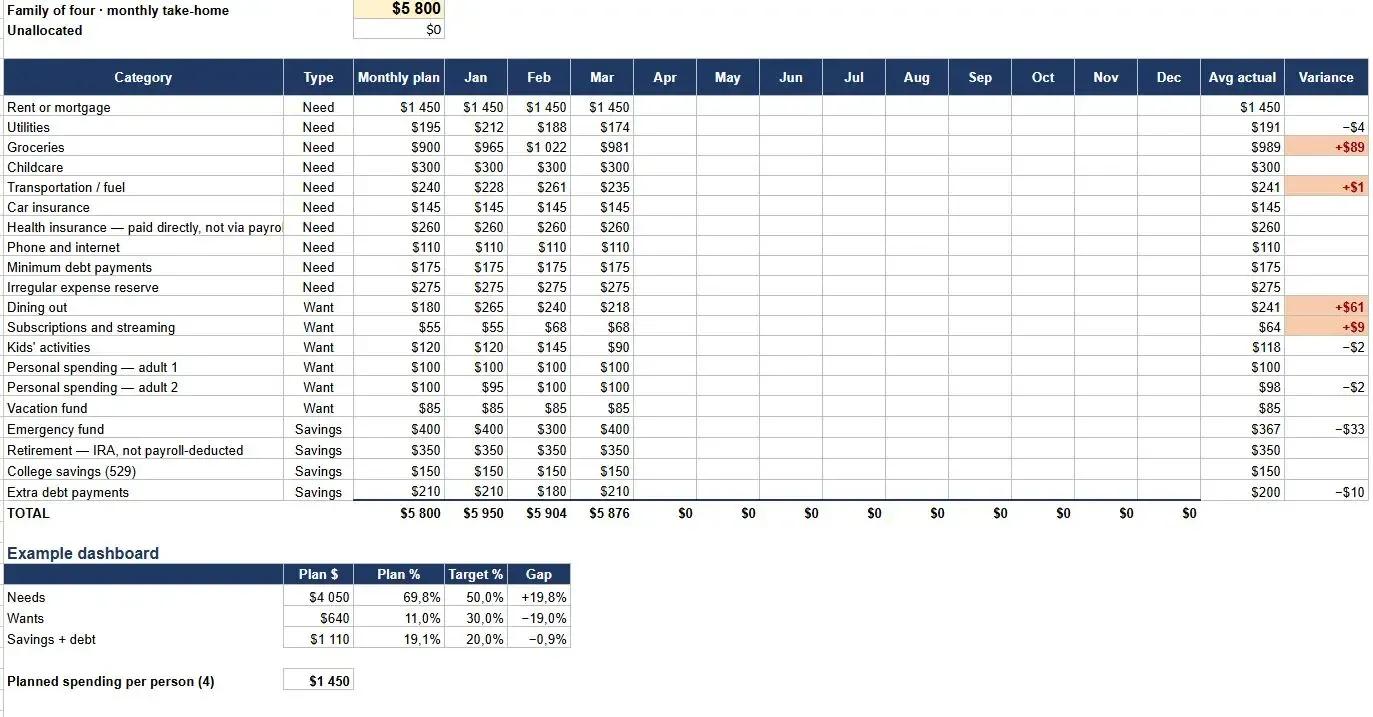
A free household budget spreadsheet for families of three to five, with categories pre-filled and a separate tab that spreads yearly bills like insurance and registration across all twelve months. No email, no sign-up, works in Excel and Google Sheets.
Why Parent PLUS Loans Have Become a Hidden Retirement Crisis for American Parents
Parent PLUS loans can follow parents into retirement, reduce savings, and expose Social Security benefits to offset after default. Here is what near-retirement borrowers should know.