


Bank Branch Closures by State: Where Access Shrunk Most – and What to Do
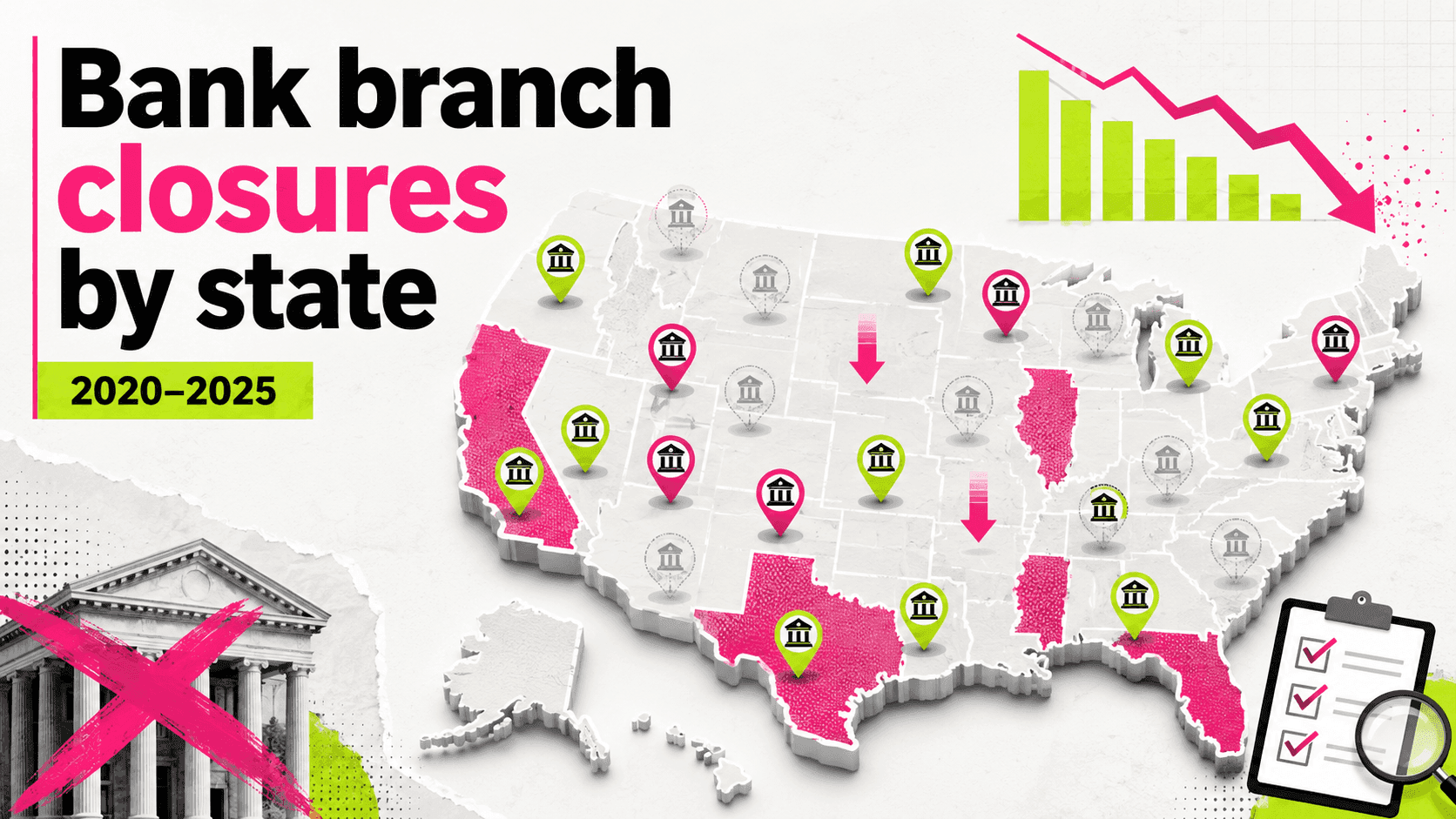
Bank Branch Closures by State: Where Access Shrunk Most - and What to Do
Bank branch closures have reduced the physical banking network across the United States, but the effect is not evenly distributed. In the Federal Deposit Insurance Corporation's annual Summary of Deposits, the number of office records across the 50 states and Washington, DC, fell from 84,618 in June 2020 to 75,804 in June 2025.
That is a net decline of 8,814 offices, or 10.4%, in five years. Every state and DC had a lower office count in the 2025 snapshot than in 2020.
The largest percentage declines were in Oregon, Maryland, Michigan, Hawaii, and Virginia. California had the largest absolute reduction. For a customer, however, the useful question is not simply where a state ranks. It is whether the next available branch can handle the services the customer still needs in person.
Key findings
- FDIC office records declined 10.4% between the June 2020 and June 2025 snapshots.
- All 50 states and Washington, DC, had fewer office records in 2025.
- Oregon recorded the steepest percentage decline, at 21.1%.
- California recorded the largest absolute net decline, with 1,118 fewer office records.
- A statewide decline does not prove that every resident traveled farther or lost practical banking access.
- A branch closure is not the same event as a bank failure or the closing of a customer's account.
One precision point is essential: 8,814 is not a count of 8,814 individual branch-closing events. It is the net difference between two annual snapshots. Closures, openings, relocations, consolidations, mergers, and reporting amendments can all change the total. This analysis measures where the reported office network shrank, not why every individual location disappeared.
Bank branch closures by state: the 10 largest percentage declines
| Rank | State or district | Offices in 2020 | Offices in 2025 | Net change | Percentage change |
|---|---|---|---|---|---|
| 1 | Oregon | 912 | 720 | -192 | -21.1% |
| 2 | Maryland | 1,431 | 1,153 | -278 | -19.4% |
| 3 | Michigan | 2,373 | 1,934 | -439 | -18.5% |
| 4 | Hawaii | 263 | 217 | -46 | -17.5% |
| 5 | Virginia | 2,213 | 1,832 | -381 | -17.2% |
| 6 | California | 6,611 | 5,493 | -1,118 | -16.9% |
| 7 | New Jersey | 2,714 | 2,258 | -456 | -16.8% |
| 8 | Washington | 1,629 | 1,363 | -266 | -16.3% |
| 9 | District of Columbia | 215 | 180 | -35 | -16.3% |
| 10 | Nevada | 478 | 404 | -74 | -15.5% |
Source: analysis of FDIC Summary of Deposits office records for June 30, 2020, and June 30, 2025. Percentages are calculated from unrounded counts. The complete table for all 50 states and the District of Columbia is published as a CSV in the research repository, alongside the methods note and evidence ledger.
The ranking changes with the measure. Oregon's net loss of 192 offices was the steepest relative to its 2020 base. California's count fell by 1,118 - the largest absolute decline - but its 16.9% contraction placed it sixth by percentage.
Both measures are useful. Neither shows whether a particular neighborhood still has convenient access to a suitable branch.
"The broader story is not that banking is disappearing, but that its infrastructure is being redesigned. Our analysis found that the U.S. bank-office network contracted by 10.4% between 2020 and 2025, while FDIC data show that 48.3% of banked households already used mobile banking as their primary access method in 2023 and 70.5% primarily used an off-site channel. Federal Reserve research also found that, despite a 19% decline in branches from 2014 to 2024, the average distance to the nearest branch increased by only 0.02 to 0.28 miles. Together, these findings point to a more efficient hybrid model: routine transactions are moving online, overlapping locations are being consolidated, and physical branches are increasingly reserved for complex services that benefit from human support. The question now is not how many buildings remain, but whether this leaner network preserves convenient access for the customers and transactions that still need a physical branch."
- Denis Goncharenko, Bromoney
Why are banks closing branches?
No single explanation applies to every bank branch closure. An FDIC analysis of banking-office structure identifies several long-run factors: population migration, efforts to reduce office expenses, banking-industry consolidation, and financial technology.
Online and mobile banking can replace routine tasks such as checking balances, transferring money, paying bills, and depositing some checks. Mergers can leave an institution with overlapping locations. Population and business activity may move away from one area and toward another. At the same time, a bank may still open or redesign branches where it expects in-person service to matter.
These factors provide context, not a causal explanation of this ranking. The FDIC state snapshots do not identify the reason each office record disappeared, and they should not be used to claim that digital banking - or any other single factor - caused the 2020-2025 changes.
Fewer branches do not automatically mean a banking desert
A statewide count is a supply measure, not a complete access measure. It cannot show travel time, public transit, opening hours, disability access, broadband quality, mobile-deposit limits, cash acceptance, language support, or the services available at the surviving locations.
The distinction matters because different research designs can produce different but compatible findings. A 2025 Federal Reserve FEDS paper on branch consolidation calculated distance at a detailed census-block level. Although it found a 19% decline in branches between 2014 and 2024, average distance to the nearest branch increased by only 0.02 to 0.28 miles, depending on area density. The authors still found some localized reductions in access.
Earlier Federal Reserve research on rural communities explains why averages can miss practical friction. A rural area can appear adequately served per person while residents still face long drives or poorly distributed locations. Participants reported that technology replaced many, but not all, branch services, with greater difficulty for some older and lower-income customers, people without reliable transportation, and small-business owners.
The responsible conclusion is therefore narrower than "every closure creates a banking desert." The national office network is smaller, average distance may change only modestly, and particular communities can still lose meaningful access.
Why branch access can matter to small businesses
For a household that rarely uses a teller, a reliable mobile app and a nearby in-network ATM may be enough. A business that deposits cash, needs coins or change, uses night-deposit services, or relies on a banking relationship faces a different calculation.
A 2024 Federal Reserve FEDS paper on nearby branch closures used merger-related variation to study economic effects. The authors found that nearby branch closures decreased small-business employment growth and new-business entry in their research design.
That result does not mean every closing causes the same outcome. The paper represents its authors' research rather than an official position of the Federal Reserve Board. It does show why local branches can matter for relationship-based services and credit access, not only for cash withdrawals.
If a business handles cash, it should test the full replacement process before the closing date: accepted denominations, deposit cut-off times, night-deposit access, coin services, daily limits, fees, and the timing of funds availability.
How much notice does a bank have to give before closing a branch?
For branch closings covered by Section 42 of the Federal Deposit Insurance Act, the FDIC's examination guidance describes notice to affected branch customers at least 90 days before the proposed closing, and a notice posted conspicuously on the branch premises for at least the final 30 days.
The rules do not treat every location change identically. Under the interagency policy statement, Section 42 generally covers traditional brick-and-mortar branches but not an ATM, remote service facility, loan-production office, or temporary branch. A short relocation or consolidation within the same immediate neighborhood may also be treated differently if it does not substantially change the business or customers served.
For an interstate bank closing a branch in a low- or moderate-income area, the customer notice must include the mailing address of the appropriate federal regulator and explain that comments may be sent there. The regulator can facilitate a community meeting in qualifying circumstances, but the policy statement says the agency does not have authority under this provision to prevent the closing.
The bank's notice should therefore be treated as a testing window, not as paperwork to ignore.
What to do if your bank branch closes: a six-step checklist
1. Confirm exactly what is changing
Read the entire bank branch closing notice. Determine whether the location is permanently closing, moving nearby, or consolidating with another office. Record the effective date, replacement address, hours, phone numbers, and any instructions for safe-deposit-box customers.
Do not confuse three separate events:
- a branch closure changes the institution's physical network;
- a bank failure concerns the institution itself;
- an account closure concerns the customer's specific account.
This state dataset tracks office records. It is not a failed-bank list and does not show customer account closures.
2. List the tasks you still perform in person
Review the previous six to twelve months. Include cash or coin deposits, withdrawals above ATM limits, cashier's checks, safe-deposit-box access, document verification, wire assistance, loan servicing, notarization where offered, and help resolving a complicated error.
The right question is not "Do I bank online?" It is "Which important task still requires a person or physical location?"
3. Test the proposed alternative before the old branch closes
Make the trip at the time you would normally visit. Verify travel time, transit, parking, hours, wheelchair access, language support, appointment requirements, teller services, ATM network, and cash-deposit capability.
The FDIC's consumer guidance on branch closings also recommends checking mobile-deposit options, asking whether the bank will waive fees for using other ATMs, and confirming the plan for a safe-deposit box.
4. Ask the current bank for a workable alternative
Before moving accounts, ask what the institution can offer. Possibilities may include a higher mobile-deposit limit, a different cash-deposit location, ATM-fee reimbursement, telephone support, an appointment at another branch, or a transfer plan for the safe-deposit box. Availability depends on the bank and account.
Save important answers in writing or through secure messages. A service available at the old location may not be available at the replacement branch.
5. Compare the entire account, not only branch distance
If the replacement does not work, compare banks and credit unions on monthly fees, minimum-balance requirements, overdraft policy, deposit insurance, ATM access, cash-deposit options, support, mobile features, and branch hours.
A closer location can still be a poor fit if the account is more expensive or lacks an essential service. Verify the institution and its insurance status through the appropriate official regulator before moving a large balance.
6. Use an overlap period if you switch
The Consumer Financial Protection Bureau's checking-account switching checklist recommends listing automatic deposits and withdrawals, redirecting direct deposit, and leaving enough in the old account for uncleared checks and pending payments.
Transfer the remaining balance only after the new flows work correctly. Then close the old account and request written confirmation. The overlap reduces the risk of missed deposits, returned payments, and avoidable fees.
Frequently asked questions about bank branch closures
What happens to my account when a bank branch closes?
A branch closure alone is not the same as an account closure or bank failure. Read the notice to learn where the bank will service the account after the closing and whether any location-specific service must move. Contact the bank directly if the notice is unclear.
Do I lose my money if my bank branch closes?
A physical branch closing does not, by itself, mean the bank has failed or that deposits disappeared. Confirm that the institution remains open, check the instructions in the notice, and verify deposit-insurance status through the appropriate regulator. Questions about a failed bank belong to a separate FDIC process.
Can I still use the ATM after the branch closes?
Do not assume the ATM will remain. Federal branch-closing rules generally treat ATMs separately from traditional branches, so the ATM may stay, move, or be removed according to the institution's plan. Check the bank's current locator and ask whether the machine accepts deposits and remains fee-free for the account.
What happens to a safe-deposit box when a branch closes?
The bank should explain whether the contents must be removed or whether the box will be transferred. The FDIC advises customers who have not received instructions to contact the bank before the closing date. Do not wait until the final days, because identification, inventory, or appointment requirements can take time.
Which banks are closing branches in 2026?
This analysis does not provide a live 2026 bank-by-bank closing list. It compares state office totals in two annual FDIC snapshots. For current announced or effective branch closings, use the FDIC BankFind Suite's Bank Structure Changes search and verify the date, institution, and location.
How can I find bank branch closures near me?
Start with the closing notice and the bank's official locator. Then search FDIC BankFind for structure changes and compare nearby insured institutions. Test travel time and needed services in person; a map pin does not confirm hours, accessibility, cash deposits, or safe-deposit-box availability.
What this state ranking can - and cannot - tell you
The 2020-2025 result is broad: reported FDIC office counts contracted in every state and Washington, DC. The ranking can help consumers, reporters, and researchers identify places worth examining more closely.
It cannot show that every resident lost access, determine whether a specific tract became a banking desert, measure service quality, or attribute a particular closing to fintech, a merger, population change, or cost cutting.
A stronger local analysis would join branch locations to road travel time, transit, demographics, broadband, business density, and the services available at surviving offices. Until that work is completed, the evidence supports a cautious conclusion: America's physical banking network is smaller, while the practical burden remains local and uneven.
Methodology
This analysis counts institution-reported FDIC Summary of Deposits office records by branch state for the June 30, 2020, and June 30, 2025, snapshots. The source includes covered main offices and branch offices. U.S. territories were excluded; the 50 states and District of Columbia were retained.
For each jurisdiction, percentage change equals:
(2025 office count / 2020 office count - 1) × 100
No missing values were imputed. Before the geographic filter, the source returned 84,982 office records for 2020 and 76,120 for 2025; excluding the territories produces the totals used here.
The research package contains the versioned 51-row state table, an executed Jupyter notebook whose validation checks fail if that table changes, this methods note, a claim-level evidence ledger linking each statement to its official source, and a manifest recording SHA-256 hashes for those files.
FDIC records are institution-reported and may be amended. These findings represent the data vintage retrieved on August 10, 2026, rather than a live count of branches operating today.

Denis Goncharenko
Head of Content
Editorial Policy: no secondary statistics. Every claim is linked to an official source and dated — datasets and methods are open for review.

Was this article helpful?
Same blogs
What Average Household Expenses Show About Price Pressure - and What They Can't
The average US consumer unit spent $78,535 in 2024 - about $6,545 a month. This page sets that spending record against the price indexes for the same two years, category by category, using our own CE-CPI crosswalk, and states plainly what the figures cannot show.
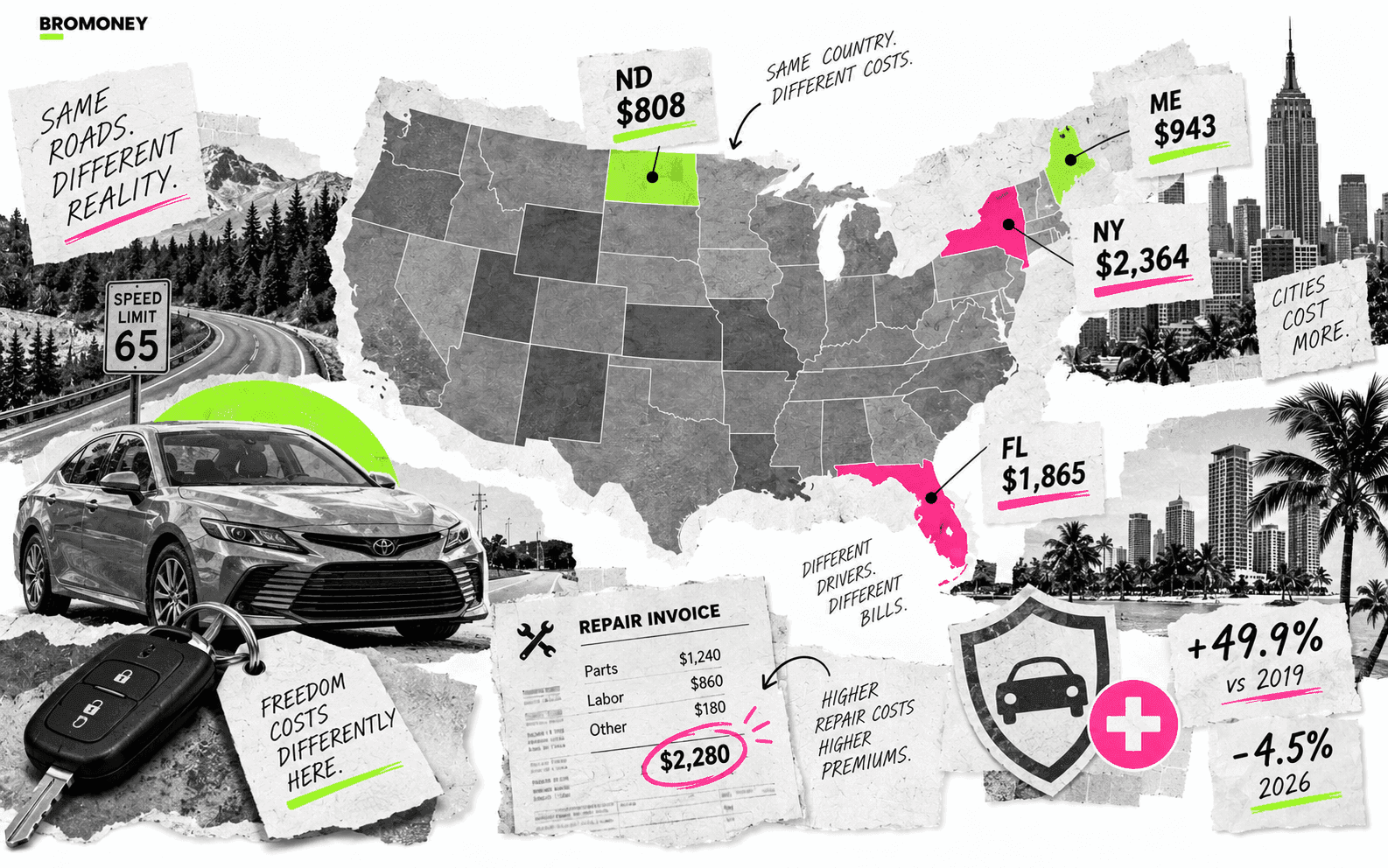
Why Car Insurance Went Up and What Actually Moves the Premium
Car insurance spending rose 12.3 percent in 2024, one of only two costs BLS called statistically significant. NAIC's 2023 state averages, why rates are falling even as the level sits 49.9 percent above 2019, what actually drives claims costs, and which levers on your policy are worth checking.
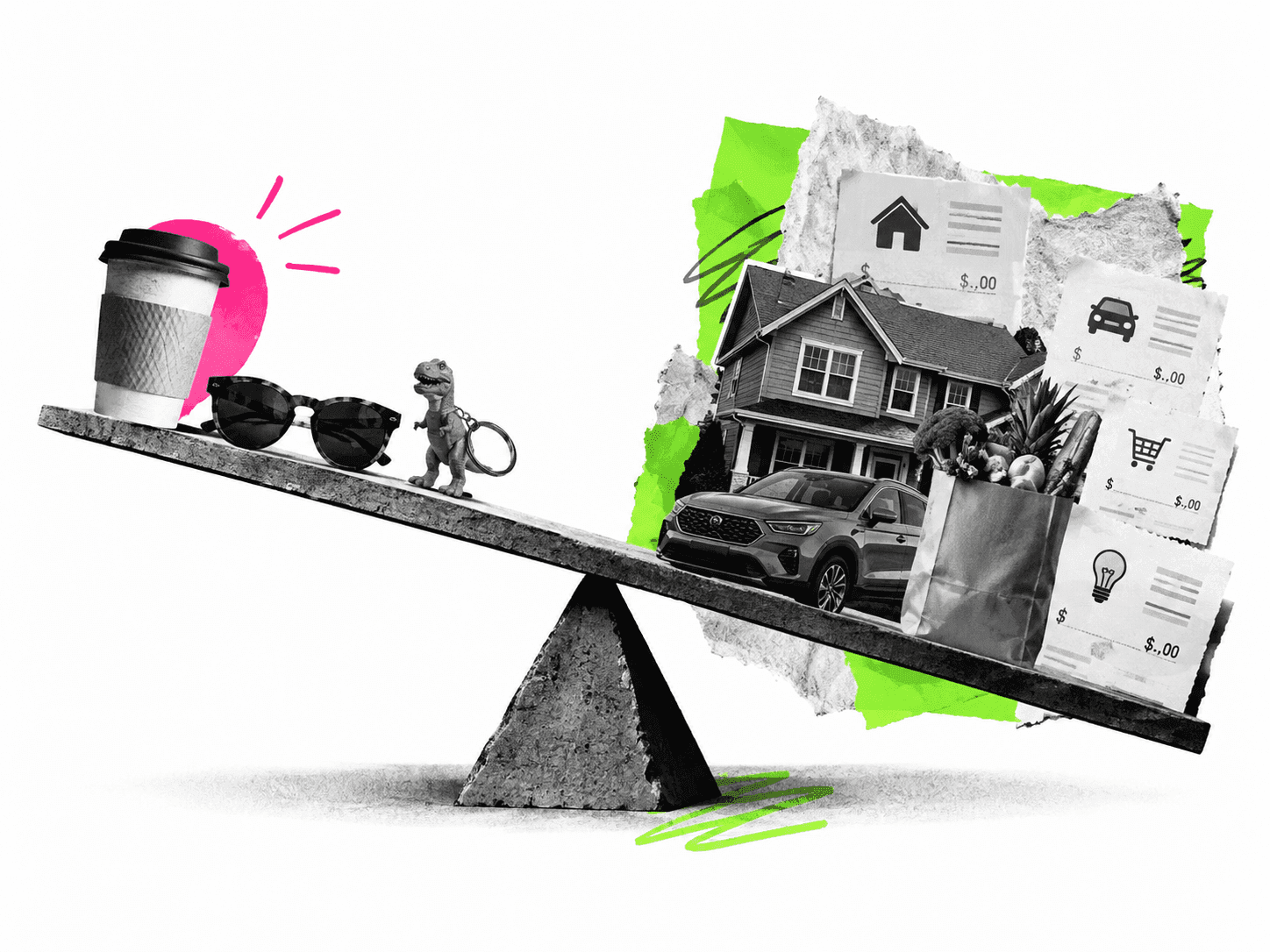
Stop Blaming the Latte: Impulse Buying Isn't the Whole Budget Story
BLS data shows apparel and entertainment spending barely moved in 2024, while car insurance, housing and groceries rose - some by double digits. Why the numbers behind the top impulse-buying articles don't hold up, and a review method that starts with the bills, not the coffee.