
APR vs. Interest Rate: Why APR Matters More When Comparing Loans
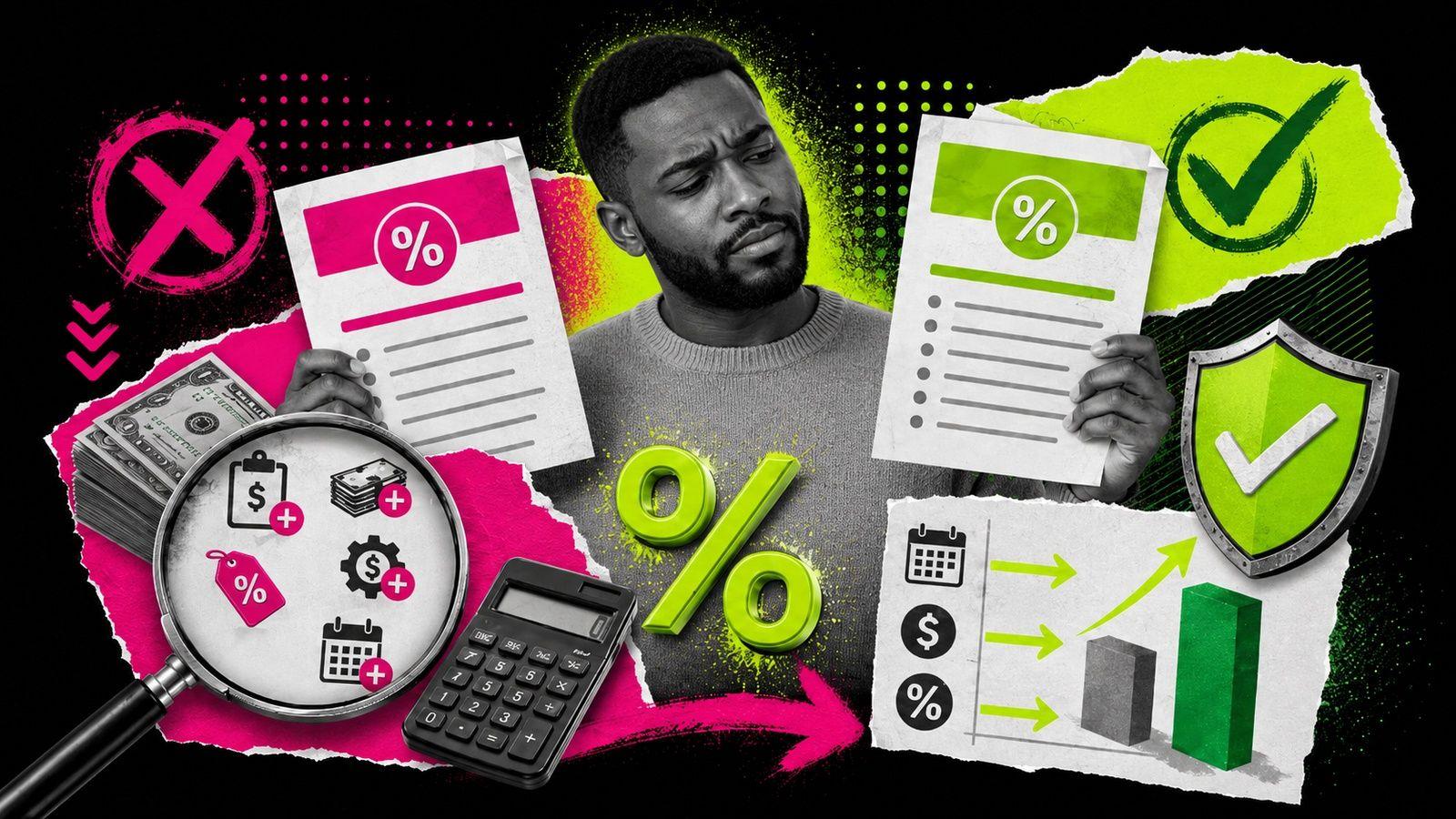
Many borrowers believe the interest rate tells the full story of a loan. Lenders benefit from that assumption.
Advertisements often highlight a low interest rate in large bold numbers while burying fees, origination charges, and repayment costs deeper inside the disclosure documents. A loan that looks inexpensive at first glance sometimes becomes far more expensive after all charges enter the equation.
This confusion becomes even more dangerous for borrowers with damaged credit histories because bad credit lending frequently includes additional fees layered on top of already elevated interest rates.
After reviewing personal loan agreements, lender disclosures, refinancing structures, and bad credit financing offers across the U.S. market, one conclusion appears repeatedly: APR reveals the real borrowing cost more accurately than the interest rate alone.
Understanding that difference changes how borrowers compare offers and avoid overpriced debt.
What Is an Interest Rate?
The interest rate represents the cost of borrowing the principal balance.
If a lender offers a $10,000 loan at a 12% interest rate, the borrower pays interest based on that percentage over time according to the repayment schedule.
The interest rate focuses narrowly on the borrowing cost tied directly to the principal.
It does not automatically include:
- Origination fees
- Processing fees
- Broker charges
- Certain lender add-ons
That limitation creates confusion during loan comparisons.
Two loans may advertise identical interest rates while carrying radically different total costs because one includes significant upfront fees.
Borrowers focusing only on interest rates often miss the bigger financial picture entirely.
What Is APR?
APR stands for Annual Percentage Rate.
APR combines the interest rate with many lender fees into one standardized annual borrowing cost. This structure helps borrowers compare loans more accurately across different lenders and products.
APR matters because it exposes hidden expenses that interest rates alone fail to show. A lender advertising a 10% interest rate with heavy origination fees may produce a higher APR than a lender offering a 12% interest rate with minimal fees.
That distinction explains why APR remains one of the strongest comparison tools available to borrowers.
Why APR Exists in Lending
Before APR disclosure rules became standardized, comparing loans was difficult. Lenders advertised attractive interest rates while disguising real borrowing costs through layered fees and confusing repayment structures.
APR created a more transparent system.
Federal lending laws now require most lenders to disclose APR clearly so borrowers can evaluate financing offers using a standardized benchmark. The system is not perfect. Certain charges still fall outside APR calculations depending on the loan type. APR still provides a far clearer comparison framework than interest rates alone.
Borrowers searching for a low apr loan bad credit option should focus heavily on APR because bad credit products often contain substantial fee structures.
A Simple Example: Interest Rate vs. APR
Consider two lenders offering a $5,000 personal loan.
Lender A advertises a 15% interest rate with no origination fee.
Lender B advertises a 13% interest rate but charges an 8% origination fee deducted upfront.
At first glance, Lender B appears cheaper because the interest rate looks lower.
The APR tells a different story.
The origination fee increases the total borrowing cost substantially. After including that fee, the APR on Lender B's loan may exceed the APR on Lender A's offer.
This example illustrates why comparing interest rates without considering the APR can lead borrowers to misleading conclusions.
Why APR Matters More for Bad Credit Borrowers
Bad credit lending carries elevated lender risk.
Lenders compensate through:
- Higher rates
- Larger fees
- Stricter repayment structures
- Additional servicing costs
That means APR becomes even more important when comparing bad credit loans.
A borrower searching for a loan with low apr for bad credit may encounter lenders advertising manageable interest rates while quietly attaching expensive fees behind the scenes.
Origination fees deserve special attention here. Some bad credit lenders deduct 6% to 12% from loan proceeds immediately after approval. The borrower repays the full loan balance despite receiving less cash upfront.
APR exposes that hidden cost far more clearly than interest rates alone.
Monthly Payments Can Hide Expensive Loans
Borrowers under financial stress often focus on one number first: the monthly payment. Lenders understand that psychology perfectly.
Stretching repayment across longer timelines lowers monthly obligations while increasing total interest paid over time. A seven-year repayment structure produces smaller payments than a three-year structure. The total borrowing cost often becomes dramatically higher.
APR helps reveal that tradeoff because it standardizes the annual borrowing expense more effectively than payment size alone.
A lower monthly payment does not automatically mean a cheaper loan. That misunderstanding traps thousands of borrowers every year. A smaller payment spread across years often costs far more overall.
Fixed APR vs. Variable APR
APR structures fall into two categories: fixed and variable.
Fixed APR remains stable throughout repayment. Monthly obligations stay predictable unless penalties or modifications occur.
Variable APR changes over time based on benchmark interest rates or lender formulas.
Borrowers with weak credit profiles should evaluate variable APR products carefully because rising rates increase repayment pressure later. A loan beginning at 14% APR may climb substantially after market conditions change.
Fixed-rate loans provide stability. Stability matters when budgets already operate close to financial limits. Many borrowers seeking a low interest loan with bad credit prioritize predictable repayment over chasing lower introductory pricing.
What APR Usually Includes
APR calculations commonly include:
- Interest charges
- Origination fees
- Processing fees
- Certain closing costs
Some charges may still fall outside APR calculations depending on loan structure and lender practices. Late fees, overdraft charges, optional insurance products, and penalty fees often remain separate. Borrowers should still review the full agreement carefully, even after comparing APRs. APR improves transparency significantly. It does not eliminate every hidden cost automatically.
The Danger of Ignoring Fees Entirely
Some borrowers focus only on approval speed during emergencies. That urgency creates expensive outcomes.
Origination fees, processing fees, late penalties, and refinancing charges dramatically alter total borrowing costs over time. A lender approving funds within hours still deserves careful review.
Borrowers comparing a low-interest-rate loan for bad credit should always calculate:
- Total cash received
- Total repayment amount
- Total fees paid
- Repayment timeline
- Monthly obligations
Those numbers reveal whether the loan truly improves financial stability or simply delays financial pressure.
How to Compare Loans Correctly
The strongest comparison process stays simple.
Review these five elements together:
- APR
- Interest rate
- Total repayment amount
- Fees
- Loan term
Ignoring any one of those factors creates blind spots. The cheapest loan rarely comes from the flashiest advertisement or fastest approval promise. It usually comes from transparent pricing, manageable repayment timelines, and minimal fees.
Borrowers who understand APR gain a major advantage because they evaluate the real cost of borrowing instead of reacting emotionally to marketing language.
The Bottom Line
Interest rates tell only part of the lending story.
APR reveals a broader picture by combining interest charges with many lender fees into one standardized annual borrowing cost. That makes APR one of the strongest tools for comparing loans accurately.
This matters even more in bad credit lending, where lenders frequently layer additional fees onto already elevated rates.
Borrowers searching for a loan with low apr for bad credit should focus less on promotional language and more on the total borrowing structure. APR, repayment length, fees, and total repayment cost work together.
The smartest loan decisions happen when borrowers slow down long enough to compare the full math behind the offer. A lower advertised interest rate means little if the loan becomes expensive everywhere else.
Frequently Asked Questions
Is APR always higher than the interest rate?
APR is usually higher because it includes certain lender fees alongside interest charges. If a loan carries no additional fees, the APR and interest rate may appear nearly identical.
Why does APR matter for bad credit loans?
Bad credit loans often include origination fees and elevated charges. APR helps borrowers compare the real borrowing cost more accurately.
Is a low-interest loan with bad credit realistic?
Yes. Credit unions, secured loans, and borrowers with stable income sometimes qualify for lower APR products despite damaged credit histories.
What is the difference between fixed APR and variable APR?
Fixed APR remains stable throughout repayment. Variable APR changes over time based on market conditions or lender formulas.
Does a lower APR always mean a cheaper loan?
Not always. Loan term length also affects total repayment cost. A lower APR spread across a much longer repayment period may still generate higher total interest overall.

Denis Goncharenko
Head of Content
Editorial Policy: no secondary statistics. Every claim is linked to an official source and dated — datasets and methods are open for review.
Was this article helpful?
Same blogs
"Easiest Loan to Get With Bad Credit" Decoded: What That Phrase Usually Really Means
Easy approval rarely signals low risk for borrowers—it signals low risk for lenders through higher costs and stricter terms.

Bad Credit Loans by Goal – Know These Red Flags, and Legit Checks
Learn how to match bad credit loans to your specific goal and avoid scams with expert verification strategies.

Avoid These Scams: Advance‑fee Loans, "Guaranteed approval", Fake calls/texts
Learn how bad credit loan scams work and how to identify advance-fee fraud, fake guarantees, and impersonation tactics.