


Refinancing vs Debt Consolidation: What These Terms Actually Mean
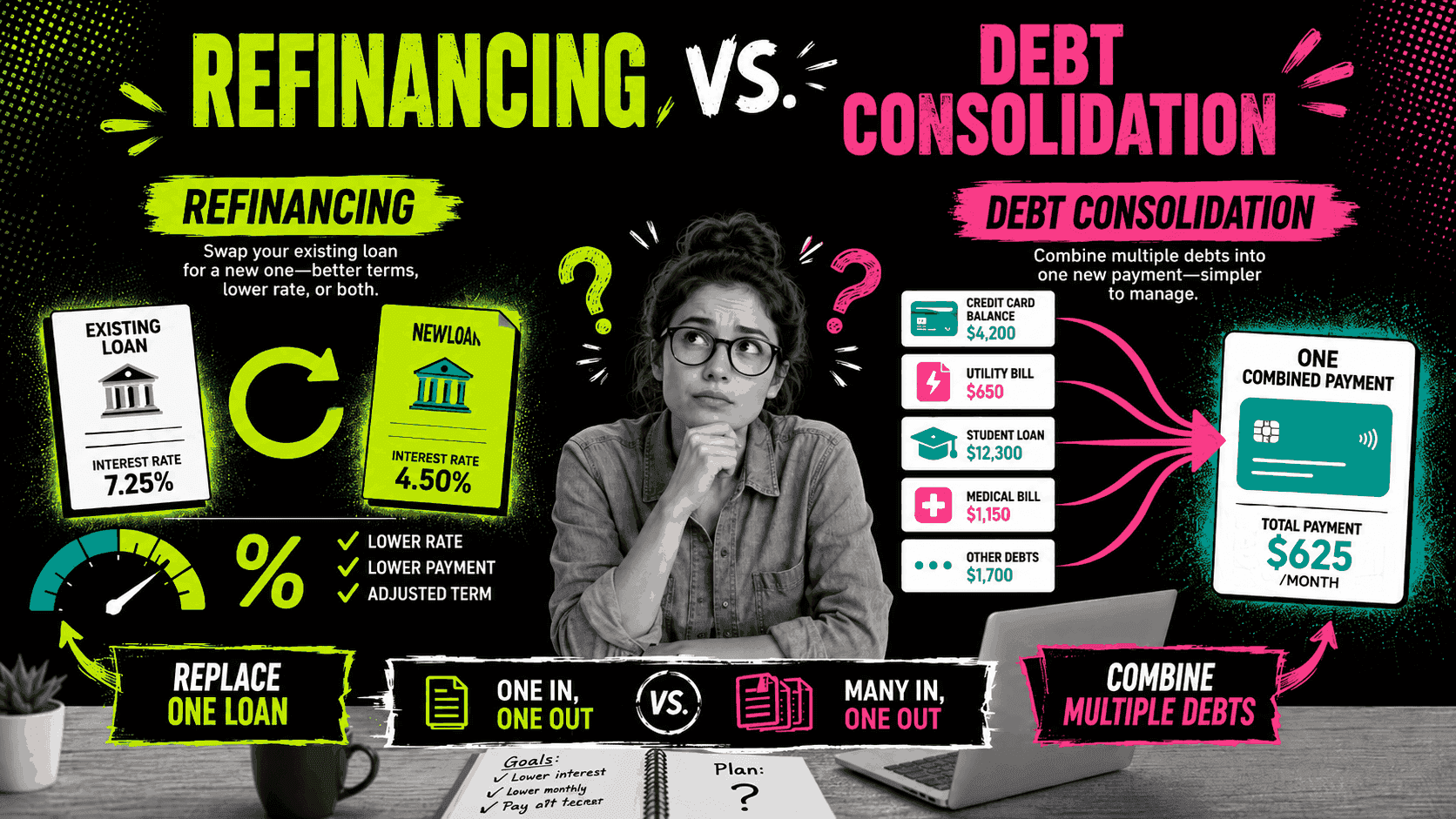
Borrowers often use "refinancing" and "debt consolidation" as if they mean the same thing. Lenders, credit card companies, mortgage companies, and debt relief advertisers do not always help. One company may advertise refinance debt consolidation. Another may call a balance transfer credit refinancing. A mortgage lender may describe a cash-out refinance as a way to consolidate debt. The language overlaps, but the strategies are not identical.
The difference matters because the wrong term can lead to the wrong product. A borrower who wants one payment for several credit cards may need debt consolidation. A borrower who already has one loan and wants better terms may need refinancing. A homeowner comparing a refinance and a home equity line of credit is making a separate decision about mortgage structure and home collateral. A credit card borrower comparing debt consolidation vs credit card refinancing is deciding whether to move several balances into one new loan or replace card terms through a balance transfer or another credit product.
Debt consolidation vs refinancing is not a fight between two products. It is a terminology problem with real financial consequences. This guide explains what each term means, where they overlap, and how to choose the right language before choosing the right lender.
What Debt Consolidation Means
Debt consolidation means combining multiple debts into one repayment structure. The borrower may use a personal loan, balance transfer card, home equity loan, HELOC, debt management plan, or cash-out refinance. The defining feature is not the product. The defining feature is the number of debts being combined.
A borrower with four credit cards, one medical bill, and one small personal loan may consolidate them into one new personal loan. After the payoff, several due dates become one monthly payment. The goal is usually lower interest, simpler repayment, a fixed payoff date, or all three.
Debt consolidation does not automatically reduce the amount owed. If the borrower owes $18,000 across several accounts, consolidation usually moves that $18,000 into a new structure. The balance may grow if fees get added. The balance may shrink only if creditors accept less than owed, which is debt settlement rather than standard consolidation.
The cleanest debt consolidation plan answers four questions before funding: which debts get paid, what the new payment costs, when the debt reaches zero, and what prevents old balances from returning. Without those answers, consolidation becomes account shuffling rather than debt repayment.
What Refinancing Means
Refinancing means replacing an existing debt with a new debt, usually to get better terms. The borrower may refinance a mortgage, auto loan, student loan, personal loan, or credit card balance. The defining feature is replacement, not combination.
A borrower with one auto loan at a high rate may refinance into a new auto loan at a lower rate. That is refinancing, even though no consolidation occurs. A homeowner may replace an old mortgage with a new mortgage. That is refinancing, even if no credit card debt gets paid. A borrower may move a credit card balance to a new card with a promotional APR. That is often described as credit card refinancing, although many lenders market it as a balance transfer.
Refinancing can lower the rate, change the payment, extend or shorten the repayment term, switch from variable to fixed, or access equity through a cash-out refinance. The benefit depends on total cost, not the advertised monthly payment. A lower payment created by a longer term can cost more over time.
This is the first major distinction in debt consolidation vs refinancing: consolidation focuses on combining debts; refinancing focuses on replacing debt terms. One strategy can include the other, but they are not the same word wearing a different jacket.
Where the Terms Overlap
Refinancing debt consolidation happens when a borrower replaces one or more existing debts with a new loan and uses that new loan to combine balances. A personal loan used to pay off five credit cards is both a refinancing move and a consolidation move. The old credit card terms disappear, and several balances become one loan.
A cash-out mortgage refinance can also combine both ideas. The homeowner refinances the mortgage into a larger loan, receives cash, and uses that cash to pay off credit cards. The mortgage has been refinanced. The credit cards have been consolidated into the new mortgage balance. That can lower interest compared with credit cards, but it also turns unsecured consumer debt into debt secured by a home.
This overlap is why marketing language gets messy. Refinance debt consolidation may refer to a personal loan, a mortgage refinance, a balance transfer, or a home equity product. The borrower should look past the phrase and identify the structure. What debt is replaced? How many accounts are combined? Is collateral involved? What happens if payments fail?
A useful rule: refinancing changes terms; consolidation changes the number of payments. When both happen, both labels apply.
Credit Card Refinancing vs Debt Consolidation
Credit card refinancing vs debt consolidation is one of the most common terminology traps. Credit card refinancing usually means replacing one credit card balance with another credit product, often a balance transfer card or personal loan. Debt consolidation means combining multiple debts into one repayment path.
A balance transfer from one card to another can be credit card refinancing without consolidation if only one balance moves. A personal loan that pays off five credit cards is both credit card refinancing and debt consolidation. A debt management plan that combines several card payments through a nonprofit counseling agency is a consolidation, but not refinancing in the normal loan sense, because no new loan replaces the debts.
Debt consolidation vs credit card refinancing comes down to the borrower's starting point. If there is one card and the goal is a lower rate, the situation looks like refinancing. If there are several cards and the goal is one payment, the situation looks like consolidation. If several cards move into one lower-rate loan, both concepts apply.
The right choice depends on repayment discipline. A balance transfer can cost less when the borrower pays the balance before the promotional period ends. A personal loan can work better when the borrower needs a fixed payoff schedule. A debt management plan can work better when the borrower needs creditor concessions and an outside structure.
Refinancing a Loan vs Consolidating Debt
A borrower with one existing loan usually refinances. A borrower with several debts usually consolidates. This distinction sounds simple, but many real cases sit between those two lines.
A borrower with one personal loan at 22% APR may refinance into a new personal loan at 14% APR. No debts are combined. The benefit comes from better terms. A borrower with three personal loans and two credit cards may consolidate them into one loan. The benefit comes from fewer payments and possibly a lower blended rate.
The term also affects how lenders evaluate the application. A refinancing lender may ask about the existing loan balance, payoff amount, and current terms. A consolidation lender may ask which creditors will be paid, whether funds go directly to creditors, and whether the new loan amount covers all target balances.
In both cases, the borrower should compare the total repayment cost. Lower monthly payments deserve skepticism when the term gets longer. A payment that feels easier this month can keep the debt alive for years.
Mortgage Refinancing and Debt Consolidation
Mortgage refinancing enters the conversation when homeowners want to use home equity to pay off non-mortgage debt. A cash-out refinance replaces the existing mortgage with a larger new mortgage. The borrower receives cash at closing and may use that cash to pay credit cards, personal loans, or medical bills.
This can be refinance debt consolidation when several debts get paid with the cash-out proceeds. It can lower the rate compared with credit cards, but the risk changes. Credit card debt is usually unsecured. Mortgage debt is secured by the home. Missed payments can put the property at risk.
The math also depends on the existing mortgage. Replacing a low-rate mortgage with a higher-rate mortgage just to pay off credit cards can raise the cost of the entire home loan. Closing costs add another layer. A borrower should compare the new mortgage payment, total interest over the expected time in the home, closing costs, and the cost of other consolidation options.
Mortgage-based consolidation can work for stable homeowners with meaningful equity and strong cash flow. It is risky when the debt comes from ongoing budget shortfalls. If card balances rebuild after the refinance, the borrower has a larger mortgage and fresh card debt.
Difference Between Refinance and Home Equity Line of Credit
The difference between refinance and a home equity line of credit starts with the mortgage structure. A refinance replaces the existing mortgage. A home equity line of credit, or HELOC, usually sits beside the existing mortgage as a separate credit line.
A refinance creates a new first mortgage. In a cash-out refinance, the new mortgage is larger than the old one, and the borrower receives the difference in cash. A HELOC keeps the current first mortgage in place and gives the borrower access to a revolving line secured by home equity.
That distinction matters when the current mortgage has a favorable rate. A homeowner with a low existing mortgage rate may not want to refinance the entire mortgage into a higher-rate environment. A HELOC can preserve the old mortgage while creating access to equity. The tradeoff is that HELOCs often have variable rates, draw periods, and payment changes when repayment begins.
A refinance can make sense when the new mortgage improves the overall loan or when the borrower needs a large lump sum and plans to stay in the home long enough to justify costs. A HELOC can make sense when the borrower needs flexible access and wants to keep the current mortgage untouched. Neither option should be chosen only because it pays off credit cards today. The home becomes part of the debt strategy, and that raises the stakes.
Common Terminology Mistakes
The first mistake is assuming all consolidation is refinancing. A debt management plan can consolidate payments without creating a new loan. The borrower pays through a counseling agency, and creditors may reduce rates or fees, but there is no standard refinance.
The second mistake is assuming all refinancing consolidates debt. A mortgage refinance or auto refinance may replace one loan and leave every other debt untouched. That is still refinancing.
The third mistake is using credit card refinancing and balance transfer as if they always mean the same thing. A balance transfer is one form of credit card refinancing. A personal loan can also refinance credit card balances, especially when it pays cards directly.
The fourth mistake is ignoring debt settlement language. Some promotions use consolidation wording while selling settlement services. Settlement is a different strategy with different risks. It may involve missed payments, creditor negotiations, fees, and credit damage.
The fifth mistake is treating "lower payment" as proof of improvement. Lower payment often comes from a longer term. The debt may cost more even when the monthly bill shrinks.
How to Choose the Right Strategy
The choice between debt consolidation vs refinancing begins with the debt list. Count the accounts. Write down balances, APRs, minimum payments, due dates, fees, and whether each rate is fixed or variable. That inventory shows whether the problem is scattered debt, expensive terms, or both.
If several debts create confusion and high interest, consolidation deserves review. If one loan has poor terms, refinancing deserves review. If several credit cards need payoff and the borrower qualifies for a lower-rate personal loan, refinancing debt consolidation may be the accurate description because both things happen at once.
Collateral should be treated as a separate decision. A home equity loan, HELOC, or cash-out refinance may lower the rate, but the borrower turns unsecured debt into home-secured debt. That trade can make sense only when income is stable, the total cost is clear, and old credit card balances will not return.
Before signing, compare the new option with the current path. The comparison should include APR, fees, term, monthly payment, total repayment cost, collateral risk, credit impact, and payoff date. A product that wins on one factor but loses on three others needs caution.
Final Takeaway
Debt consolidation vs refinancing is a terminology issue, but the terminology points to different financial decisions. Debt consolidation combines multiple debts into one repayment structure. Refinancing replaces an existing debt with a new debt, usually to change the terms. When a new loan pays off several old debts, both labels can apply.
Credit refinancing and credit refinance are broad phrases that need clarification before action. Credit card refinancing vs debt consolidation depends on whether the borrower is replacing one card balance, combining several balances, or using a structured repayment plan. The difference between refinance and home equity line of credit is even more concrete: a refinance replaces the mortgage, while a HELOC usually adds a separate credit line secured by home equity.
The right term should lead to the right comparison. Count the debts, identify the product, calculate the total cost, and check collateral risk. A good strategy reduces confusion and moves balances toward zero. A bad strategy only gives old debt a cleaner name.
Frequently Asked Questions
What does credit refinancing mean?
Credit refinancing means replacing existing credit with new credit that has different terms. It can involve a balance transfer, personal loan, auto refinance, or another credit product.
What is the difference between debt consolidation vs refinancing?
Debt consolidation combines multiple debts into one repayment structure. Refinancing replaces an existing debt with a new debt under different terms. One loan can do both when it replaces several old debts.
Is credit card refinancing vs debt consolidation the same thing?
Not always. Credit card refinancing usually replaces one or more card balances with a new credit product. Debt consolidation combines multiple debts into one payment. If a personal loan pays off several credit cards, both terms can apply.
What is the difference between refinance and a home equity line of credit?
A refinance replaces an existing mortgage with a new mortgage. A home equity line of credit usually keeps the current mortgage and adds a separate revolving line secured by home equity.
Is refinancing debt consolidation risky?
Refinance debt consolidation can help when it lowers costs and creates a clearer payoff path. It becomes risky when it stretches repayment too long, adds high fees, or turns unsecured debt into home-secured debt.

Denis Goncharenko
Head of Content
Editorial Policy: no secondary statistics. Every claim is linked to an official source and dated — datasets and methods are open for review.

Was this article helpful?
Same blogs
Debt Consolidation Options Compared: Which Path Fits Your Debt?
Compare debt consolidation options including personal loans, balance transfers, home equity, and debt management plans to find your best path.

Compare: Personal Loan vs Balance Transfer vs HELOC vs Home Equity Loan
Compare four debt consolidation options to find the right balance between cost, risk, and flexibility for your situation.

Debt Consolidation Quick Self-Check: Affordability, Timeline, Lower APR
Test three critical factors before consolidating debt: affordability, timeline, and lower APR to ensure real financial improvement.